
A solar inverter changes DC power from panels into AC power for your home or to send to the grid. Picking the right inverter size means matching it to your panels. This way, your system works well and doesn’t waste energy.
This guide will teach you the basics of solar system design. You’ll learn how to compare your panel’s DC power to the inverter’s AC power. You’ll also see why a bit of extra power is good and when you need a bigger inverter for heavy use.
You’ll find useful tips, formulas, and examples for rooftop, off-grid, and RV systems. For more details, check out an installer guide like EcoFlow’s solar inverter sizing guide while planning.
Key Takeaways
- Solar Inverter converts DC from panels into AC for your home or grid export.
- Match inverter capacity to panel output to balance clipping and wasted capacity.
- A small DC oversize (around 1:1.15) often boosts annual energy yield.
- Hybrid inverters must cover peak loads plus battery charge rates.
- Apply simple sizing formulas and consult manufacturer guidance for final selection.
Why Solar Inverter Sizing Matters for Your System
The inverter connects your solar panels to your home’s power needs. It changes DC power from the panels into AC power for your appliances. Modern inverters use advanced technology to create a stable power flow.
Choosing the right inverter size is key to its performance. Most inverters work best when they’re about 80% full. Running them too lightly or too full can reduce their efficiency.
The inverter’s size also affects how much energy it can produce. If it’s too small, it can’t use all the power from the panels. This means less energy for you. On the other hand, a too-large inverter wastes money and energy.
Getting the inverter size right is important for saving money. The wrong size can lead to wasted energy and higher costs. It can even shorten the inverter’s lifespan.
Choosing the right inverter size is also about saving money. A too-large inverter wastes energy and money. It’s better to match the inverter size to your energy needs.
Getting the inverter size wrong can cost a lot. It might mean spending more on replacement and labor. This can make a small mistake very expensive.
| Risk | How It Affects Performance | Typical Financial Impact |
|---|---|---|
| Undersizing (clipping) | Lost energy during peak sun; higher operating temperature; increased wear | Reduced annual revenue; early replacement; up to ~20% efficiency loss |
| Oversizing | Lower average inverter efficiency; higher idle losses; idle capacity cost | Higher upfront cost; longer payback; small annual yield gains |
| Proper sizing | Balanced inverter efficiency and array output; optimized energy yield | Best lifetime return; avoids premature replacement and limits labor costs |
Understanding the DC-to-AC Ratio and Inverter Loading Ratio (ILR)
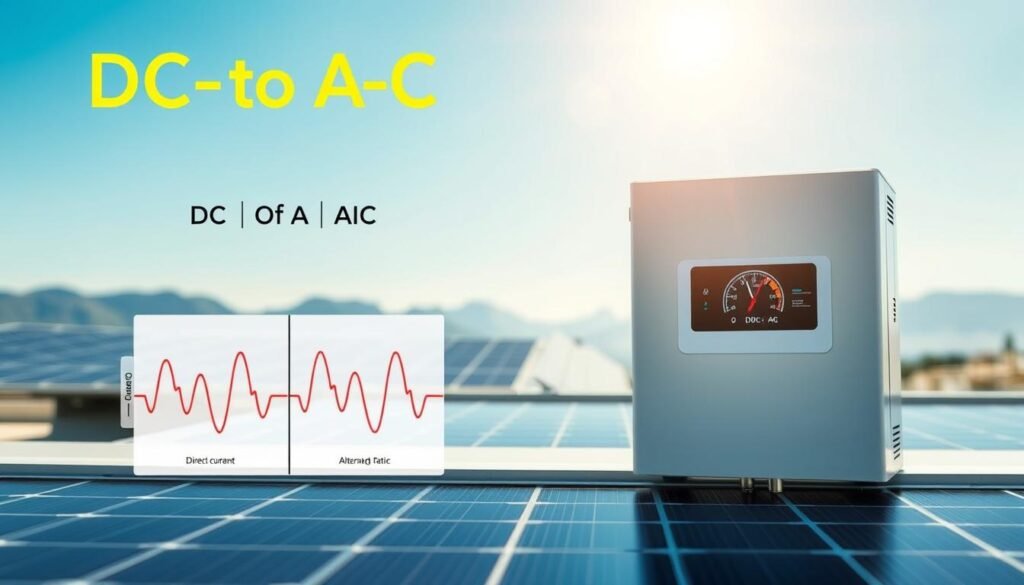
Before making sizing decisions, you need to understand the basics. The DC-to-AC ratio, also known as the Inverter Loading Ratio, is the DC power from panels divided by the inverter’s AC power. For instance, a 6 kW array with a 5 kW inverter has a 1.2 ILR. This ratio affects how much power you can use and how much you might lose.
Industry standards and EIA guidance help in planning. ILR values usually range from 1.10 to 1.30. The U.S. Energy Information Administration says most systems fall between 1.13 and 1.30. Designers often start with these numbers when planning.
Choosing the right ILR impacts daily and yearly energy production. An ILR above 1.0 increases power during low-to-moderate sun hours. This is because the array works closer to the inverter’s best operating point.
Oversizing can lead to inverter clipping at peak sun hours. It’s important to compare clipped energy to the extra energy gained. For example, a 100 kW inverter might produce 163.06 MWh with no clipping at a 1.0 ILR. But at 1.3, it produces 193.86 MWh with 1.8 MWh clipped (0.9%).
Decide whether to add more inverter capacity or accept some clipped energy. This balance affects upfront costs, long-term production, and warranty performance.
| DC-to-AC ratio | Annual AC Production (MWh) | Clipped Energy (MWh) | Clipping % of Production | Primary Consideration |
|---|---|---|---|---|
| 1.0 | 163.06 | 0.0 | 0.0% | Minimal clipping, lower morning/late-afternoon harvest |
| 1.3 | 193.86 | 1.8 | 0.9% | Good balance of added yield and low clipping |
| 1.5 | 217.24 | 11.0 | 4.8% | High yield increase with noticeable clipping losses |
Inverter Clipping: What It Is and How to Model It
When your array MPP goes over an inverter’s AC rating, the inverter limits power. It keeps output at its nameplate value. This is called inverter clipping. It prevents the converter from using the module’s maximum power point.
You can model clipping to see its yearly impact. This helps decide if oversizing is worth it. Performance packages like Aurora simulate array MPP. They apply the inverter AC cap to each timestep.
Modeling clipping adds up clipped energy. It shows a clipping percentage for the year.
Below are sample Aurora-derived outcomes for a 100 kW inverter at different DC/AC ratios. The table shows annual AC yield, clipped energy, and the percent clipped. This lets you compare net production versus clip losses when adjusting inverter sizing.
| DC/AC Ratio | Annual AC Yield (MWh) | Clipped Energy (MWh) | Clipping (%) |
|---|---|---|---|
| 1.0 | 163.06 | 0.00 | 0.0% |
| 1.3 | 193.86 | 1.80 | 0.9% |
| 1.5 | 217.24 | 11.00 | 4.8% |
When you consider clipping, small percentages under 1–2% can be cost-effective. In many U.S. locations with high irradiance, modest oversizing captures extra energy. Modeling clipping helps you see the extra energy gained versus losses.
Avoid high clipping if it’s several percent of your annual yield. If you must meet strict grid export or feed-in guarantees, add inverter capacity. Or split arrays to reduce clipping and ensure reliable AC delivery.
Types of Inverters and How They Affect Sizing Decisions
Choosing the right inverter is key. It depends on your roof, budget, and future plans. Each type affects how you size your system. Here are some practical tips to help you decide.
Microinverters and per-panel sizing
Microinverters convert DC to AC at each panel. You size them per panel, so a high-watt panel needs a matching microinverter rating. This reduces whole-system clipping and helps in shaded or mixed-orientation arrays.
Microinverters give panel-level monitoring and long warranties from brands like Enphase. You pay more up front compared with string inverters, and rooftop access is needed for service. For incremental expansion, microinverters simplify adding panels while keeping MLPE benefits.
Central string inverters and array-level limits
String inverters handle multiple panels wired in series. You size the inverter by comparing total array DC to the inverter’s AC capacity using an ILR. This makes string inverters cost-effective for unshaded, uniformly oriented systems.
String inverters from SolarEdge, Fronius, and SMA work well for large arrays. They cost less per watt but suffer when a shaded panel drags down a whole string. You must watch clipping risk more closely with oversized arrays when using string inverters.
Power optimizers, hybrid inverters, and trade-offs
Power optimizers sit at each panel and send conditioned DC to a central inverter. They give many MLPE benefits like improved panel performance and safer shutdown without the full cost of microinverters.
Hybrid inverters combine PV conversion with battery management. When sizing hybrid inverters, plan for panel input plus battery charge rates and peak load. Brands such as Tesla and Solis require you to consider simultaneous charging and household demand when choosing capacity.
| Feature | Microinverters | String Inverters | Power Optimizers | Hybrid Inverters |
|---|---|---|---|---|
| Best for | Shaded or mixed roofs | Large, uniform arrays | Mismatched panels with central inverter | Systems with batteries |
| Cost | Higher upfront | Lower per watt | Mid-range | Variable, often higher |
| Sizing focus | Per-panel microinverters sizing | Whole-array ILR and AC capacity | Optimizer rating plus inverter AC size | Panel input, battery charge rate, peak load |
| Monitoring | Panel-level | String or system-level | Panel-level | System and battery |
If you want deeper technical guidance, review manufacturer specs and practical sizing examples at solar inverter sizing resources. That page ties inverter types to real-world installation choices and ILR guidance.
- Match microinverters sizing to each panel wattage for best per-panel yield.
- Use string inverters when your array is uniform and shading is minimal.
- Choose power optimizers to gain MLPE benefits without replacing central inverter architecture.
- Size hybrid inverters for simultaneous battery charging and peak household loads when you plan storage.
How to Calculate Your Ideal Inverter Size
Calculating inverter size is a simple process. First, add up the watts of all your panels. Then, apply a loss factor to account for inefficiencies. Use a formula to find the minimum inverter size needed. The DC-to-AC ratio helps choose an inverter that fits well with home systems.

Step-by-step formula
- Sum total panel wattage: multiply number of panels by each panel’s watt rating.
- Apply system loss factor: multiply total by 0.80 to account for wiring, soiling, temperature, mismatch, and shading losses (typical 10–25% losses).
- Divide by the chosen inverter-loading factor using the inverter sizing formula: (Total Panel Watts × 0.80) ÷ 1.15 = minimum inverter size in watts.
- Round to the nearest available inverter size (for example, 3 kW, 3.5 kW, 5 kW, 6 kW).
Recommended DC-to-AC ratios
Most experts suggest a 1.1–1.3 DC-to-AC ratio. The 1:1.15 ratio is often preferred for its balance between energy production and clipping. This ratio ensures reliable energy output from your solar array.
Example calculations
| Example | Panel Nameplate | After 20% Losses | Divide by 1.15 | Nearest Inverter |
|---|---|---|---|---|
| Example A | 20 × 400 W = 8,000 W | 8,000 × 0.80 = 6,400 W | 6,400 ÷ 1.15 ≈ 5,565 W | 5.5 kW or 6 kW |
| Example B | 10 × 400 W = 4,000 W | 4,000 × 0.80 = 3,200 W | 3,200 ÷ 1.15 ≈ 2,783 W | 3.5 kW or 4.0 kW |
Quick rule
For a quick estimate, use (Total Panel Watts × 0.80) ÷ 1.15. Then, pick the closest standard inverter model. This method ensures accurate sizing and aligns with industry standards.
Climate, Location, and System Type Effects on Sizing
Your inverter choice should reflect local climate, typical irradiance, and how you plan to use the system. Small shifts in temperature and sunlight change panel output. These changes affect the ideal DC-to-AC ratio, inverter loading, and long-term energy yield.
Temperature effect on panels matters because cell voltage drops as heat rises. In hot regions, a panel rarely reaches its STC wattage. This reduces peak array power and makes a slightly undersized inverter practical.
In cool climates, panels run closer to rated output. You may want a tighter match and a lower DC-to-AC ratio to limit clipping during clear, cold days.
Higher irradiance raises clipping risk when the array MPP exceeds inverter rating. If you sit in a high-sun area, model clipping for midday peaks above 1000 W/m². A common tactic is to accept mild clipping for most days while preserving higher annual harvest. Use local irradiance data to tune climate inverter sizing.
Grid-tied vs off-grid inverter sizing follows different rules. For grid-tied systems, you can size more aggressively because the grid supplies shortfalls. This permits higher DC-to-AC ratios to maximize daily energy harvest.
Off-grid systems must meet peak loads and battery charging without grid support. You typically size inverters 30–50% larger for off-grid use to handle simultaneous loads and charging demands.
When you compare grid-tied vs off-grid inverter sizing, remember surge and continuous ratings. Off-grid setups often need extra surge capacity for motors and pumps. Factor battery charge rates into inverter selection so you do not overload the system during high-demand periods.
RV inverter sizing has its own constraints. Roof area and weight limit panel count. Typical RV installs fall in the 1,200–2,000 W panel range with 1,000–2,000 W pure sine inverters.
Many RV appliances produce high startup currents. Air conditioners and microwaves can require 2,000–3,000 W surge even when running at lower steady wattage.
Plan RV systems for portability and real-world usage. Choose an inverter that balances continuous load capability, surge headroom, and battery weight. If you expect frequent AC loads, select a higher surge-rated inverter and size batteries to support both inverter runtime and recharge cycles.
| Climate Factor | Impact on Sizing | Practical Guidance |
|---|---|---|
| Hot, high ambient | Lower Vmp, reduced peak power | Slightly undersize inverter or use ILR ~1.05–1.15; model temperature losses |
| Cool, high irradiance | Panels near rated output, more clipping risk | Lower ILR ~1.0–1.15; consider larger inverter to cut clipping |
| Sunny, frequent peaks | High midday clipping | Model clipping; accept trade-off for greater annual yield or increase inverter size |
| Grid-tied | Grid supplies deficit; high ILR feasible | Use higher DC-to-AC ratio to boost harvest; check local interconnection rules |
| Off-grid | Must meet peak loads and charging needs | Increase inverter capacity 30–50%; size for simultaneous loads and battery charge |
| RV and mobile | Limited roof area and weight; high surge needs | Balance panel count and inverter surge; typical RV inverter sizing 1,000–3,000 W depending on loads |
Balancing Oversizing and Undersizing: Costs, Efficiency, and Lifespan
Choosing the right size for your solar array and inverter is key. Oversizing can help during low light hours. But undersizing might save money upfront but can lead to lost energy at peak sun.
It’s important to compare options carefully before making a decision. Use clear models to see the differences.
Pros and cons of oversizing the array relative to inverter capacity
Oversizing can increase your energy output. It captures more energy in the mornings and evenings. A small oversize can also lower your energy costs.
But, too much oversizing can lead to lost energy during the day. This might mean you need a bigger inverter, which costs more. Weigh the benefits and drawbacks by looking at how much energy you save versus how much you lose.
Risks of undersizing: clipping, heat stress, and reduced inverter life
Undersizing can cause clipping at peak sun hours. This means you get less energy when you need it most. It also makes the inverter work harder, which can shorten its life.
Shorter inverter life is a big risk. String inverters usually last 10–15 years, while microinverters can last 20–25 years. Heat and constant use can reduce this lifespan and increase costs.
Modeling trade-offs: when an extra inverter or larger inverter is justified
Good modeling helps you see if adding capacity is worth it. If clipping is less than 1–2% of your annual output, sticking with what you have might be best. But if clipping or future plans increase, adding a second inverter or upsizing could be a smart move.
Think about future plans, battery integration, and export limits. These can change the cost-benefit analysis. Use simulations to compare different scenarios and find the best option.
| Scenario | Primary Benefit | Main Drawback | When Justified |
|---|---|---|---|
| Modest oversize (10–20%) | Higher AM/PM yield, lower LCOE | Minor clipping at peak sun | Clipping |
| Large oversize (>25%) | Maximizes annual AC in low-irradiance regions | Significant midday clipping; may need extra inverter | High energy prices or export constraints |
| Undersize inverter (save capex) | Lower initial cost | Undersize inverter risks: heat stress, reduced life, lost peak output | Temporary install with planned upgrade |
| Buy larger inverter / add inverter | Reduces clipping, supports expansion and batteries | Higher upfront cost and installation labor | Frequent clipping, planned EV/battery load growth |
Planning for Future Expansion and Battery Integration
Designing a solar system for growth means you can add panels, batteries, and EV chargers later. Start by checking your roof’s space, direction, and shade. This ensures future upgrades fit both physically and electrically. For tips on expanding, check out SolarEdge’s guide on expanding your solar system.
Plan to size your inverter 10–25% bigger than your initial needs if you’ll add panels or a charger. For example, a 5 kW system might grow to 6–6.5 kW. A 6–7 kW inverter is best for this. This way, you avoid the cost and downtime of replacing the inverter later.
Think about battery-ready inverters if you plan to add storage. Hybrid inverters need to handle PV-to-load flow, PV-to-battery charging, and battery-to-load discharge. Most lithium batteries charge at 0.5C to 1C, so a 5 kWh battery needs 2.5–5 kW charge capacity. Make sure your inverter and battery can handle your expected loads.
EV charging changes how you use energy. If you’ll have a Level 2 charger, size your hybrid inverter for 6–7 kW. This ensures solar and battery can power charging without overloading. Smart energy management can help manage charging to reduce peaks and improve self-consumption.
Consider the cost of buying a larger inverter upfront versus retrofitting later. A bigger inverter costs $200–$800 more. Replacing it can cost $1,500–$3,000, including labor and permits. A slightly larger initial investment can save you money in the long run.
Modular systems and panel-level optimizers make adding panels easy. Many optimizers work with different panels, making upgrades simpler. For more on battery options, cycle life, and expansion, see the lithium battery overview at lithium battery expansion.
Before you decide, check your roof for future modules, choose the right inverters, and size for peak loads including EV charging. Also, get a grid limit and permit check from your utility. This planning helps avoid surprises and makes upgrades affordable and easy.
Solar Inverter
Choosing the right inverter is key to getting good performance and value. Look at efficiency, warranty, and how it fits your system. Also, consider the brand’s reputation, monitoring features, and UL1741 SB compliance.
Selecting brands and models based on efficiency and warranty (micro vs string vs hybrid)
Check the conversion rates and real-world results. Enphase microinverters have long warranties and panel monitoring. SMA and Fronius string inverters are reliable and have wide installer support.
Victron Energy and Elios Inversa offer strong hybrid solutions. They have high conversion figures and work well with batteries.
Look at the warranty terms closely. A high efficiency rating but weak warranty can cost more over time. Check surge capacity, MPPT inputs, and remote diagnostics to fit your system.
Typical inverter lifespans and warranty expectations
Microinverters often have warranties up to 25 years, matching panel lifespans. String and central inverters usually have 10–15 year warranties, with extensions available. Hybrid inverter warranties vary; check coverage for PV and battery systems.
Think about the inverter’s lifespan when comparing costs. A longer warranty can save money and reduce downtime risk if you plan to keep panels for 25 years or more.
Installation site, ventilation, and placement effects on inverter performance
Heat is a big threat to electronics. Place the inverter in a shaded, well-ventilated area at moderate temperatures. Avoid hot spots like attics or direct sun.
Placement also affects code compliance and serviceability. Ground-mounted string inverters are easier to access than roof-level microinverters. Plan for ventilation, access, and meeting rapid-shutdown requirements.
- Check manufacturer guidance for ambient limits and clearance.
- Plan for airflow around the cabinet and simple access for technicians.
- Verify how warranty terms treat temperature-related failures.
Conclusion
Getting your inverter sizing right is key for a reliable solar system. Use a DC-to-AC ratio of 1.1 to 1.3, with 1:1.15 being common. This ensures your inverter works well and captures more energy.
Use tools like Aurora to predict your system’s performance. This helps you see how much energy you’ll get and how much you’ll lose. Then, compare the lost energy to the cost of a bigger inverter.
Choose the right inverter for your site. Microinverters are good for shaded areas, while string inverters work best for uniform arrays. Power optimizers are for mixed conditions, and hybrid inverters are for backup and battery integration. Make sure your inverter is durable, like IP65, for harsh environments. Learn more about durable hybrid options at IP65 hybrid solar inverters.
Consider your climate, future plans, EV charging, and off-grid needs when sizing. Think about efficiency, warranties, ventilation, and serviceability to save money in the long run. For a practical step, calculate your array’s nameplate and apply a loss factor. Then, check your estimate with simulations or a licensed installer. This approach will help you make choices that meet your performance, cost, and future needs.