
When setting up a home solar system, you face a key choice: lithium battery or lead-acid battery. This choice impacts your energy use, battery lifespan, and system setup. Lithium batteries, like LiFePO4, often provide more usable energy, better efficiency, and longer life than lead-acid batteries.
This guide explores the differences in lifetime value, charging, maintenance, safety, and system compatibility for home solar storage. Lithium batteries might cost more initially but can save money over time. They’re a good choice for reliable backup power, affecting system size, location, and long-term savings.
Key Takeaways
- Lithium battery systems, including LiFePO4, tend to offer higher usable capacity and efficiency than lead-acid battery options.
- Lead-acid batteries have lower upfront cost but usually shorter service life and lower depth of discharge.
- For daily cycling and frequent solar storage use, lithium often provides better lifetime value despite higher initial price.
- Consider weight, space, and maintenance: lead-acid may need watering and equalization; lithium is mostly maintenance-free.
- Match your budget, backup needs, and installation limits to decide which chemistry fits your residential solar plan.
How lithium battery and lead-acid battery technologies work
Understanding what happens inside batteries is key before choosing solar. This section explains basic chemistry, cell formats, and safety controls. These factors affect performance and reliability.
Basic chemistry and charge carriers
Lead-acid batteries store energy through lead and sulfuric acid reactions. When they discharge, lead and lead dioxide turn into lead sulfate. The electrolyte’s concentration changes too.
There are different types of lead-acid batteries. Flooded, AGM, and gel types all use the same chemistry. But they have different needs for maintenance and ventilation.
Lithium batteries use Li-ion charge carriers. These ions move between the cathode and anode during charge and discharge. LiFePO4 cells are popular for solar because they’re stable at high temperatures and last a long time.
This ion movement affects how much charge a battery can hold. It also determines its capacity and how well it works in cold temperatures.
Cell construction and common formats for solar storage
Lead-acid cells are big and heavy. Flooded wet cells have large cases with removable caps. AGM and gel types have the electrolyte in mats or gel, making them easier to maintain.
Lead-acid batteries are often found in 6V or 12V bricks or large monoblocs.
Lithium batteries come in different shapes and sizes. Prismatic LiFePO4 cells can be stacked to fit 12V, 24V, or 48V systems. Manufacturers also use cylindrical and pouch cells in modular packs.
Modular LiFePO4 designs make it easy to scale and service your solar bank.
Typical Battery Management Systems (BMS) and safety controls
Lithium packs usually have a built-in BMS. This BMS protects against overcharge, over-discharge, overcurrent, and short circuits. Many BMS units also have temperature protections and a low-temperature charge cut-off.
Redodo shows how modern LiFePO4 packs can have over 20 protections. They also offer Bluetooth monitoring for easy diagnostics.
Lead-acid setups rely on charge controllers and inverter/charger settings. They manage charge profile and equalization. Flooded lead-acid needs periodic equalization and ventilation to handle hydrogen off-gassing.
Lithium batteries often have more built-in safety and smarter monitoring. Lead-acid batteries rely on system-level controls and routine maintenance.
The chemistry and cell design you choose will affect usable capacity, charging behavior, safety, and smart features. These factors impact system integration and daily operation.
Cycle life and lifespan comparison for solar applications
When picking between lithium and lead-acid for your solar system, think about battery life. This section talks about cycle ranges, the DoD effect, and service years. This helps you plan for replacements and costs.
Lithium cycles range from 2,000 to 5,000 for many Li-ion and LiFePO4 packs. Premium LiFePO4 modules can go up to 15,000 cycles. Lead-acid cycles are lower, with 200–500 cycles common in real use.
The DoD effect varies by chemistry. Lead-acid batteries last less if you discharge too much. Lithium packs can handle deeper discharges, making them last longer.
Here’s a quick comparison to help estimate your battery’s life and when you might need a new one.
| Metric | Lithium (Li-ion / LiFePO4) | Lead-Acid (Flooded / AGM) |
|---|---|---|
| Typical cycle life range | 2,000–5,000 common; premium LiFePO4 4,000–15,000+ | 200–1,000; many real-world deep-cycle units 200–500 |
| Recommended usable DoD | Up to 80–100% usable with BMS protection | About 50% to avoid accelerated wear and sulfation |
| DoD effect on lifespan | Lower marginal penalty at higher DoD versus lead-acid | Significant cycle loss and capacity fade when deeply cycled |
| Expected residential service years | Typically 10+ years with moderate daily cycling | Typically 3–7 years depending on use and maintenance |
| Practical note for owners | Better battery cycle life and deeper usable capacity reduce replacements | More frequent replacements raise total lifecycle cost and downtime |
Daily cycling makes battery life key to long-term costs. Lithium’s longer cycles and deeper DoD mean fewer replacements over time.
When planning for your solar battery’s life, consider annual cycles, DoD, and the manufacturer’s cycles. This gives a clear view of when you’ll need a new battery and the total cost.
Usable capacity and depth of discharge differences
When sizing a solar storage system, rated capacity is just the beginning. You must also consider usable capacity and recommended depth of discharge. This is key for reliable backup and accurate battery sizing for your home.
Rated capacity vs usable capacity explained (Ah and kWh)
Rated capacity is shown as amp-hours or kWh on the datasheet. Usable capacity is what you can safely draw without damaging the battery. Lead-acid batteries usually have a 50% depth of discharge recommended to extend their life.
Lithium batteries, on the other hand, can handle a higher percentage of their rated capacity safely. Use usable kWh to compare different battery types directly.
Examples: 50Ah lithium vs 100Ah lead-acid practical comparison
Let’s look at the numbers for 50Ah lithium vs 100Ah lead-acid. Both can provide similar usable energy when considering depth of discharge. The lithium’s smaller rated Ah doesn’t mean it’s less capable.
Weight and charge time are also important. A 50Ah LiFePO4 battery weighs 11–13 lbs and charges in 2–5 hours. A 100Ah lead-acid battery weighs 60–70 lbs and takes 6–12 hours to charge. These differences affect your system’s layout and performance.
Impact on system sizing and number of batteries required
For sizing, compare usable kWh, not just rated Ah. Lithium batteries support deeper discharge, so you might need fewer modules. This reduces the system’s footprint and weight.
To deliver 3 kWh usable, you might need five 50Ah LiFePO4 modules or ten 100Ah lead-acid batteries. Lead-acid banks are often oversized to protect their cycle life and meet energy goals.
| Metric | 50Ah LiFePO4 (12V) | 100Ah Lead-Acid (12V) |
|---|---|---|
| Rated capacity (kWh) | 0.6 kWh | 1.2 kWh |
| Typical usable capacity (kWh) | ≈0.6 kWh (≈100% usable) | ≈0.6 kWh (≈50% DoD) |
| Usable capacity per rated Ah | 50Ah usable | 50Ah usable |
| Approximate weight | 11–13 lbs | 60–70 lbs |
| Typical time-to-full (hours) | 2–5 hours | 6–12 hours |
| Implication for battery sizing | Fewer modules needed for target usable kWh | More units required to hit same usable kWh |
When buying, ask for usable kWh targets and confirm the recommended depth of discharge. This ensures your battery sizing meets your energy needs over time.
Efficiency and round-trip energy losses
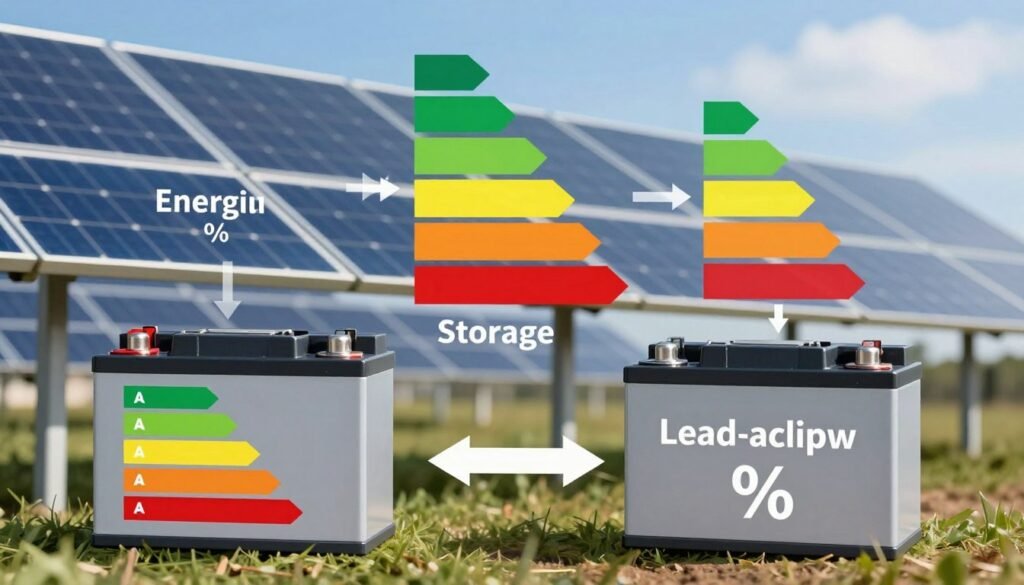
It’s important to know how much solar energy you actually use. Round-trip efficiency shows how much energy you get back after using it. This affects how much power your solar panels can provide.
Modern lithium batteries usually have a round-trip efficiency of 90–95%. Lead-acid batteries, on the other hand, range from 70–85%. These numbers show the difference in efficiency between lithium and lead-acid batteries.
Lower round-trip efficiency means more energy is lost in the system. If your inverter and wiring are efficient, lithium batteries can deliver more energy. This means you might not need as many panels to meet your energy needs.
Think about how much money you can save each month. Better battery efficiency means you use less energy from the grid. With lead-acid batteries, you might need to buy more, which can increase your costs.
Real-world performance also depends on how deep you discharge the battery, temperature, and charge rates. Even the best system can lose energy if it’s not matched well with your inverter. Or if you use it too much or too little.
Use round-trip efficiency numbers to predict how much energy your panels will deliver. This helps you plan the right size for your panels and batteries. It also helps you estimate how long it will take to pay back your investment and your monthly savings.
Charging speed and responsiveness to solar generation
Understanding how batteries handle midday solar is key. This lets you plan your system for daily use. Fast charging means you can use the energy by evening. Slow charging might miss out on peak sun hours.
Charge acceptance lithium
Lithium batteries from Tesla, LG Chem, and BYD charge quickly. They can fill up in 2 to 5 hours with the right settings. This quick charge helps capture more solar during the day.
lead-acid charging time
Lead-acid batteries, like those from Trojan or Rolls, take longer. They need 6 to 12 hours to fully charge. This slow charging limits how much solar energy you can store for the evening.
Performance under irregular charging cycles
Lithium batteries handle variable charging well. They can be topped up often without damage. This makes them reliable even when the sun is not steady.
Lead-acid batteries don’t like irregular charging. Shallow or interrupted charges can harm them. You need to do extra maintenance to keep them working well.
How charging speed affects daily PV utilization
Fast charging lets you use more solar energy. With lithium batteries, you can store more energy for later. This means you need less power from the grid.
Slow charging limits how much solar you can store. If you need to use solar every day, you might need bigger batteries. This could mean more batteries or a larger system.
- High charge acceptance lithium = shorter time-to-full, better midday capture.
- Long lead-acid charging time = more unused PV during peak hours unless oversized.
- Solar charge responsiveness drives how well your system follows PV variability.
Weight, size, and installation footprints
Before installing solar batteries, knowing your space and load is key. Compact batteries save room in garages, basements, or RVs. They offer more energy density than lead-acid, so you need less space for the same power.
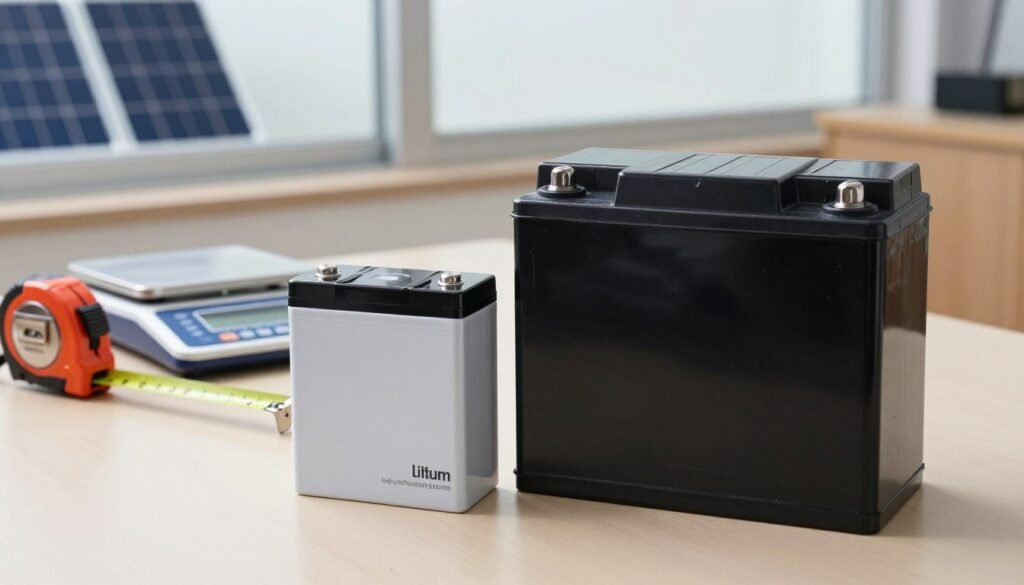
When planning for roofs or mobile installs, weight matters. A 50Ah LiFePO4 cell weighs 11–13 lbs. In contrast, a 100Ah lead-acid unit weighs 60–70 lbs. This big difference means you might not need heavy racks or extra support.
Think about how you’ll mount and ventilate your batteries. Lead-acid systems need special trays and space for air. But, lithium batteries, like wall-mounted ones, are easier to place and need less labor.
Plan for secure anchoring and clearance. Even though LiFePO4 batteries are lighter, they must be fastened well. This prevents them from tipping during transport or earthquakes. Floor-standing cabinets offer bigger capacity choices, while wall-mounted packs save space and make access easier.
Choose lithium for a smaller footprint and easier installation on rooftops or vehicles. If cost and structural support are more important, lead-acid might be better. It fits where weight isn’t as big of a deal.
Maintenance needs and operational simplicity
Managing a solar battery system means keeping it running smoothly. Lead-acid batteries need regular care, like adding distilled water and equalizing them. This prevents sulfation.
AGM and gel batteries are easier to handle but require correct charging and occasional checks. This helps avoid early failure.
Lithium batteries offer a simpler life. Many are maintenance-free, meaning no need for watering or equalizing. They also have built-in management systems that protect the cells and balance the charge.
These systems can be monitored remotely through apps or Bluetooth. This lets you check their health without having to visit them.
Lead-acid systems require more work. You need to check electrolyte levels, clean terminals, and ensure the charger settings are correct. You also have to run equalization charges regularly.
These tasks take time and may require service calls. Each visit can cause downtime and might need a technician for testing or replacement.
Lithium systems are easier to maintain. They need fewer checks and no watering. This means less time spent on maintenance.
They also last longer, which means you won’t have to replace them as often. This reduces downtime caused by swaps or repairs.
It’s important to consider the total cost of ownership. Lead-acid systems cost more in the long run due to frequent checks and replacements. Lithium systems may be more expensive upfront but save money in the long run.
If you want less maintenance and fewer interruptions, lithium batteries are a good choice. Lead-acid systems require more effort and time for upkeep.
Cost comparison and return on investment for solar owners
Choosing between battery types is more than just looking at prices. You need to consider upfront costs, long-term performance, and how each affects your return on investment. This section will guide you in picking a system that fits your budget and needs.
Upfront cost differences and average price ranges
Lead-acid batteries are often cheaper upfront. For example, a 100Ah flooded lead-acid pack costs $150–$200. On the other hand, a 50Ah LiFePO4 battery is about $200–$300.
Brands like Trojan and Rolls offer affordable lead-acid options. But, LiFePO4 systems from Battle Born and RELiON have higher costs. Yet, the price difference narrows when you consider usable capacity and system extras.
Cost per usable kWh and cost per cycle calculations
Look at usable energy to get a fair comparison. A 100Ah lead-acid battery has about 1.2 kWh of capacity. But, only 30%–50% of that is usable, giving you around 0.36–0.6 kWh.
A 50Ah LiFePO4 battery has about 0.6 kWh of capacity. But, you can use up to 80%–100% of it, giving you 0.48–0.6 kWh. Over time, lithium batteries offer better value because they give more usable energy per dollar.
| Metric | 100Ah Lead-Acid | 50Ah LiFePO4 |
|---|---|---|
| Typical purchase price | $150–$200 | $200–$300 |
| Usable kWh (typical) | 0.36–0.6 kWh | 0.48–0.6 kWh |
| Cycle life (typical) | 200–500 cycles | 4,000+ cycles |
| Approx. cost per usable kWh over life | $0.50–$2.00 (varies by replacement) | $0.10–$0.50 (driven by long life) |
Lithium batteries have a big advantage in cost per cycle. They are rated for thousands of cycles, spreading the cost over many cycles. This makes them more cost-effective for frequent use.
Payback scenarios and long-term ROI examples for residential systems
Your payback time depends on system size, solar output, and usage. Daily cycling benefits from lithium’s efficiency and long life, reducing replacement costs. This boosts your long-term ROI, even with a higher initial cost.
For occasional use, lead-acid might offer quicker payback. But, it needs more frequent replacements and maintenance. Over 10–15 years, lithium often has lower total cost of ownership, including replacements and lost energy.
Calculate total lifecycle cost divided by total usable kWh to compare costs. This method shows the true cost per kWh. Compare it to local grid rates and incentives to find the best battery for your budget and goals.
Safety, thermal behavior, and extreme temperature performance
Choosing the right battery chemistry for solar is critical. Modern lithium systems use LiFePO4 cells with a battery management system. This system prevents overcharge, over-discharge, overcurrent, and short circuits. This makes lithium safer than older types, but careful installation and monitoring are key.
Flooded lead-acid batteries release hydrogen when charging. So, it’s important to have good ventilation. Place these batteries in well-ventilated areas or cabinets. Also, follow charger profiles to limit gassing and avoid explosions.
Cold weather affects how batteries charge. Many lithium packs have cut-offs for low temperatures to prevent damage. Some even have internal heaters for charging in cold conditions. Always follow these limits to avoid damage.
Lead-acid batteries lose capacity in cold and degrade faster in heat. Adjust the charging voltages for the temperature. Avoid high temperatures to keep the battery in good condition.
Enclosures and site requirements vary by chemistry. Lithium systems need less ventilation but must follow safety codes. NEC rules and local codes dictate placement, wiring, and signage for both lithium and lead installations.
Follow manufacturer guidelines and use certified installers. Check vendor pages like commercial high-voltage lithium battery for safety data. This ensures compliance and warranty conditions.
For safer systems, ensure proper ventilation for flooded banks. Enforce low temperature charging limits. Use modern BMS-equipped LiFePO4 modules. Document compliance with local electrical inspectors. These steps reduce risks and improve performance in various climates.
When planning your system, consider thermal protections, ventilation, and code requirements. Match these with your climate and use case. This helps choose the right battery type for reliable performance in all conditions.
Environmental impact and end-of-life recycling
Choosing a battery for solar means thinking about mining, disposal, and recycling. Mining and production have big impacts on the environment. How we handle batteries at the end of their life is key to understanding the environmental cost.

Lithium mining affects water and habitats in places like the Atacama and Australia. This has big effects on communities and nature. But, lithium batteries often last longer, which means we need to replace them less often.
Material extraction impacts: lithium mining vs lead production
Lead production uses a lot of energy and can be toxic. It needs strict controls to avoid pollution. We must consider the emissions and dangers of handling and moving lead.
Lithium mining has its own challenges. It uses precious water in dry areas. Mining rock for lithium also creates waste and uses a lot of energy. Think about where materials come from and how they affect local communities.
Recycling rates and established recycling programs
Recycling lead-acid batteries is well established in the U.S. and other countries. Programs by battery makers and recyclers recover almost all lead and plastic. This reduces the need for new lead and limits pollution.
Lithium recycling is just starting. Recycling rates for lithium are lower because of technical issues and different cell types. Use certified programs to recycle lithium batteries and prevent waste.
Recycling challenges for lithium chemistries and improving circularity
Recycling lithium-ion batteries is harder than lead-acid because of mixed materials and safety risks. Current methods are expensive and use a lot of energy. Companies like Redwood Materials and Li-Cycle are working to make recycling cheaper and more efficient.
Second-life uses for EV batteries offer another solution. Some EV batteries can be used for home storage through programs by Tesla and Nissan. This extends their life and improves recycling when done right.
| Aspect | Lead-Acid | Lithium-Ion |
|---|---|---|
| Typical recycling rate | Near 95–99% material recovery in U.S. programs | Variable; often below 50% for many streams today |
| Main environmental risks | Lead toxicity, smelting emissions | Water use, chemical waste, battery component hazards |
| End-of-life handling | Established collection and smelting networks | Growing collection programs; requires specialized processing |
| Benefits for circularity | Fast, efficient material loop; lowers raw lead demand | Higher value materials if recovered; possible second-life use |
| Practical advice for you | Use certified recyclers for safe lead-acid recycling | Join manufacturer take-back or certified lithium recycling programs |
System compatibility and smart features for solar integration
Before buying, make sure your inverter works with lithium batteries. Look for brands like SMA, Victron, Schneider, or Tesla. They should support lithium charging and have the right communication links.
Inverter/charger links and communication
Adjust your inverter to match the battery’s needs. Use CAN, RS485, or Modbus for communication. This lets the inverter and battery share important info.
For reliable control, use a wired link if your battery has a built-in BMS. This ensures smooth communication between the inverter and battery.
For more details, check out this system design and BMS selection guide. It helps you choose the right inverter and BMS for your setup.
Monitoring, apps, and Bluetooth management
Lithium batteries often come with Bluetooth for easy monitoring. This lets you check cell voltages, temperature, and cycle counts on your phone. It makes troubleshooting faster and reduces site visits.
For full control, connect the BMS to a gateway or GX device. This gives you system-wide data. Some systems also use external monitors for more accurate state-of-charge readings.
Hybrid system design and scalability
Plan your hybrid solar battery system for growth. Lithium batteries are modular, working in 12V, 24V, and 48V stacks. This makes it easy to add more storage without replacing the whole system.
When you add more capacity, remember to manage alternator charging. Proper control prevents overheating and ensures safe charging for large lithium banks.
| Aspect | What to check | Why it matters |
|---|---|---|
| Inverter compatibility lithium | Supported chemistries, configurable charge profiles, communication ports (CAN/Modbus/RS485) | Ensures correct voltages, avoids premature cutoffs, enables remote control |
| Battery communication protocols | CAN, RS485, Modbus, BMS daisy-chain wiring | Provides alarms, charge control, and system coordination |
| Battery monitoring Bluetooth | Local app access to SOC, cell voltages, temperature, cycle count | Quick troubleshooting and operator alerts without extra hardware |
| Hybrid solar battery systems | Stacking voltage options, inverter/charger mix, alternator integration | Flexible scaling, backup capability, simplified upgrades |
- Verify that your inverter and BMS speak the same protocol before installation.
- Prefer BMS models with pre-alarm and load/charge disconnect functions for safety.
- Set monitor parameters correctly: charge efficiency near 99% and Peukert around 1.05 for lithium when you use a shunt-based monitor.
Conclusion
Choosing the right battery for your solar system depends on how you use it and how long you plan to keep it. For daily use and long-term ownership, lithium batteries like LiFePO4 are a great choice. They offer more usable capacity, last longer, charge faster, and are 90–95% efficient.
This means you’ll need to replace them less often. You’ll also get more energy from your solar panels.
If you’re looking for the cheapest option upfront and don’t use it much, lead-acid batteries might be for you. But, they need more maintenance and last less long. You’ll have to replace them more often.
When deciding, think about the battery’s capacity, how long it lasts, and how efficient it is. Also, consider how well it works with your system’s parts. Look at the total cost over time and compare the two types.
If you want advice, tell us about your needs, space, and budget. We can help you find the best fit for your solar system.