
You count on solar lithium batteries to keep power flowing when it’s dark. Knowing how long they last helps you plan for replacements and system sizes. The life of a lithium battery depends on how often it’s charged, the temperature, and how well you care for it.
LiFePO4 batteries are known for their long life: many can go through thousands of cycles and last over a decade. On the other hand, regular lithium-ion batteries have a much shorter life, lasting only a few hundred cycles. Better quality ones might last up to 1,000 cycles. It’s important to look at both cycle and calendar years when picking a battery.
Big manufacturers offer warranties of five to fifteen years. But, these warranties end when the battery can’t hold 60–80% of its original charge. Even after that, batteries can be used but won’t last as long. For more information and a manufacturer’s view on solar battery life, check out this EcoFlow overview.
Key Takeaways
- Battery lifespan combines cycle life and calendar life; assess both for accurate planning.
- LiFePO4 longevity typically outpaces standard lithium-ion cells, often delivering 4,000–6,000+ cycles.
- Warrantied life often ranges five to fifteen years; end-of-life is commonly defined at 60–80% capacity.
- Maintenance, temperature control, and moderate depth-of-discharge extend solar battery life.
- After EOL, batteries can be used but with reduced runtime; factor this into replacement timing and costs.
Overview of Solar Lithium Battery Lifespan
Understanding how long a solar lithium battery will last is key. Its lifespan is split into cycles and shelf life. This split explains why lifespans vary a lot.
What lifespan means: cycle life vs. calendar life
Cycle life and calendar life are two ways a battery can fail. Cycle life counts how many times you can charge and discharge it before it weakens. Calendar life tracks how long it lasts from the day it’s made, even if it’s not used.
Every time you charge and discharge a battery, it wears out a bit. But even sitting idle, it can age due to chemical changes and corrosion. Heat and how fully charged it is also play a role.
Typical lifespan ranges for lithium solar batteries
The lifespan of a lithium battery depends on its type and how it’s used. High-quality lithium-ion batteries often last 15–20 years under the best conditions. LiFePO4 batteries, in particular, can handle thousands of cycles.
But cheaper lithium cells might only last a few hundred to a thousand cycles. This means they could last 2–10 years in real use. How hot it is, how deep you discharge it, and how fast you charge it can affect its lifespan.
How manufacturers define end-of-life (EOL) — 80% capacity benchmark
Manufacturers set a standard for when a battery is no longer useful. This is when it can only hold 80% of its original charge. This is the 80% capacity benchmark.
Lab tests often show how many cycles a battery can handle before it hits this point. But real-world use is different. It faces changing loads, heat, and partial charges that can affect its actual lifespan.
How Charging Cycles Affect Battery Capacity
Repeated use changes how much energy a battery can hold. Knowing what a charge cycle is helps track this change. Small daily habits add up, showing the impact of partial cycles compared to full ones.
Definition of a charge cycle and partial cycles
A charge cycle is when a battery goes from 0% to 100% and back to 0%. But, you usually don’t use it this way. Two 50% discharges count as one full cycle.
Partial cycles, like those from daily use, also wear down the battery. They add up to full cycles, affecting the battery’s life the same way.
Capacity loss per cycle and real-world expectations
Each full cycle makes the battery hold less energy. The loss varies with how deep you discharge it, temperature, and charge rate. Shallow daily use causes less loss than deep discharges.
Manufacturers give cycle ratings to 80% capacity to guide expectations. These Li-ion cycle ratings are just a starting point. Your actual use and the battery’s management system play big roles in performance.
Examples: Li-ion vs LiFePO4 cycle ratings
Standard lithium-ion batteries usually last hundreds to around 1,000 cycles under normal use. LiFePO4 batteries, on the other hand, can last thousands of cycles.
For example, some systems from brands like EcoFlow keep at least 80% capacity after thousands of cycles. Check manufacturer pages or sites like Aisen Solar Energy for more details on commercial-grade options.
| Chemistry | Typical cycles to ~80% | Common use case | Notes |
|---|---|---|---|
| Standard Li‑ion (NMC, NCA) | 300–1,000 | Smartphones, laptops, light home storage | Sensitive to high temperature and deep discharge |
| LiFePO4 | 2,000–6,000+ | Residential solar storage, ESS, off-grid systems | High cycle life, stable chemistry, safer thermal profile |
| Grade A Cells with Smart BMS | 6,000+ | Wall-mounted and floor-standing batteries | Active balancing and strong longevity claims for heavy use |
| Lead‑acid replacement LiFePO4 | Up to 3,000 | Direct lead-acid swap applications | Optimized for reliability with intelligent BMS |
- Track partial cycles to estimate accumulated wear.
- Expect capacity loss per cycle to accelerate with deeper DoD and heat.
- Choose LiFePO4 if long life and many cycles matter most for your system.
Depth of Discharge and Its Impact on Longevity
Knowing how much you use from a battery is key to its life span. Depth of discharge DoD shows the battery usage percentage before recharging. Your DoD choices affect how long the battery lasts, its daily performance, and when it needs to be replaced.
What DoD means for solar systems
DoD is easy to track on most battery monitors. If you use half the energy, it’s 50% DoD. Keeping an eye on DoD helps plan charging from solar, grid, or generator. This avoids deep drains that shorten battery life.
Recommended DoD for longer life
Manufacturers suggest a DoD to balance energy use and battery life. For lithium solar setups, 50–80% is common. Using 50% gives more cycles, while 80% offers more energy but fewer cycles.
How chemistry changes acceptable DoD
LiFePO4 batteries can handle deeper discharge without losing capacity fast. You can use 80–90% of a LiFePO4 cell, lasting longer than lead-acid. But, avoid using it at the limit to extend its life.
| Battery Type | Typical Recommended DoD | Cycle Life at Recommended DoD |
|---|---|---|
| LiFePO4 (deep-cycle LiFePO4) | 50–80% | 3,000–6,000+ cycles |
| Flooded Lead-Acid | 30–50% | 200–1,200 cycles |
| AGM/VRLA Lead-Acid | 30–50% | 300–1,000 cycles |
When sizing a solar battery bank, consider lead-acid DoD. Lead-acid wears out faster at high DoD, increasing costs. LiFePO4 lets you use it at a higher DoD with less replacement.
For longer battery life, aim for shallow daily draws. Small, frequent charges reduce stress and extend life in off-grid and backup systems.
Temperature Effects on Solar Battery Lifespan
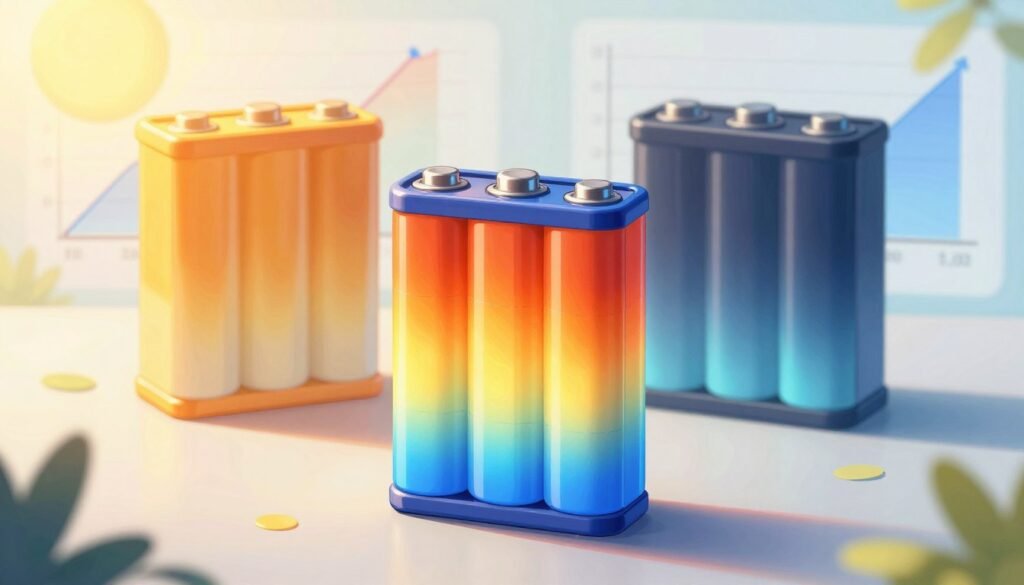
Managing temperature is key to your solar lithium battery’s lifespan. Small changes in temperature affect chemical reactions inside the cells. This impacts how much capacity is lost, how many cycles it can handle, and its long-term reliability.
How high heat accelerates chemical aging
High temperatures speed up the breakdown of electrolytes and corrosion of electrodes. This process, known as high heat chemical aging, increases internal resistance. It also reduces the battery’s usable capacity faster than usual.
Brands like Tesla and Battle Born warn that high heat shortens warranty life and reduces cycle counts.
Damage risks of charging in freezing temperatures
Charging batteries below 32°F can cause lithium metal plating and irreversible damage. Cold charging risks include internal shorts and loss of active material. Many LiFePO4 makers allow discharge in cold weather but restrict charging until cells warm up or a low-temperature charger is used.
Optimal operating and storage temperature ranges (practical guidance)
For the best longevity, keep batteries between 50–86°F. This range balances performance with slow aging. Some manufacturers give wider limits for short-term use, but prolonged extremes reduce lifespan.
Store batteries at about 40–60% state of charge in a cool, dry place. If you expect winter charging, use a battery with built-in low-temperature protection or add a heater kit. When planning installations, place packs where heat buildup is minimal and airflow is steady.
By following these practices, you can reduce the risk of premature capacity loss. This minimizes high heat chemical aging and avoids cold charging risks. It keeps your battery within recommended operating temperature ranges.
Charge and Discharge Rates (C-Rate) and Stress on Cells
Understanding how current draw affects battery capacity is key to protecting your system. The C-rate definition shows that 1C on a 100Ah battery means 100A. Lower currents are gentler, while higher ones stress the cell more.
The C-rate tells you how fast energy can be moved in and out of the battery safely. Knowing this helps you choose the right batteries, inverters, and chargers for your needs.
High C-rates lead to more heat, faster resistance growth, and quicker wear on electrodes. These issues cut down on battery life and increase the chance of overheating when using high currents for a long time.
When designing your system, consider the C-rate for sizing capacity versus load. Opt for currents around 0.2C–0.5C to keep the battery cooler and last longer. While some LiFePO4 packs can handle occasional high currents, repeated use can harm their performance.
Size your battery and inverter loads to keep charging and discharging within safe C-ranges. Use chargers with the right limits and a BMS that enforces safe rates to avoid stress.
Here’s a checklist for planning your system:
- Calculate peak and continuous currents to find the effective C-rate.
- Choose a battery that matches the recommended charge and discharge rates.
- Leave some room for everyday loads to operate at 0.2C–0.5C, not 1C or higher.
Battery Management System (BMS) Role in Extending Life
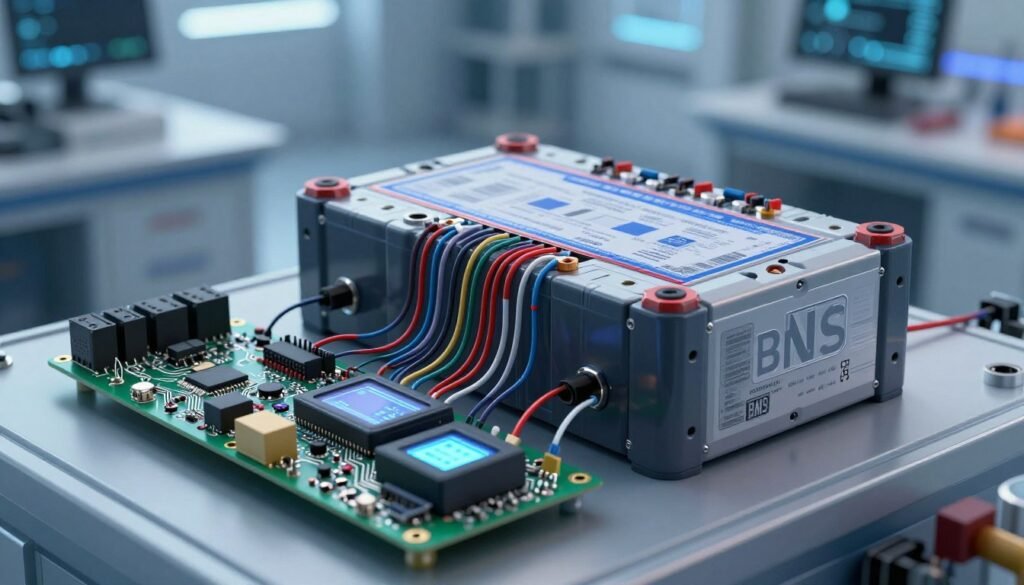
A good battery management system BMS is key to keeping your battery healthy. It watches over voltage, current, and temperature. This stops damage that can shorten its life.
Look for BMS features like overcharge and deep-discharge stops, temperature controls, and cell balance checks. These features protect your battery from harm and keep it running well.
Key protections to check
Check the BMS specs for over and under voltage limits. Make sure it has temperature limits for charging and discharging. Also, look at the current ratings for your inverter and loads.
- Over/under voltage limits that match the cell chemistry
- Charge/discharge current ratings for your inverter and loads
- Temperature cutoffs and derating behavior
- Balancing method and frequency for cell balancing
How a quality BMS prolongs cycles
A good BMS keeps all cells balanced. This means no single cell gets overcharged, which helps your battery last longer. You’ll get more use out of your battery and fewer sudden failures.
Good BMS features also prevent overheating. Some BMS designs are better at handling big systems. This makes them more reliable for large solar setups.
What to look for in specifications
When comparing BMS systems, check the specs carefully. Look for clear limits, balancing strategies, and field performance data. Brands like Tesla, LG Energy, and Victron share detailed info to help you choose.
| Feature | Why it matters | Typical good spec |
|---|---|---|
| Overvoltage cutoff | Prevents cell overcharge and plating | Per-cell limit within manufacturer tolerance (e.g., 4.15V for many Li-ion) |
| Undervoltage cutoff | Avoids deep discharge that shortens life | Per-cell cutoff above damaging levels (e.g., ~2.5–3.0V depending on chemistry) |
| Continuous/peak current rating | Ensures BMS can handle loads without overheating | Continuous ≥ expected draw; peak for surge events |
| Temperature protection | Prevents charging in freezing conditions and overheating | Charge inhibit below 0°C; derating above 30–35°C |
| Balancing method | Maintains even state of charge across the pack | Active balancing or frequent passive shunt balancing |
| Communication and reporting | Gives you diagnostics and logs for maintenance | CAN/RS485/Bluetooth with clear telemetry |
For a quick review of what a BMS does, check out battery management system basics. This guide covers monitoring, protection, and reporting.
Choose a BMS based on its specs and performance. Good BMS protections and balancing mean your battery will last longer. This avoids the need for early replacement.
Comparison: Lithium Battery vs. Lead-Acid and Other Chemistries
Choosing the right battery for solar storage is key. This section compares lifespans, energy density, weight, and maintenance needs. This helps you understand the cost per cycle and long-term costs.
Typical lifespans and cycle counts
LiFePO4 batteries last 4,000–6,000+ cycles and up to 10+ years. Generic lithium-ion cells last 300–1,000 cycles, 2–10 years. Lead-acid batteries last 200–300 cycles, 3–5 years.
NiMH batteries fall in between, lasting 500–800 cycles, 2–5 years.
Energy density, weight, and maintenance differences
Lithium batteries have higher energy density, meaning more power in less space. This makes them lighter and easier to install. Lead-acid batteries are heavier and need regular maintenance.
Lithium batteries, like LiFePO4, are safer and more stable. But, they might need better cooling.
Cost-per-cycle and total cost of ownership comparisons
Lithium batteries cost more upfront but last longer. They need less maintenance and are replaced less often. This makes them cheaper in the long run.
Compare the initial cost, cycle life, and replacement frequency. For example, a LiFePO4 pack might cost more but save money over time with daily use.
| Chemistry | Typical Cycles | Expected Years | Energy Density (relative) | Maintenance | Relative Cost per Cycle |
|---|---|---|---|---|---|
| LiFePO4 | 4,000–6,000+ | 10+ years | High | Low | Low |
| Generic Lithium-ion | 300–1,000 | 2–10 years | High | Moderate | Moderate |
| Lead-acid (deep-cycle) | 200–300 | 3–5 years | Low | High | High |
| NiMH | 500–800 | 2–5 years | Moderate | Moderate | Moderate |
Consider energy density, upfront cost, and maintenance when choosing. Lithium batteries often have advantages in solar systems. But, your choice depends on your budget, system size, and use patterns.
Real-World Lifespan Examples and Manufacturer Ratings
When you look at battery claims, you need real examples. Real-world battery life often doesn’t match lab results because conditions vary. Below, you’ll see cycle ratings from manufacturers with notes to help you understand how long your system will last.
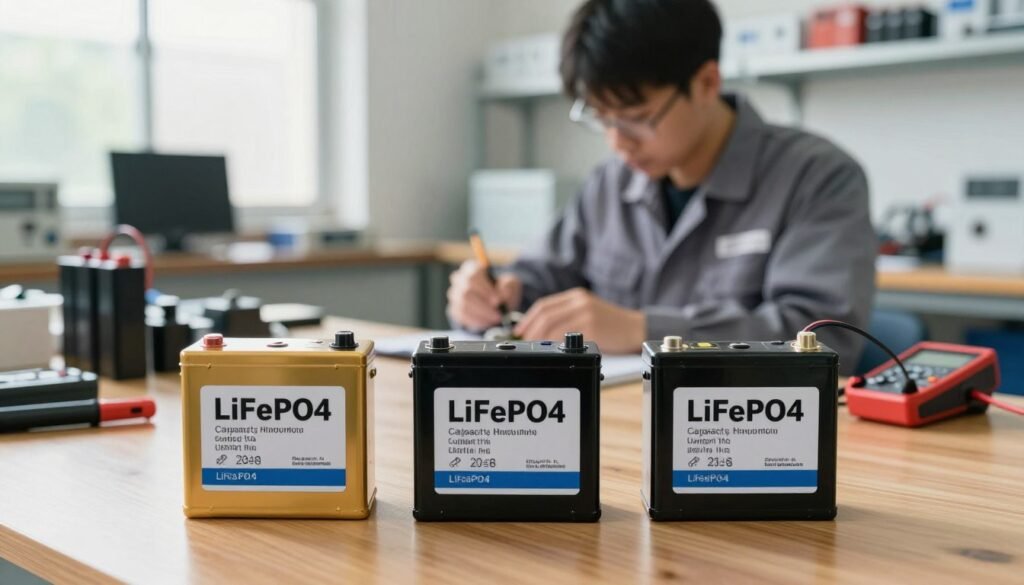
EcoFlow says the DELTA 2 Max lasts about 3,000 cycles to 80 percent. The RIVER 2 Pro also lasts around 3,000 cycles. These numbers give you a starting point for mid-range portable and home backup units. If you use it every day, you can easily figure out how many years it will last.
BSLBATT reports over 6,000 cycles at 80% DoD and 25°C for some LiFePO4 packs. This means over 16 years of use, with capacity above 60 percent after 6,000 cycles. This longevity is why many choose lithium iron phosphate chemistry.
Manufacturer tests are done in controlled conditions. But your system faces real-world challenges like temperature changes and varied use. So, expect its lifespan to be less than what’s tested.
Think of cycles to 80 percent as the number under test conditions. To find out how many years it lasts, divide the cycle rating by your daily use. For example, 3,000 cycles at one cycle daily equals about eight years. If you use it twice a day, it’s roughly four years.
| Brand / Model | Manufacturer Cycle Ratings | Test Conditions | Practical Years (1 cycle/day) | Notes on Real-World Battery Life |
|---|---|---|---|---|
| EcoFlow DELTA 2 Max | ≈3,000 cycles to 80 percent | Controlled temp, set DoD and C-rate | ≈8 years | Good for home backup; expect fewer cycles in hot or cold climates |
| EcoFlow RIVER 2 Pro | ≥3,000 cycles retaining ≥80% | Manufacturer lab conditions | ≈8+ years | Portable use sees varied DoD; maintain moderate C-rates for best life |
| BSLBATT LiFePO4 packs | >6,000 cycles at 80% DoD | 25°C, specified DoD and C-rate | >16 years | Top-tier cycle life in controlled tests; yet robust in field if cooled |
When comparing specs, always read the fine print. Cycle ratings show capacity at a certain point, but your use will affect the actual lifespan. Use these examples to plan for replacements and manage your expectations for long-term performance.
Maintenance Practices to Maximize Battery Life
Keeping your solar battery system healthy starts with simple, regular checks. You should monitor voltage SOC and inspect cell balance to catch small issues before they grow. A reliable battery management system will automate many tasks, but you should do periodic manual checks.
Regular monitoring: voltage, state of charge, and cell balance
Check voltage and SOC daily when your system is active. Do this weekly during light use. Use tools from Tesla, Victron, or Battle Born for accurate readings.
Look for cells that deviate from pack averages. Imbalance often signals early failure.
Storage best practices: state of charge and environment
When storing batteries long term, aim for about 40–60% SOC. Store units in a cool, dry space away from direct sunlight and rapid temperature swings. Inspect stored batteries every two to three months.
Top up charge if SOC drifts below recommended levels.
Routine maintenance tips for solar installations and off-grid systems
Avoid persistent overcharging or deep-discharge events. Use manufacturer-recommended chargers and charge controllers from brands like OutBack or Morningstar. Rotate batteries in multi-bank setups so one unit does not sit idle.
Keep enclosures ventilated and free from moisture. Protect terminals from corrosion and physical damage.
Follow a simple checklist: monitor voltage SOC, apply storage best practices, and perform routine inspections. These steps reduce failures and improve long-term solar battery upkeep for your home or off-grid setup.
System Design Choices That Improve Longevity
Smart system design choices can extend service life. They reduce stress on cells and lower the risk of failures. Focus on how the battery, inverter, and controls work together. This ensures daily use is moderate and discharge is low.
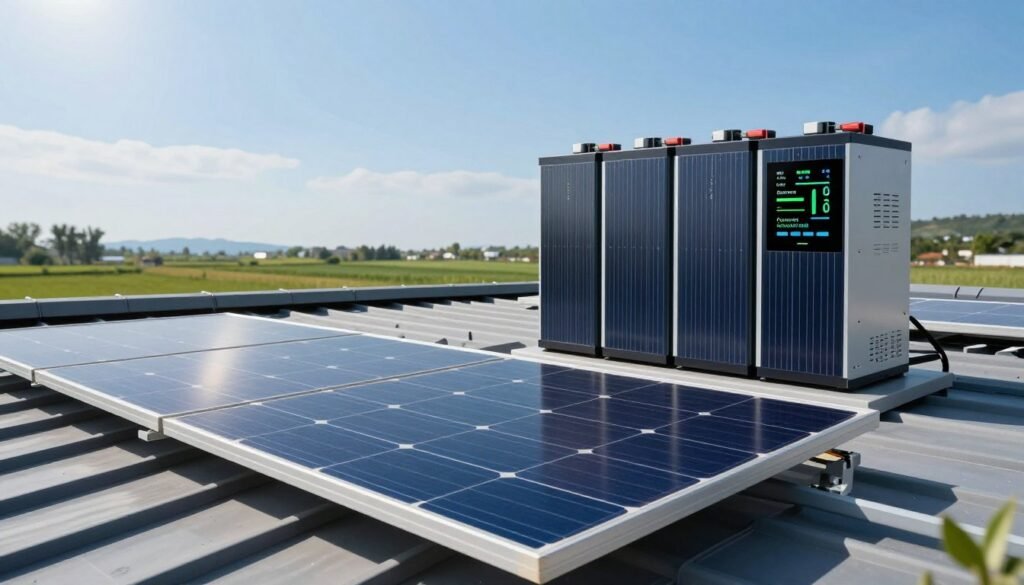
Right-sizing battery capacity and inverter loads
Choose capacity that matches your daily needs and peak loads. Right-sizing keeps C-rates in the 0.2C–0.5C range. This lowers routine DoD, preserving cycle life.
Oversizing the battery by 20–50% reduces wear and gives room for inefficiencies. It also prepares for future load growth.
Using charge controllers and temperature management solutions
Use MPPT charge controllers from trusted brands for stable charging. They protect cells and prevent overcharge. They also optimize acceptance during variable solar input.
Temperature management is key. Fit temperature sensors and controls to keep cells safe. This lowers chemical aging and improves performance.
Hybrid strategies and redundancy to reduce risk
Hybrid battery systems combine chemistries for different roles. For example, use lithium for daily cycling and lead-acid or reserve lithium for backup. This reduces stress on any single pack.
Add redundancy with parallel banks or multiple smaller modules. This allows for rotation or replacement independently. Redundancy reduces downtime and extends system life.
For practical examples and product options, check out AISEN Solar Energy. They offer guidance on matching components to your site and goals.
How to Estimate Replacement Timing and Total Cost of Ownership
Estimating when to replace a solar lithium pack’s battery is simple. First, match the battery’s cycles to your daily use. This tells you when it will need to be replaced and when to plan for a new one.
To find the battery’s life, divide the rated cycles by your daily use. For example, a 4,000-cycle LiFePO4 battery lasts about 10.95 years at 1 cycle a day. But, at 0.5 cycles a day, it lasts around 21.9 years. This method helps you plan for different usage levels.
Next, figure out the cost per kWh over the battery’s life. Multiply the battery’s capacity by cycles and usable DoD to find total energy. Then, divide the purchase price by this energy to get the cost per kWh cycle. LiFePO4 batteries often cost less per kWh cycle than lead-acid, even with a higher initial price.
When planning your budget, remember the battery’s capacity will decrease over time. Most manufacturers consider 80% capacity the end of life. But, real-world performance can vary. Plan for replacement or upgrade when capacity drops, and schedule checks before the replacement year.
Also, arrange for battery recycling or disposal early to avoid extra costs and risks. Many US manufacturers and installers work with certified recycling programs. Check with your vendor or local waste authority for recycling options and fees to include in your total cost of ownership.
Use the quick reference table below to compare scenarios and make an informed plan for budget and timing.
| Scenario | Rated Cycles to 80% | Cycles per Day | Estimated Years | Nominal Capacity (kWh) | Usable DoD | Lifetime Throughput (kWh) | Purchase Price (USD) | Cost per kWh Cycle (USD) |
|---|---|---|---|---|---|---|---|---|
| High-use home (LiFePO4) | 4,000 | 1.0 | 10.95 | 10 | 0.8 | 32,000 | $8,000 | $0.25 |
| Moderate-use home (LiFePO4) | 4,000 | 0.5 | 21.90 | 10 | 0.8 | 32,000 | $8,000 | $0.25 |
| Lead-acid equivalent | 1,200 | 1.0 | 3.29 | 10 | 0.5 | 6,000 | $3,000 | $0.50 |
Conclusion
You now have a clear guide on lithium battery lifespan for solar systems. LiFePO4 batteries usually last longer than lead-acid ones. They can go through thousands of cycles and last over a decade with proper care.
The lifespan of lithium batteries depends on several factors. These include system size, BMS quality, charging habits, and maintenance. Ratings from manufacturers, like 3,000–6,000+ cycles, are useful. But, your battery’s actual life will depend on how you use it every day.
To ensure your LiFePO4 batteries last a long time, plan your system carefully. Aim to use less power each day. Use a good battery management system and charge controllers. Also, keep batteries in the right temperature. Following these steps will help you get the most out of your investment and know when to replace them.