
This case study shows how solar garden lights have become popular. In Canada, recent events highlight their benefits. They use advanced LEDs, solar panels, and batteries for long-lasting light.
These systems are great for parks, homes, and businesses. They offer quick setup and save money on costs. Plus, they meet green living standards.
Let’s talk about what makes these lights special. They start working right away and don’t need digging. They also keep working even when the power goes out. This makes them a smart choice for any project.
They also come with features like stable light and smart controls. These let you adjust the light and check on it from anywhere. This helps keep the lights working well over time.
Now, let’s look at a high-end project in Chile. It used Sresky HONOR Series SLL-31 lights. These lights meet Dark Sky standards and adjust their brightness based on movement.
They also have systems to control temperature. This helps the batteries last longer. This shows how solar lights can meet your needs and look good too.
Key Takeaways
- Solar garden light systems now offer high lumen output and reliable runtime without trenching or grid ties.
- All-in-one solar luminaires simplify installation and reduce long-term operating costs.
- Smart controls and cloud monitoring enable adaptive dimming and predictive maintenance.
- Projects can meet aesthetic and Dark Sky requirements while delivering safety and uniform light.
- Temperature control and modern lithium batteries extend service life and improve resilience during outages.
Project Overview and Client Needs for Modern Landscape Lighting
This project aims to light up an upscale neighborhood with green, attractive, and energy-saving lights. You want lights that match the area’s wood and red-tile roofs. They should also be easy to see and low to maintain. The goal is to use solar power for its reliability and quick setup.
Site context and client goals
The neighborhood is small and fancy, with narrow paths and small trees. You need lights that are pretty and safe. The lights should also reduce sky glow and support a green community image.
Climate and technical constraints
The area often has cloudy skies and lots of rain. The temperature can drop a lot at night. This means lights need to charge quickly and work well in cold weather.
Key performance and design requirements
You want lights that look good and work well. They should be modern and bright enough for safety. The lights should also turn on when someone walks by and not shine too much up.
| Requirement | Target | Design Implication |
|---|---|---|
| Nighttime autonomy | ≥ 10 consecutive days under poor insolation | Large capacity battery, efficient LED driver, adaptive dimming profiles |
| Peak lumen output | Up to 3000 lm | High-efficiency LEDs and optics to limit glare |
| System efficiency | ~230 lm/W reported | Optimize PV panel angle, MPPT charge controller, low-loss wiring |
| Sensor coverage | PIR ~8 m | Motion-triggered boost with baseline safety lighting |
| Durability & warranty | 3-year warranty minimum | Specify proven battery chemistries and temperature protection |
| Light pollution | Dark Sky compliant | Cutoff optics, shielded fixtures, low CCT options |
| Operational cost | Zero grid electricity, low maintenance | All-in-one solar luminaires with remote management |
This brief sets the stage for finding the right lights. You need to find lights that work well in the area’s climate and look good. They should meet all your requirements.
Solar garden light Product Selection and Aesthetic Integration
You want fixtures that blend with your planting and pathways. They should also cut installation time and upkeep. A focused solar garden light product selection helps you pick units that meet performance needs and match your landscape lighting design intent. The right choice saves labor and keeps the setting cohesive.
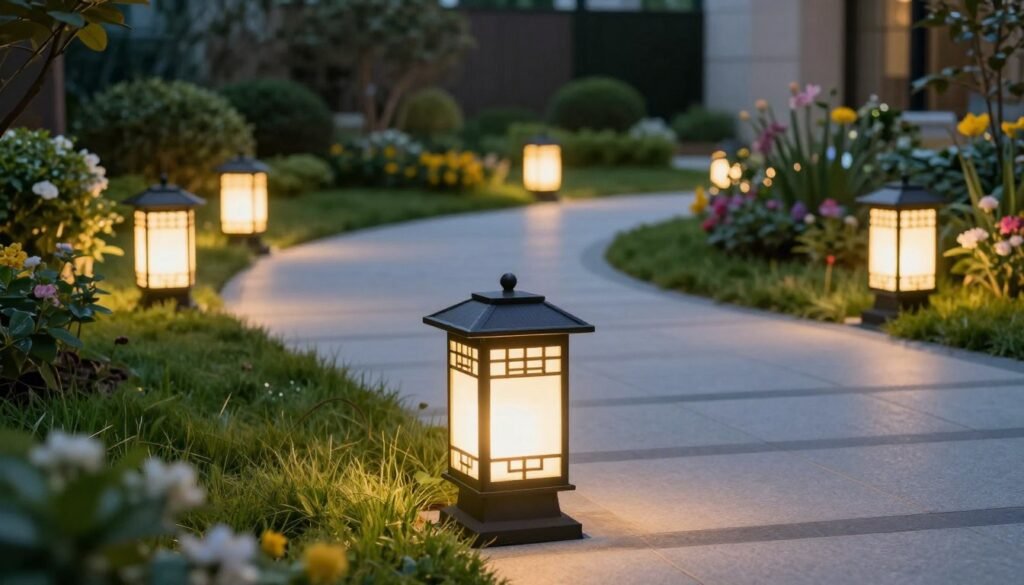
Why choose an all-in-one solar garden light luminaire
Choose an all-in-one solar luminaire for compact systems that simplify installation. These models combine PV, battery, LED, and controls in one housing. This avoids trenching and cabling. You can activate many fixtures the same day and reduce long-term O&M costs.
Manufacturers like Sresky and components from OSRAM show industry movement toward modular, service-friendly designs. This approach lowers replacement costs and makes future upgrades easier for your property.
Design considerations for landscape harmony
Match the fixture scale and finish to the architecture and plantings. This achieves a decoration + lighting effect. For sidewalks and shrub borders, a 360° omni-directional canopy works well for even coverage without bulky streetlight aesthetics.
In your landscape lighting design, prioritize fixtures with slim profiles and neutral finishes. This choice maintains a modern, minimalist look while preserving sightlines and plant forms.
Light quality and optics
Focus on light quality solar lights that use high-CRI LEDs and engineered lensing. OSRAM LED chips with CRI above 70 provide natural color rendering and softer scenes for residential settings. Optics that direct output downward reduce glare.
For neighborhoods with night-sky rules, select Dark Sky compliant solar lights. Models with controlled beam spread and 3000-lumen class output eliminate dark spots on walkways while preventing skyward spill. This preserves safety and community comfort.
| Factor | What to look for | Benefit |
|---|---|---|
| Form factor | Low-profile aluminum body, Panlite PC canopy | Blends with planting; resists corrosion |
| System type | All-in-one solar luminaire with modular battery | Simpler install; same-day activation; easier service |
| Light output | 3000-lumen class, 230 lm/W system efficiency | Uniform walkway illumination; fewer fixtures needed |
| Optics | Downward-directed lensing, 360° canopy options | Minimizes glare; meets Dark Sky compliant solar lights standards |
| Controls | Adaptive dimming, app control, motion scenes | Custom ambiance; energy savings; user-friendly operation |
| Light quality | OSRAM LEDs, CRI >70 | Natural color, comfortable nighttime appearance |
Technical Solution: Power, Controls, and Thermal Management
You’ll get a detailed plan that combines solar power, smart controls, and battery protection. This package uses top-notch panels, durable lithium batteries, and smart firmware. It aims to meet your needs while reducing maintenance visits.
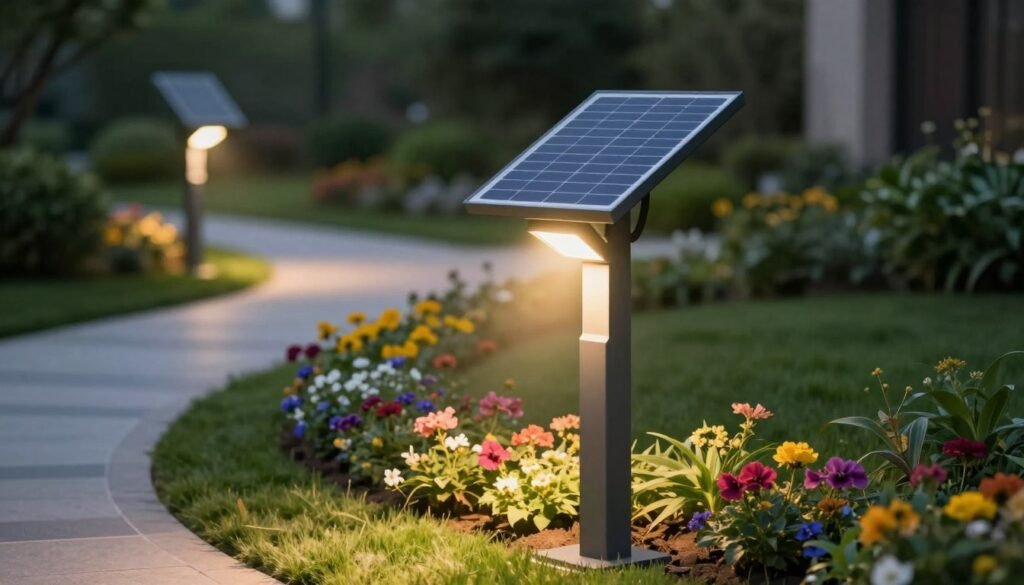
The chosen solar garden light uses high-efficiency panels and a big lithium battery. It charges fully in about 6.7 hours under good sun. It supports three modes to fit your site’s needs and how long it can run on its own.
The system is designed to be modular. This means you can easily swap out the battery or controller. There’s also a hybrid option for places that need grid backup during cloudy days. Cloud telemetry sends updates on battery state, charge cycles, and faults, making maintenance easier.
The controls adapt to your site’s needs. They dim lights by time and brighten them when needed. The system uses an algorithm to keep lights on for over 10 days in poor weather.
The solar light also has a motion sensor. It keeps a low light level and goes full bright when it sees movement. This saves energy at night and keeps paths safe for people and cars.
For safety, the system has a thermal control system for the battery. It keeps the battery between -20°C and 60°C. This prevents damage from cold or heat.
Tests show that this system makes batteries last up to 50% longer. You’ll need to replace batteries less often and know when they’ll need replacing.
| Subsystem | Key Feature | Benefit for Your Site |
|---|---|---|
| Photovoltaic array | High-efficiency monocrystalline panels | Faster charging, compact footprint, reliable daytime harvest |
| Battery pack | Large-capacity lithium with TCS | Extended lifetime, safe operation from -20°C to 60°C |
| Control system | Adaptive lighting controls with cloud telemetry | Optimized autonomy, remote updates, predictive maintenance |
| Motion detection | PIR motion sensor solar integration | Energy savings and on-demand brightness for safety |
| Serviceability | Modular, service-friendly architecture | Fast field swaps, lower lifecycle cost, scalable deployment |
Installation Process, Commissioning, and Onsite Challenges
Planning well and using all-in-one fixtures makes installation quick. Solar garden lights can be installed in one day, without digging or wiring. This saves money and time, for both small and big projects.
https://www.youtube.com/watch?v=cjLL_aXPmnE
Preparation and mounting strategy
Start with a site survey to understand sun paths and tree growth. In Chile, teams used sleek poles to fit modern designs and avoid shrubs. Place poles evenly for full coverage of walkways and landscapes.
When installing solar lights, make sure panels face the sun. Place lights near buildings and paths for beauty and function. Use easy-to-change mounts to save time and make repairs simple.
Commissioning and configuration
Check if lights charge, work on their own, and have the right sensors and optics. Set up the lights to match the season and safety needs. Adjust the PIR sensitivity so lights turn on at eight meters and avoid false triggers.
Use cloud monitoring and smart controls for remote checks and maintenance. Make sure battery reports are accurate and temperature settings are right. Also, check the light’s alignment with Dark Sky standards before finishing.
Field troubleshooting and adaptations
Onsite issues like shading or cloudy weather can happen. Adjust light brightness to last longer. Check temperature settings to protect batteries from extreme temperatures.
Update firmware for better PIR timing and dimming. For big projects, choose modular designs and parts from trusted makers. This makes field replacements easier and cheaper.
For more on product features and mounting, check a manufacturer’s page on best-selling solar garden lights.
Project Results, Performance Metrics, and Community Impact
The project showed strong results in both technical and social areas. It had stable light output, reliable sensor activation, and lasted for days even on cloudy days. This section talks about the main metrics, the benefits for residents, and the long-term advantages for cities.
Measured technical outcomes
The lights consistently produced 3000 lumens, making paths well-lit. They used special controls to avoid light pollution and adjusted brightness when needed.
It took about 6.7 hours to charge the lights under normal conditions. They worked for over 10 days straight when it was cloudy. The sensors lit up areas up to 8 meters away, helping pedestrians.
Tests showed the lights were reliable and needed less maintenance. For more on how they worked in humid conditions, check out this study: greenhouse optical performance study.
Social and aesthetic benefits
The lights fit well with modern buildings and gardens. People felt safer and enjoyed the look of the lights at night.
The lights didn’t pollute the sky but kept streets and paths well-lit. You can find more about the lights and their community benefits here: solar lighting product details.
Sustainability and lifecycle advantages
The lights used no electricity from the grid, saving money right away. They had special systems to keep batteries working longer, reducing the need for new ones.
The lights were easy to add to and manage, saving money over time. They were good for the environment and could be used in many places, helping cities and the planet.
| Metric | Measured Value | Operational Benefit |
|---|---|---|
| Peak lumen output | 3000 lm | Eliminates dark spots; improves visibility |
| Autonomy under clouds | >10 days | Resilience during low irradiance |
| Sensor trigger radius | 8 m | Responsive pedestrian lighting |
| Average charge time | 6.7 hours | Quick recovery on sunny days |
| Battery life extension | ~50% with TCS | Lower lifecycle replacement costs |
- Expect great performance from solar garden lights for community areas.
- These lights save money and need less upkeep for cities.
- They make places safer, look better, and keep the sky dark at night.
- They help reduce pollution and support cities’ long-term goals.
Conclusion
This solar lighting case study highlights the benefits of using solar lights in gardens and public areas. Modern technology has made solar lights reliable and efficient. They work well without needing to connect to the grid.
Choosing the right solar garden lights can save time and effort. They come with all you need in one package. This makes setting them up and keeping them running easy.
Opt for solar lights with smart features for the best results. They offer cost savings, weather resistance, and design flexibility. The Sresky HONOR Series, for example, provides bright light and smart dimming.
For top-notch performance, pick solar lights that can be controlled remotely. Brands like Govee and LIFX offer features that meet high standards. For critical areas, consider solar lights that also use the grid.
This guide helps you choose the right solar lights. Look for high-efficiency solar panels and smart controls. This way, you get quick setup, environmental benefits, and beautiful lighting.