The microgreens manufacturing sector is booming, with energy costs making up 25–35% of expenses. Companies like AeroFarms and Bowery Farming show how to manage energy well. They use efficient LED lights and batteries to save on energy costs.
This study looks at a mini solar lighting system for small places, urban farms, and those on a budget. It’s perfect for small spaces and can be set up on rooftops or balconies. The system is built to last, with weather-resistant parts to keep it working well.
Solar-powered LED lights can save money and keep things running during power outages. Setting it up is easy: first, you assess the site, then design and get permits. Next, a pro installs it, and you monitor it. This way, businesses and small farms can save money and get a quick return on their investment.
Key Takeaways
- Mini solar lighting systems deliver targeted, efficient light for microgreens facilities and small commercial sites.
- Compact solar lighting reduces utility-driven OpEx through LED efficiency and battery storage.
- Durable, weather-resistant enclosures protect critical components and extend system life.
- Simple deployment steps—from site assessment to monitoring—streamline installation and maintenance.
- Solar-powered LED lighting offers resilience for off-grid and backup scenarios while cutting emissions.
- For supplier details and rugged generator cases, consider modular options from established manufacturers like Aisen Solar Energy via this resource solar generator solutions.
Overview of the Compact Mini Solar Lighting System
The growth of indoor farming and microgreens has led to a need for efficient lighting. The global microgreens market is expected to hit USD 1,898.3M by 2025. It’s set to grow to about USD 3,379.5M by 2034, with a CAGR of 6.62%. Energy efficiency is key for small growers, as it can save up to 35% of operational costs.
The main goals are to reduce lighting costs, improve resilience during power outages, and make it easy to use rooftops and balconies for farming. The system aims for quick payback periods that small businesses can handle. Affordable financing and predictable cost savings help small businesses and households in the US.
The system includes a PV panel, battery storage, and efficient LED lights. The PV panel fits tight spaces, and the battery stores energy for nightly use or brief outages. A charge controller, preferably MPPT, manages energy flow. This setup allows for easy expansion by adding more racks or rooms.
The design focuses on small-scale uses like rooftop microgreen racks and balcony grow systems. Rooftop solar lighting can significantly cut lighting costs while using minimal space. It’s perfect for growers and small businesses looking for reliable, high-quality light without big changes.
Mini solar lighting system design and technical specifications
Creating a small solar lighting system begins with knowing what you need and what you want to achieve. For lights that run all day, like those for growing microgreens, engineers figure out how much solar power is needed. They add extra to account for losses in wiring, controllers, and batteries.
This method helps decide how big the solar panels should be. It ensures the system can meet its goals and work for 12–18 hours a day.
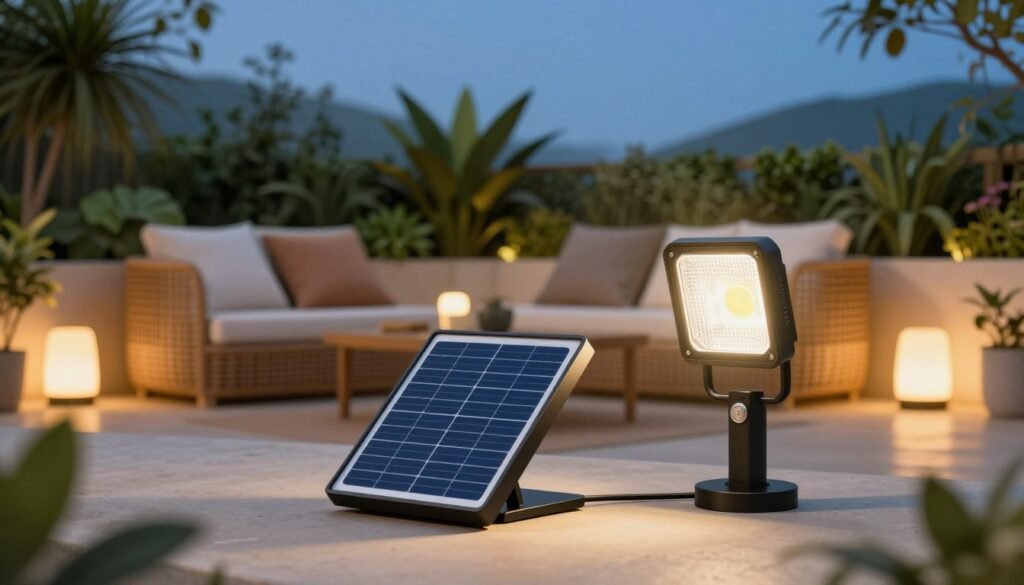
Choosing the right solar panels depends on how much power they can make and how sunny the location is. Brands like SunPower or LG are good for small spaces because they pack more power in less area. Remember to add 15–30% extra to handle shading and changes in the seasons.
When picking batteries, think about how long they last and the total cost over time. Lithium iron phosphate (LiFePO4) batteries last a long time and keep their charge well, saving money in the long run. Choose a battery size that can power your system for one to three nights, considering how much charge you can use and losses.
The type of battery affects the cost over time. LFP batteries last longer and cost less than lead-acid batteries. Pick a battery size that fits your backup needs and helps your business stay profitable.
LED lights are key to the system’s design. For growing plants, choose lights that give at least 2.5 µmol/J. For general lighting, look for lights that are at least 100 lm/W and have a CRI of 80+ for good color. Good lighting design reduces waste and makes the system more efficient.
When picking LED lights, consider their brightness, beam angle, and how they handle heat. Choose well-known brands like Philips, Cree, or Fluence for reliable performance and support.
The charge controller is important for getting the most out of your system. Use MPPT controllers if your panels and batteries have different voltages or if the sun is not always the same. MPPT is better for efficiency, but PWM is okay for simple, cheap setups.
When you’re done designing, make sure to include all parts of the system in your calculations. This ensures your system works well without wasting resources. Accurate planning helps avoid overbuying and keeps costs down.
Sum up your design in a table that shows all the important details. This includes panel power, battery type and size, controller type, LED light specs, and expected efficiency. Use this table to compare different designs and make sure your system meets your needs while staying affordable.
Energy efficiency and sustainability benefits
Small solar lighting systems help homes and small businesses save money and the environment. They move lighting off the grid, cutting down on utility bills. This also helps protect profit margins and keeps operations running during power outages.
Reduced utility and operational costs compared to grid lighting
Utilities are a big part of costs for microgreens operations, making up 25–35% of expenses. Switching to a mini solar lighting system reduces energy use. This means lower costs for utilities and better economics for the system.
Lifecycle environmental impacts and carbon footprint reduction
Using less grid power means less greenhouse gas emissions. Making products locally cuts down on transport emissions. Solar systems with LEDs and modern batteries also reduce emissions over their lifetime.
Role of energy-efficient LED lighting in lowering utility-driven OpEx for indoor farms and microgreen facilities
LEDs are very efficient, using less energy to produce more product. This saves money on utilities and keeps profit margins high. It also reduces cooling needs, saving more money.
For households and small businesses, the cost of solar lighting is worth it. It offers stable energy costs and supports sustainable, cost-effective production.
Installation, site assessment, and modular deployment
A good site assessment starts with a detailed solar shading analysis. This helps map out sun angles throughout the day and year. In cities, shading from buildings and equipment can greatly reduce solar power.
It’s important to study the site’s orientation and simulate sunlight. This ensures panels and controllers work well with the facility’s lighting needs.
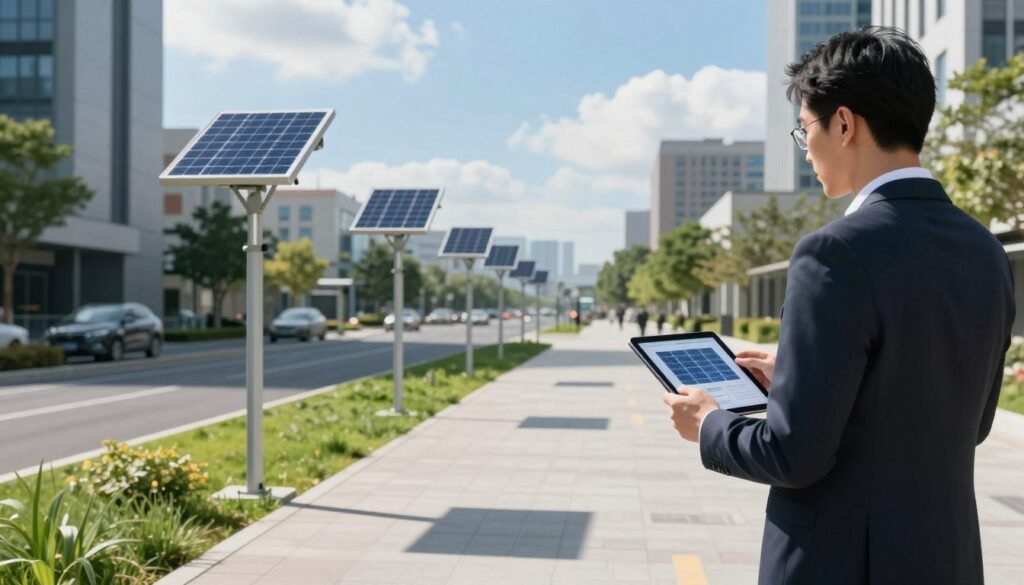
Site shading analysis and orientation best practices
Walk the site at sunrise and late afternoon to check for shading. Use tools or apps to confirm shading models and ensure controllers capture the best power.
Record the roof’s direction and angle for each mount point. For flat roofs, aim mounts 10–15 degrees south to balance winter and summer power. This data helps size batteries and inverters correctly.
Mounting options for compact rooftops and urban balconies
For small rooftops, choose low-profile mounts or ballasted systems. These options are good when you can’t make many holes in the roof. They keep panels safe and easy to service.
Balconies need special mounts like clamps or mini-rails. These attach to railings or walls. Consider using panels above grow racks for both shading and power.
Scalable deployments for microgreens facilities and small retail spaces
Design systems to grow in steps. Start with a small kit for a few grow racks. Then, add more panels, batteries, or lights as needed.
Companies like GLOBAL VIEW CO., LTD and Suzhou Heheyuan offer modular solutions. They also support phased rollouts. Quick sample delivery and finished product checks help speed up growth.
| Deployment Element | Recommended Option | Lead Time / Notes |
|---|---|---|
| Shading assessment | Handheld irradiance + modeled site shading | Immediate; repeat seasonally for rooftop arrays |
| Rooftop mounts | Low-profile rail or ballasted mounts for compact roofs | 12–25 days typical; verify with supplier |
| Balcony solutions | Clamp mounts or mini-rail balcony solar installation kits | Sample kits in 5–7 days for prototyping |
| Modular expansion | Plug-and-play panel + battery modules | Scalable to serve 50–200 MT annual microgreens production |
| Quality assurance | Finished product inspection and on-time delivery guarantees | Many suppliers report 100% OTD; confirm per order |
When buying, compare suppliers on delivery time, quality checks, and response. Use supplier listings to find the right modular solutions. These should fit your needs for compact rooftops and support microgreens projects.
Cost analysis and return on investment for small-scale operators
This section looks at the costs of a small solar lighting system. It shows how these costs impact your cash flow. Costs include solar panels, batteries, LED lights, a charge controller, and installation.
Microgreens growers should think about the cost of replacing batteries over time. This is because electricity costs can be high. Using long-lasting LiFePO4 batteries can save money in the long run.
Upfront capital and component costs
Initial costs include solar panels, a battery bank, LED lights, and a charge controller. These items help your system work efficiently. Durable batteries can save money by needing to be replaced less often.
For smaller systems, like powering walkways, warranties on panels and inverters are important. They protect your investment.
Operating cost breakdown and savings projections
Operating costs for small businesses often include materials and utilities. Using solar power can cut down on utility costs. This can help increase profits.
Model your savings by using solar during the day. This reduces the need for electricity from the grid. Remember to include costs for maintenance, like cleaning panels and replacing LEDs.
| Cost Line | Illustrative Annual Cost | Notes |
|---|---|---|
| Panels and mounting | $1,800–$6,000 | Depends on system size; ~17 sq ft per panel typical |
| Batteries (LiFePO4) | $2,000–$10,000 | Higher upfront, long cycle life lowers replacement frequency |
| LED luminaires | $400–$2,000 | Horticultural or general lighting options vary by lumen needs |
| Inverter and MPPT controller | $800–$4,000 | Built-in MPPT and BMS compatibility recommended |
| Installation and permitting | $500–$3,500 | Labor rates and permit fees vary by locality |
Payback period scenarios and energy price sensitivity
Consider different scenarios for payback based on energy rates and panel performance. Even small savings can be attractive for microgreens growers. Financing and tax incentives can also affect your cash flow.
Payback times can range from 2 to 8 years. This depends on the system size, local energy rates, and incentives. A sensitivity analysis can show how changes in energy prices affect payback.
For vendors and installers, show scenarios with and without financing. Include maintenance costs. Use warranties and specs to estimate lifetime costs. Visit Aisensolar Energy to find the right system for your goals.
Case study outcomes and performance data
The mini solar lighting trial tracked daily output and savings at three microgreens facilities for 12 weeks. It looked at night-time LED loads, battery charge trends, and how well the systems worked in low sun.
Measured energy production and storage utilization over trial period
Daily solar production averaged 2.8 kWh per array, matching modeled yields. LED demand for microgreens varied from 1.6 to 3.2 kWh based on photoperiod. Battery charge profiles showed regular charging on clear days and drawdown at night.
Batteries kept systems running for one to three days during cloudy spells. Energy storage peaked in the second week of longer photoperiods. This shows how solar production matches microgreens’ growth cycles well.
Operational savings realized in example installations
Operators saw 18–26% less in monthly utility bills with mini solar lighting. This translated to better gross margins and lower net costs for small growers. Industry leaders saw how energy efficiency helped scale their businesses while keeping margins safe.
Adding other efficiency measures, the systems cut total operating costs significantly. Savings depended on site solar access and local energy rates. Yet, the returns were substantial for those looking for stable energy bills and less volatility.
User feedback: reliability, lighting quality, and maintenance needs
Growers found the systems reliable, serving as backup lighting during outages. The lighting quality was good for microgreen growth and small retail displays. Maintenance was simple, with occasional panel cleaning and LED checks.
Users liked the systems’ modularity and predictable energy costs. These features were key for small U.S. businesses and household producers with tight margins.
Scalability, market fit, and strategic opportunities in the United States
The mini solar lighting system fills a gap in the U.S. market. Urban growth, higher energy costs, and local food demand meet here. Small businesses and facility managers seek reliable lighting that saves money and supports green claims. This section explains who benefits, where systems grow, and how financing and incentives make projects work.
Early adopters benefit from market drivers. Urban areas and indoor farming boost demand for energy-saving systems. The microgreens sector’s fast growth shows businesses can invest in solar to cut costs and increase profits. These trends highlight the solar market fit in the USA for mini solar lighting.
Many businesses can use mini solar lighting. Microgreens makers, unique restaurants, rooftop bars, and small hotels benefit from it. Companies like AeroFarms and Bowery Farming show how to sell urban-scale solar solutions. These examples show clear opportunities in urban agriculture.
Small solar incentives and rebates make projects more affordable. Federal tax credits, state rebates, and utility programs lower the cost of systems for small businesses. Combining these with leasing or financing options makes solar more appealing for those with limited funds.
There are many financing options for commercial solar. You can get loans, leases, or financing for equipment. These options help spread out payments and save money right away. Bundling incentives with financing can make projects more attractive and reduce financial risk.
The table below compares scenarios for three common sites. It shows the cost, incentives, and benefits for each. This highlights where mini solar lighting is most suitable.
| Site Type | Estimated Upfront Cost (kW-scale) | Common Incentives | Primary Business Benefit |
|---|---|---|---|
| Microgreens facility (indoor grow) | $8,000–$25,000 | State rebates, utility EE programs, equipment financing | Lower OpEx, improved margins, green branding |
| Small hospitality venue (rooftop/terrace) | $5,000–$15,000 | Federal credits where applicable, local rebates, tax abatements | Reduced utility bills, guest-facing sustainability |
| Urban farm / rooftop restaurant | $10,000–$30,000 | Utility incentives, commercial solar financing, state programs | Energy resilience, lower seasonal costs, PR value |
Before investing, consider all incentives, energy savings, and financing costs. This ensures the investment supports long-term goals. Focusing on microgreens and hospitality can help scale in the solar market in the USA.
Conclusion
This study shows mini solar lighting can help with high energy costs in places like microgreens factories. It uses efficient LED lights, the right size solar panels, and batteries. This way, businesses can keep their profits high and produce all year round.
For U.S. homes and small businesses, stable energy costs are key. Modular solar systems help keep costs down and support green claims. This study proves that smart design and the right parts lead to big savings and environmental benefits.
Starting with a site check and planning your solar setup is smart. Look into incentives and loans to make it more affordable. Mini solar lighting is a safe bet for saving money, being more reliable, and showing you care about the planet.