This case study looks at a small solar lighting system in the United States. It talks about choosing the right solar LED lights, how big the system should be, and how to keep it running. It’s for people who plan parks, paths, and small parking lots.
The study uses lessons from places like AeroFarms and Gotham Greens. It shows how lighting and energy costs affect expenses. It also talks about how Shenzhen electronics makers help with quick setup of solar lighting.
Being energy-efficient and having good light is key for success. Choosing the right vendors, following clear setup steps, and checking the system remotely are important. This keeps workers and users safe, like power line techs and sanitation teams.
Key Takeaways
- Mini solar lighting systems deliver reliable off-grid outdoor lighting for small public spaces with lower ongoing energy costs.
- Careful selection of solar LED lighting components and Shenzhen-sourced controls speeds deployment and reduces downtime.
- Design that prioritizes energy efficiency limits operating expenses and extends battery life.
- Remote monitoring and scheduled maintenance are essential to sustain safety and lifecycle value.
- Case studies from controlled-environment operators show lighting choices heavily influence total cost of ownership.
Project Overview and Goals: mini solar lighting system case study
This project aims to bring light to small public areas and industrial edges. It shows how mini solar lights can light up spaces from dusk to dawn. This is done while keeping costs low.
The project focuses on key sites, clear goals, and the right partners and funding. This makes it possible to quickly set up the lighting.
Background and site selection
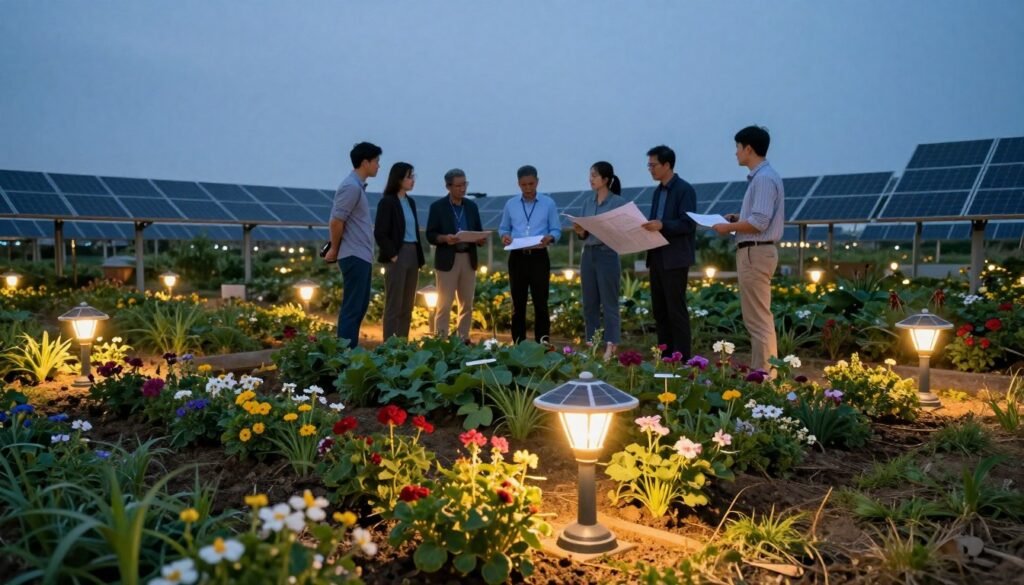
Look for places where it’s expensive or hard to get electricity: small parks, paths, gardens, transit stops, and remote lots. Areas near urban farms are also good because they help with longer work hours and safety.
Use solar assessments and local electricity costs to pick the best sites. Consider zoning, vehicle access, and storage for costs and logistics.
Project objectives and success metrics
The main goals are to provide reliable light, work all night, cut down on grid use, and boost safety. Goals should be clear and measurable to guide the project.
Success is measured by light hours, solar use, and how often lights and batteries work. Aim for over 98% uptime and few maintenance visits. Focus on saving energy to lower costs, as utilities can be 25–35% of expenses.
Stakeholders and funding model
Stakeholders include parks, utilities, neighborhoods, farmers, suppliers, and integrators. It’s important to define roles early to avoid confusion.
Funding can come from many places: city budgets, grants, rebates, partnerships, and warranties. Options like vendor-finance or performance contracts can help with costs.
| Item | Why it matters | Typical target |
|---|---|---|
| Nightly lumen-hours | Measures useful light delivered to users | 4,000–8,000 lumen-hours per fixture |
| Solar production/consumption ratio | Shows self-sufficiency and battery reserve needs | 1.2–1.5 seasonal ratio |
| Percent uptime | Reflects reliability and user experience | >98% annual uptime |
| MTBF (luminaire/battery) | Predicts maintenance cadence and costs | 10,000–30,000 hours for luminaire; 5–8 years for battery |
| Funding approach | Determines procurement speed and risk allocation | Combination of municipal funds, grants, and vendor-finance |
| Procurement priority | Short lead times and customization reduce delay | Suppliers with rapid sampling and low MOQ |
System design and component selection
The system design aims for performance, longevity, and easy maintenance. Early choices on panel size, battery type, and light optics are key. These decisions affect uptime, cost, and safety.
Designers should use site data and loss factors to create a strong system. This system should meet nightly light needs.
Solar photovoltaic module choices and sizing
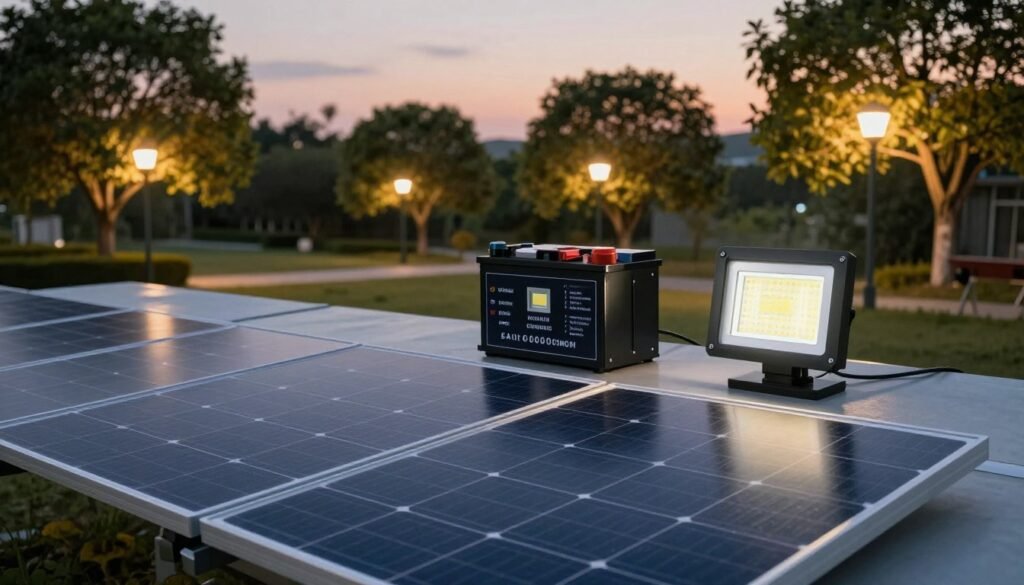
Choose high-efficiency monocrystalline modules for small spaces. Use IEC 61215/61730 certified modules for outdoor use. Add anti-theft mounts and vandal-resistant enclosures for public areas.
Calculate solar PV sizing by converting light hours into Wh/day. Add losses for controllers, wiring, and temperature. Design panels to meet nightly demand plus reserves for 3–5 low-sun days.
Battery chemistry and capacity planning
Prefer lithium iron phosphate (LiFePO4) for its long life and thermal stability. LiFePO4 offers deeper capacity and less replacement than lead-acid options.
Plan for 3–5 nights of battery life with daily discharge under 80%. Include a BMS with cell balancing and protection. Consider temperature effects and add insulation or heating as needed.
LED luminaires, optics, and control electronics
Choose LED luminaires with high efficacy, 130 lm/W or better. Select optical distributions that match use cases. Type II/III beams are good for walkways and small streets. Narrower optics spotlight features or entries.
Integrate smart controls for programmable dimming and motion-boosted lighting. Verify electronics are IP66 or higher and include surge protection. Use controllers compatible with IoT platforms for remote monitoring.
| Component | Recommendation | Key Design Notes |
|---|---|---|
| PV Module | Monocrystalline, IEC 61215/61730 | Size to meet Wh/day + 3–5 days reserve; anti-theft mounts |
| Panel Sizing Method | Site insolation + lumen-hour conversion | Account for temperature, wiring, controller losses |
| Battery Chemistry | LiFePO4 | 3–5 nights autonomy; DoD |
| Battery Sizing | Ah based on Wh/day and autonomy | Adjust for temperature derating and lifecycle planning |
| LED Luminaires | ≥130 lm/W, Type II/III optics | Match beam to application; prefer DLC or ANSI listings |
| Controls & Electronics | Programmable controller, IP66 drivers | Motion dimming, surge protection, IoT-compatible |
| Procurement | Vetted suppliers with sampling | Customization for firmware, color temp, housing |
Installation process and field deployment
Planning is key to a safe and efficient solar lighting installation. Teams sized foundations to fit pole height and wind loads. They chose pre-cast concrete footings or ground anchors after soil tests and checks for vandalism.
Trenching for conduit was done for future grid-tie expansion. This met local electrical codes and permits.
Site preparation and civil works
Staging areas were set for modules, batteries, and lights. Secure storage was near the work zone. Crane access and lift zones were assigned for pole assemblies.
Civil works included compacted backfill and corrosion-resistant anchor bolts. Drainage grading was done to prevent water pooling around footings.
Contractors documented excavation depths and conduit runs. Inspection checkpoints reduced rework. Temporary lighting and safety barriers protected crews and the public.
On-site commissioning and testing
Pre-energization checks were done for PV open-circuit voltage and short-circuit current. Panel orientation, tilt, and polarity were also checked. Battery management systems were configured and state-of-charge baselines were set.
Test cycles were run to validate charge/discharge behavior and dimming schedules. Motion-sensor response and telemetry uplink were tested. Surge protection and grounding were validated with tests.
A soak test confirmed autonomy targets. Baseline energy production and consumption data were recorded for analytics. Final steps included documenting firmware versions and handing over to local maintenance staff.
Supply chain and vendor considerations
Choosing vendors focused on certified manufacturers with good delivery records. Brands with U.S. distribution hubs were preferred for faster spare parts and warranty repairs. Shenzhen suppliers were evaluated for fast sampling and customization.
Project managers balanced cost and on-time delivery with after-sales support. Logistic buffers were kept for batteries and electronics. Incoming inspection protocols covered visual checks and performance tests.
| Activity | Key Checks | Responsible Party | Typical Duration |
|---|---|---|---|
| Foundation and anchoring | Footing depth, anchor torque, drainage grading | Civil contractor | 1–3 days per pole |
| Electrical trenching | Conduit route, sleeve placement, code compliance | Electrical contractor | 0.5–2 days per run |
| Module and pole installation | Tilt/orientation, mechanical torque, lift safety | Installation crew with crane operator | 1 day per location |
| Commissioning tests | PV VOC/ISC, BMS config, motion sensor, telemetry | Commissioning engineer | 1–2 nights for soak test |
| Quality inspection | Serial trace, performance spot-test, documentation | QA inspector | Half day per batch |
Operational performance and monitoring
A good monitoring plan connects field data to maintenance actions. Start by tracking PV generation, battery charge, driver efficiency, and night light use. Use this data to improve energy analytics dashboards and adjust light levels based on actual versus expected sunlight.
Set up KPIs for nightly light hours, battery cycles, and energy reserve days. This helps spot issues like soiling or shading early, saving costs and avoiding unexpected repairs.
Energy production and consumption analytics
Track kWh/day from the PV array and light use. Calculate ratios and trends to predict light output and panel decline. Show data in easy-to-understand charts for municipal staff to spot issues.
Link battery charge patterns with load profiles to predict when capacity is low. Include daily energy use to adjust schedules and improve performance on cloudy days.
Remote monitoring and maintenance strategy
Use cellular or LoRaWAN for real-time alerts on low battery, faults, or lost connection. Choose platforms that work with common apps and cloud services for easier field work.
Have a mix of maintenance: regular checks, annual electrical tests, and cleaning based on soiling data. Keep spare parts on hand for quick fixes and train staff or third-party teams for routine tasks.
Reliability outcomes and field observations
Field data shows better uptime with LiFePO4 batteries and quality drivers. Track replacement times to improve battery and driver planning for reliable lights.
Record changes in path use and night incidents to link lighting to community benefits. Monitor LED and battery degradation to plan for replacements and update cost models.
Cost analysis and lifecycle economics
This section breaks down the costs of mini solar lighting. It helps project managers and finance teams see the value over time. The numbers show typical costs for small outdoor lighting projects.
Capital costs include things like solar panels, batteries, and lights. Brands like Trina Solar and LG offer clear pricing and warranties. These costs are upfront and can be high.
Quality electronics and batteries mean higher initial costs. The cost of electrical work and lights can be high. Buying in bulk or getting samples can help manage risks.
Capital expenditure and installation costs
Break down costs for each node and the whole project. This makes it easier to compare different options. Remember to include extra for unexpected costs and to ask about warranties.
Operating costs and savings versus grid lighting
Using solar lights saves money on energy and maintenance. LiFePO4 batteries and LEDs last longer than older types. Remote monitoring also cuts down on maintenance visits.
Model costs over 10–15 years, including battery replacements and light depreciation. Use data to improve payback estimates. Include savings from government incentives and lower utility costs.
Scalability and funding models
Scaling up reduces costs per unit. Standard parts make deployment easier and cheaper. As you buy more, prices go down.
There are many ways to fund solar lighting projects. Options include government grants, partnerships, and vendor financing. These can help share risks and secure funding for larger projects.
| Cost Category | Typical Range (per node) | Notes |
|---|---|---|
| PV modules | $150–$450 | Higher-efficiency modules raise upfront cost, lower footprint |
| LiFePO4 battery packs | $300–$900 | Longer cycle life reduces replacement frequency |
| LED luminaires & optics | $120–$600 | Optics and quality LEDs affect lumen maintenance |
| Controllers, sensors, firmware | $80–$300 | Remote monitoring adds recurring subscription costs |
| Poles & foundations | $200–$1,000 | Local soil and permitting change foundation costs |
| Wiring, conduit, civil works | $100–$500 | Site prep can vary widely by location |
| Installation & commissioning labor | $150–$700 | Experienced crews lower rework risk |
| Total estimated CapEx | $1,100–$4,450 | Per-node estimate for typical mini solar lighting installations |
Use this framework to calculate payback and compare solar lights to grid options. Adjust for local incentives and supplier terms. This will show the savings and funding options for solar lighting.
Community impact, safety, and sustainability metrics
Mini solar lights change neighborhoods at night. They increase evening walks and park hours. Local shops get more customers with well-lit walkways.
Jobs are created for installation and maintenance. These jobs help local crews.
Lighting cuts down on crime and accidents. Parks and transit spots are safer. This is because of better visibility.
Lighting data shows fewer incidents. It proves solar lights make areas safer.
Lighting helps small farms and delivery services. It makes night work safer for businesses. Training locals for maintenance boosts jobs and ownership.
Using solar lights cuts down on pollution. It saves energy and reduces emissions. Choosing the right batteries and recycling modules helps the environment.
Tracking environmental KPIs is important. It helps plan for better, greener projects. Knowing about battery and module recycling is key.
Smart lighting supports urban goals. It uses IoT to monitor and adjust lighting. This makes cities more efficient and responsive.
Aligning with smart-city trends is smart. It shows how lighting can power a decentralized energy system. Look for eco-friendly products on supplier listings.
Presenting data clearly is important. It keeps the community informed and supports funding. It shows the value of investing in green lighting.
Conclusion
This mini solar lighting system conclusion shows key lessons. First, choose high-efficiency PV modules, quality LED lights, and LiFePO4 batteries. This combo extends life and reduces upkeep.
Also, add smart controls and remote monitoring. This ensures your lights are on over 98% of the time. They can run for three to five nights without needing a recharge.
Make sure to pick reliable vendors. They should offer certifications, warranties, and fast delivery. This avoids delays in your project.
Watch important metrics like uptime, how long they run, and their cost over time. Also, look at how much carbon they save. Start small with a pilot project and gather data for a year before growing.
Expand your system in a planned way. Use grants, ESCOs, or local funds to make it happen. This way, you can predict and fund your growth.
For the best results, focus on quality and ease of use. Use solar garden lights that are built to last. They should have strong panels, reliable batteries, and tough housings.
This approach ensures long-lasting light and real benefits for safety and the environment.