Living without electricity is tough. Darkness falls when the sun goes down. You must use expensive fuel for generators or kerosene lamps.
Solar lights offer a new solution. They work where sunlight is available. You don’t need power lines or fuel deliveries. Your home gets light without high costs.
Solar technology has improved a lot. Modern solar lights are brighter and last longer. They charge quickly, even in weak sunlight. Batteries now last for years, not months.
Buying solar lights is a smart move. You won’t have to pay for electricity or fuel. Your money goes a long way, saving you money for years.
In Africa, Asia, and rural areas worldwide, solar lights make a big difference. Schools stay open late. Clinics offer care at night. Families can read and study safely, without kerosene fumes.
Key Takeaways
- Solar lights work in any remote location without power lines or fuel delivery
- Modern solar technology provides reliable lighting that lasts for years
- You eliminate monthly electricity bills and fuel expenses completely
- Installation requires no trenching, electrical permits, or contractor fees
- Solar lighting enables healthcare, education, and economic activity after dark
- Off-grid communities reduce dangerous indoor air pollution from kerosene lamps
- Solar systems improve safety and security in remote neighborhoods
The Evolution of Off-Grid Lighting Technology
Remote areas have always needed good lighting. Early solutions were dangerous and dirty. Now, we have clean, renewable energy options.
This change is huge. What was once a backup is now the main light source for many. Solar tech and battery advancements have made this possible.
From Kerosene Lamps to Modern Solar Solutions
Kerosene lamps were common for a long time. They were dim and unhealthy. Burning fuel harmed indoor air and caused breathing problems.
Solar lights came next. They were simple but safer. They offered a cleaner way to light homes.
The switch to solar wasn’t easy. People needed reliable systems. Now, solar lights are the main light source, not just a backup.
How Solar Technology Has Improved Over the Past Decade
The last ten years saw big changes in off-grid lighting. Solar panels, batteries, and LEDs got better. These changes mean lights charge faster, last longer, and work in tough weather.
Solar panels now catch more sunlight. This means your lights work better, even on cloudy days. You don’t need big or expensive setups.
Batteries have also improved. Lithium batteries power most solar lights now. They last longer and work better than old batteries. Your lights will last longer too.
LEDs have made lights brighter. Now, your home is well-lit, not just dim. You can see clearly indoors and outdoors at night.
Modern lights can handle bad weather. They work in extreme temperatures, rain, and sun. They last longer without needing repairs.
Smart charging systems are the latest innovation. They make sure your lights work well and last longer. Some even let you control them from afar.
| Technology Component | Past Performance (2014) | Current Performance (2024) | Real-World Impact |
|---|---|---|---|
| Solar Panel Efficiency | 12-15% conversion rate | 20-22% conversion rate | Charges 40-50% faster in varied light conditions |
| Battery Capacity | 1000-2000 mAh (NiMH) | 3000-5000 mAh (Lithium) | Provides 5-8 hours of operation versus 3-4 hours |
| LED Brightness | 50-100 lumens | 300-500 lumens | Comparable brightness to electric lighting |
| Weather Resistance | IP44 rated | IP65-IP67 rated | Functions reliably in rain, dust, and extreme temperatures |
| Battery Lifespan | 2-3 years | 5-7 years with smart charging | Triple the durability reduces replacement costs |
These changes mean better lights for you. They charge faster, last longer, and work in bad weather. You can count on them for your home’s lighting.
Now, solar lights are your main light source. You can trust them for your home. They are reliable, durable, and bright.
- Improved solar panel efficiency captures more sunlight daily
- Longer-lasting lithium batteries support extended nighttime use
- Brighter LED outputs deliver adequate illumination for all activities
- Weather-resistant construction withstands extreme conditions
- Smart charging systems optimize power management automatically
- Faster charging times mean more reliable daily operation
- Extended battery life reduces long-term replacement expenses
Understanding Off-Grid Solar Light Systems and How They Work
Off-grid solar lighting systems work on a simple idea. During the day, your solar panels catch sunlight and turn it into electricity. This energy goes to your rechargeable battery storage, like lithium-ion or LiFePO4, to use at night. When it gets dark, sensors turn on your LED lights, which are bright and use little power.
This cycle happens every day without you doing anything. It’s a simple, automatic process.
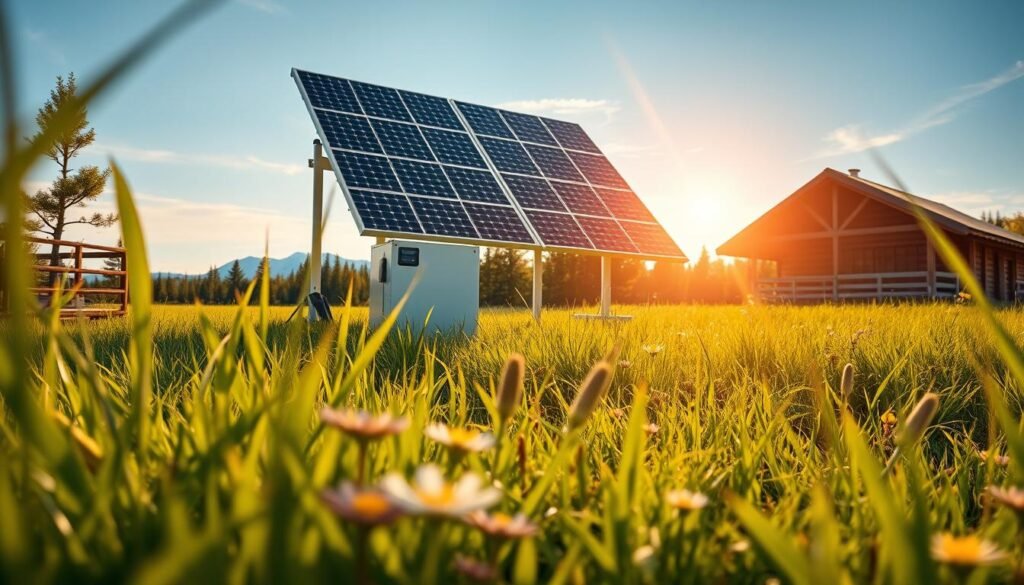
Solar panels are great because they can be used in many ways. You can have just one light for your shed or a whole system for your house. There are lights for paths, home kits, and even big lights for streets.
System Components Explained
Every off-grid solar light system has three key parts.
- Photovoltaic solar panels that capture sunlight and convert it to electricity
- Rechargeable battery storage, typically lithium-ion or LiFePO4 that holds energy for nighttime use
- Efficient LED fixtures that provide bright illumination while consuming minimal power
Types of Solar Lighting Systems Available
There are many options for different needs. Here’s a table showing your choices:
| System Type | Best For | Light Output | Coverage Area |
|---|---|---|---|
| Solar Post Lights | Garden pathways and deck edges | Low to medium | Individual spots |
| Pathway Markers | Walking routes and driveways | Low | Small focused areas |
| Home Lighting Kits | Complete residential properties | High | Entire property |
| Area Lights | Large yards or commercial spaces | Very high | Wide coverage |
| Streetlights | Remote roads and rural communities | Very high | Extended distance |
Knowing how these systems work helps you choose the right one. Think about how much light you need and how big your area is. Also, consider if you need the lights for a short time or forever.
The batteries, like lithium-ion or LiFePO4, decide how long your lights stay on. Good batteries keep your LED lights bright all night. This is why solar systems are great for places with a lot of power outages.
Your solar panels need little care and work well in all kinds of weather. They keep working every day, automatically, making off-grid lighting easy and reliable for remote places.
Zero Operating Costs: The Financial Advantage of Solar Lighting
Switching to solar lights for your remote property or off-grid location saves you money. You won’t have to worry about monthly electricity bills anymore. No more fuel purchases for generators or kerosene for lamps either.
This change helps your finances by cutting down on a big cost of off-grid living. Your wallet stays fuller because of it.
Calculating your current spending shows the real savings. Running a generator for lighting costs hundreds of dollars a year in fuel alone. Add delivery costs for remote locations, and your expenses go up even more.
Solar lights stop this financial bleeding. They require no ongoing maintenance contracts and no delivery charges for fuel to remote locations.
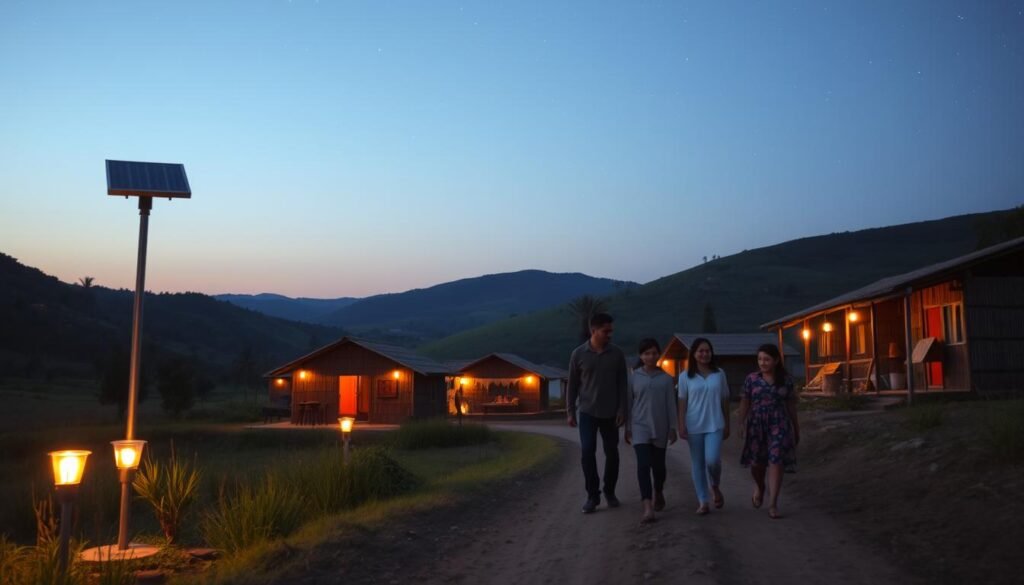
Eliminating Fuel Expenses in Remote Locations
Remote areas face unique challenges when buying fuel. Transportation costs are high because suppliers have to deliver to isolated places. You’ll save money by not spending on these deliveries.
Many families in off-grid communities spend $50 to $200 monthly on generator fuel and kerosene.
Solar lights work without any of these expenses:
- No diesel or gasoline purchases
- No kerosene lamp refills
- No delivery fees for fuel shipments
- No equipment repairs from fuel damage
- No storage containers or safety concerns
Return on Investment for Off-Grid Communities
Your initial investment is $200 to $500 per light fixture, depending on size and features. This cost goes away quickly through your savings. Solar lights last 3-5 years or longer and need no operational expenses.
Your payback period is usually 1-2 years, depending on your current costs.
| Cost Factor | Annual Generator Spending | Annual Solar Spending | Annual Savings |
|---|---|---|---|
| Fuel purchases | $400 | $0 | $400 |
| Delivery charges | $150 | $0 | $150 |
| Maintenance contracts | $100 | $0 | $100 |
| Electrician fees | $75 | $0 | $75 |
| Total Annual Costs | $725 | $0 | $725 |
You’ll get your money back through saved fuel costs, avoided electrician fees, and increased property value. A $400 solar light installation pays for itself in about 7-8 months when you spend $725 annually on traditional lighting. After that, every year is pure savings.
This section gives you the financial justification to switch. Solar lighting is not just good for the environment. It’s also smart for your wallet, saving you money every month.
Health and Safety Benefits of Solar Lights in Remote Areas
Living in a remote area without electricity means your lighting choices are key. Solar lights bring health and safety benefits that change lives. They offer safer, cleaner light that keeps your family safe from health risks.
Kerosene and paraffin lamps are dangerous. They release harmful fumes that can hurt your lungs. They also have open flames that can burn you, which is a big risk for kids. Solar lights get rid of these dangers. They let you breathe cleaner air and keep your family safe from fires.
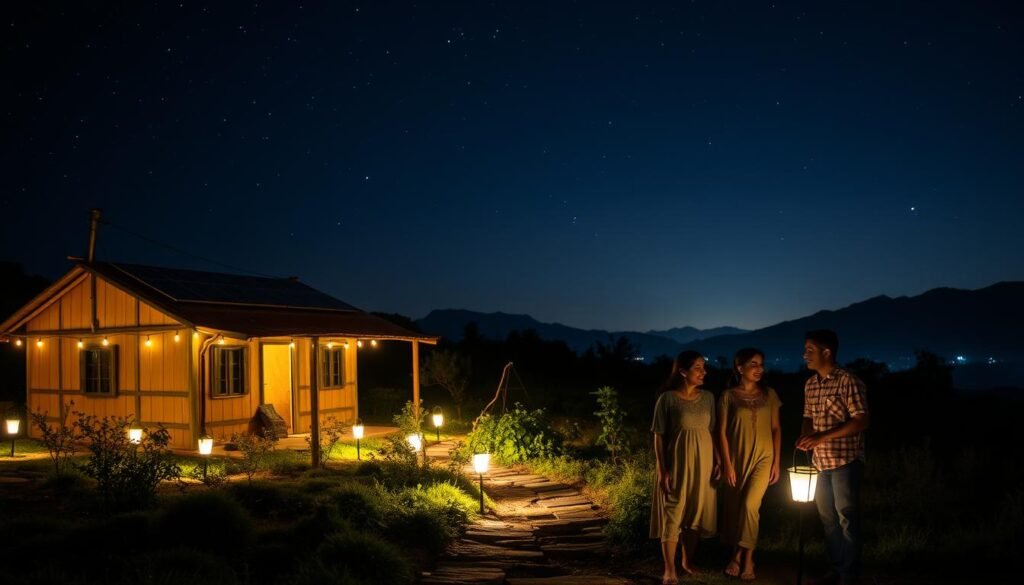
Good lighting makes you safer and helps you get medical help faster. You can walk safely at night without tripping. And, you can handle emergencies better with reliable light.
Key Health Improvements You’ll Experience
- Reduced respiratory infections from eliminating kerosene fume exposure
- Decreased burn injuries from removing open flame risks
- Better sleep patterns from reliable, consistent lighting
- Improved medication storage in cool, well-lit spaces
- Enhanced food safety through better food preparation visibility
Safety Advantages for Your Community
| Safety Factor | Kerosene Lighting | Solar Light Systems |
|---|---|---|
| Fire Risk | High – Open flames present | Zero – No combustion involved |
| Air Quality | Poor – Toxic fumes released | Excellent – Zero emissions |
| Eye Strain | Significant – Dim, flickering light | Minimal – Steady, bright output |
| Nighttime Visibility | Limited – Small radius | Excellent – Wide coverage |
| Chemical Exposure | Constant – Daily contact risk | None – No hazardous materials |
Switching to solar lighting makes your home healthier and safer. It removes dangerous elements and gives you better light for your daily life.
Solar Light Applications Across Different Remote Environments
Solar lighting is great for many remote settings. It’s perfect for managing a remote resort, camp, ranch, or off-grid home. This section helps find the right solar lighting for your needs. Each place has its own lighting needs that solar tech can meet affordably.
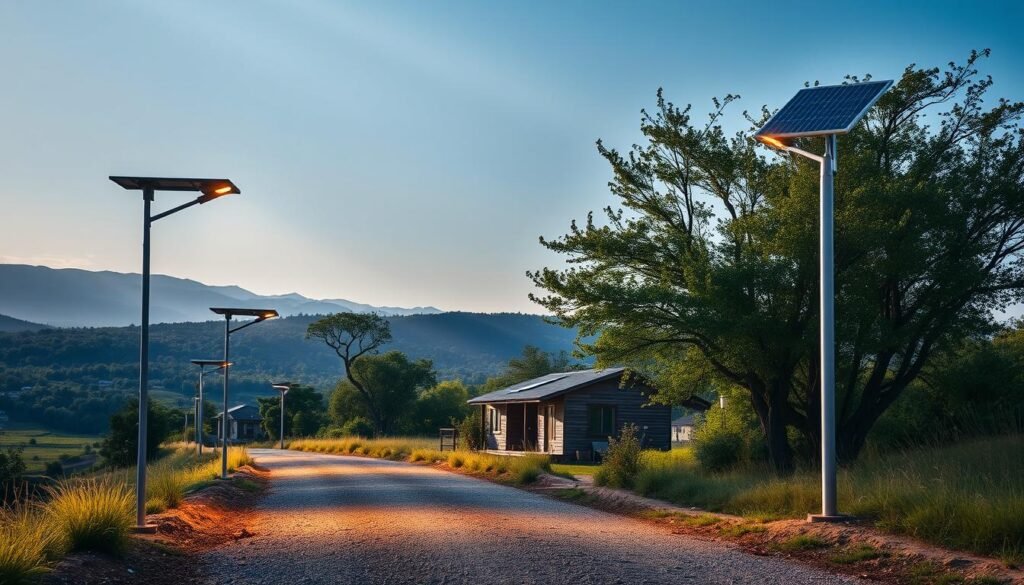
Remote areas face big challenges with lighting. Traditional power lines are too expensive and slow. Solar lighting solves these problems, bringing light to where it’s needed most.
Rural Healthcare Facilities and Medical Access
Healthcare in remote areas needs reliable lighting. Medical clinics and emergency rooms need steady power for equipment and patient safety. Solar garden lights with battery storage systems provide the reliable illumination needed without grid connections.
Good lighting is key for medical staff to work accurately. Emergency rooms need bright light for nighttime care. Solar systems offer backup power during grid failures, common in isolated areas. They work well in harsh weather and remote conditions.
Educational Opportunities in Off-Grid Communities
Schools in remote areas struggle without proper lighting. Students need bright spaces to study and learn. Solar lighting solutions extend school hours and make evening programs possible.
Pathway lighting for parks and recreational areas near schools makes walking to class safe. Security lighting for remote businesses or storage facilities protects school property and equipment. Illumination for agricultural operations requiring evening work also benefits rural school communities where farming is key.
- Classroom lighting that supports reading and writing activities
- Outdoor lighting for safe student pathways and playgrounds
- Evening study programs powered by solar energy
- Secure lighting around school buildings and equipment storage
Solar streetlights for community roads where trenching power lines is cost-prohibitive make travel safe. These lights reduce accidents and crime, supporting better academic outcomes in remote communities.
Energy Independence and Emergency Preparedness
Power outages are getting more common in the United States. Weather events are getting stronger, and the grid is aging. This means blackouts last longer. You need a backup plan that doesn’t rely on utility companies or fuel supply chains. Solar lighting offers you that independence and can also lower your monthly electricity costs.
Thousands of Americans are adding solar lighting as backup systems to their homes and properties. These solutions provide insurance against grid failures without the worry of running out of fuel or waiting for repairs. When you gain control over your essential services through energy independence, you stop depending on external power sources that could fail you when you need them most.
Your emergency preparedness strategy should include multiple types of solar lighting solutions. Consider positioning solar pathway lights to illuminate evacuation routes across your property. These lights guide people safely during darkness and emergencies without draining batteries or requiring electricity. Install solar floodlights for perimeter security during extended outages to keep your property visible and secure. Maintain solar lanterns for portable illumination during emergencies so you can move light wherever needed inside your home or yard.
| Solar Lighting Type | Primary Purpose | Backup Benefit | Maintenance Level |
|---|---|---|---|
| Solar Pathway Lights | Evacuation route illumination | Safe navigation during outages | Minimal |
| Solar Floodlights | Perimeter security lighting | Property protection during extended outages | Low |
| Solar Lanterns | Portable emergency lighting | Flexible illumination in multiple locations | Very low |
The autonomy that comes with solar lighting becomes increasingly valuable as climate change intensifies weather events. Your family gains peace of mind knowing you have independent power for essential lighting. A reliable solar generator with battery storage provides backup power that keeps your lights working through the longest outages.
You’ll discover that this independence works differently than traditional grid systems. No fuel deliveries needed. No scheduled maintenance appointments required. Your solar lights charge during daylight hours and deliver illumination when darkness falls. Even grid-connected properties benefit from this backup approach because it bridges the gap between a power failure and grid restoration.
- Position lights strategically along walkways and driveways
- Install high-powered options for security and visibility
- Keep portable units charged and ready for deployment
- Test your system monthly to ensure reliability
- Store backup units in accessible locations
This shift toward energy independence protects your household from the unpredictable nature of modern power systems. You stop worrying about blackouts affecting your safety or comfort. Solar lighting gives you the control that utility companies cannot guarantee anymore.
Environmental Impact: Reducing Carbon Emissions in Underserved Areas
Many communities use harmful lighting that hurts health and the planet. Solar lighting is a clean option that changes how areas light up. By using solar power, your community can avoid dangerous fuels and cut down on carbon emissions a lot.
Solar streetlights run on renewable energy, taking electricity off the grid. This move lowers your area’s energy use and makes the environment cleaner. The benefits of solar lighting go beyond just lighting up the night.
Replacing Dangerous Kerosene and Paraffin Lighting
Kerosene and paraffin lamps are bad for your health and the air. They release toxic fumes that can harm your lungs and pollute the air inside. Solar lighting gets rid of these dangers.
- Kerosene lamps release harmful carbon monoxide and nitrogen dioxide
- Paraffin smoke increases respiratory illness rates in children and adults
- Solar lights produce zero emissions and zero indoor air pollution
- LED fixtures in solar systems last over 20 years with minimal maintenance
Contributing to Sustainable Development Goals
Switching to solar lighting green urban development helps meet global sustainability goals. Replacing 1,000 streetlights with solar ones cuts down carbon dioxide emissions by about 400 metric tons. That’s like taking nearly 90 cars off the road each year.
| Impact Metric | Annual Benefit | Environmental Equivalent |
|---|---|---|
| CO₂ Reduction (1,000 lights) | 400 metric tons | 90 cars removed from roads |
| Battery Lifespan | 10+ years | Reduced waste and replacement |
| LED Fixture Lifespan | 20+ years | Lower maintenance emissions |
| Grid Independence | 100% renewable | Zero fossil fuel consumption |
Solar lighting makes the air cleaner in your neighborhood. DarkSky-approved lights reduce light pollution and protect nature. Your community can also save money on electricity and use it for green projects. These projects help the environment in underserved areas for a long time.
Real-World Success Stories from Africa and Southeast Asia
Solar lighting has changed lives worldwide, proving it’s the best for remote areas. The Ghana Energy and Development Access Project is a great example. It’s a $220 million effort that has powered schools, businesses, and parks in Ghana. This shows even big programs choose solar for remote electrification.
Numbers show solar’s impact. Over 450,000 people got better services from solar projects. And, 45,000 homes now have safe solar lighting. This has changed daily life and economic chances for many.
People really use their solar lights. A 97% retention rate after a year shows they’re happy. And, 98.4% use their lights every night for 3 hours. This shows it’s not just a gadget, but something people rely on every day.
Vietnam shows solar can grow with communities. Over 500 homes got solar systems, totaling 1.5MW. This shows solar works for both single homes and whole communities.
The Lao PDR villages of Ko Bong and Tha Phai Bai show real benefits. Students can do homework at night. Health centers work without power breaks. And, food stays fresh longer, improving health and food security.
| Region | Project/Location | Installation Scope | Key Achievement | User Impact |
|---|---|---|---|---|
| Ghana | Energy and Development Access Project | Schools, businesses, parks, recreation areas | $220 million initiative (2017-present) | 450,000+ people gained improved services |
| Vietnam | Residential solar systems | 500+ households | 1.5MW total capacity | Scalable from individual to community implementation |
| Lao PDR | Ko Bong and Tha Phai Bai villages | Residential and community facilities | Health centers, schools, food storage | Students study at night, uninterrupted medical care, food preservation |
| Pan-Africa/SE Asia | Multiple residential programs | Residential homes | 45,000+ homes with safe solar lighting | 98.4% use lights 3 hours nightly, 97% retention after one year |
Solar works in many climates, proving it’s reliable. Knowing solar works in hot and humid places, it will work in your area too. The tech that works in tough climates will work for you.
When picking battery storage, choose proven options. Lithium battery systems are reliable, lasting over 6000 cycles. They work with major inverters, fitting your location’s needs.
- 45,000+ homes now have safe solar lighting across Africa and Southeast Asia
- 98.4% of users operate lights nightly for approximately 3 hours
- 97% retention rate demonstrates exceptional user satisfaction
- Systems function reliably in tropical and arid climates
- Health centers, schools, and businesses operate independently from grid power
These stories show what solar can do for communities. Your remote American location can also enjoy independence, reliability, and life-changing benefits.
Installation Simplicity: No Trenching or Electrical Contractors Required
Setting up solar lighting is much simpler than traditional electrical systems. You don’t need to hire expensive electricians or worry about permits in most places. This makes solar lighting easy for anyone to use, no matter their skill level.
The process has just four steps. First, pick a spot that gets a lot of sunlight. Then, attach the fixture to a post or wall using the hardware provided. Make sure the solar panel faces south (in the Northern Hemisphere) for best sun exposure. Lastly, turn it on and you’re all set.
The biggest plus is not needing to wire or dig trenches. You can light up areas that are too hard or expensive to wire. This is great for places like parks, beaches, trails, or remote areas where digging would harm the land or hit bedrock.
Solar systems are flexible, unlike permanent wiring. You can move lights if your needs change, which is hard with wired systems. Plus, you can add lights bit by bit as you can afford it, without a big electrical project.
Doing it yourself saves a lot of money. You avoid the high costs of hiring electricians for traditional lighting. This guide shows you can do it yourself, no matter your skill level.
- Choose locations with maximum daily sunlight
- Use included mounting hardware for secure installation
- Position solar panels toward the south for optimal performance
- Activate the system and begin enjoying instant illumination
- Add more fixtures whenever your budget permits
- Relocate lights without professional help or extra costs
Solar lighting makes it easy to add light to your outdoor spaces. You can control your lighting without waiting for contractors or planning big electrical projects.
Conclusion
Solar lighting for remote areas is not new or experimental. The World Bank and United Nations see it as the best way to bring electricity to remote places. With hundreds of thousands of successful setups around the world, your choice is backed by proven reliability.
Choosing solar lighting means you get many benefits. You won’t have to pay for electricity after you install it, saving you money. It also means no more health risks from burning fuels, keeping your family safe.
Installing solar lighting is easy, even without professional help. This saves you a lot of money. Plus, it keeps your lights on when the power goes out, giving you peace of mind. It’s also good for the planet, reducing harmful emissions and fossil fuel use.
The technology keeps getting better every year. Solar panels capture more light, even on cloudy days. Batteries last longer and charge faster. You can also control your lights better with smart controls.
LED lights get brighter and use less power. The system you buy today will be great, and it will only get better if you add more later. Solar lighting is perfect for your remote cabin, off-grid home, or any place far from the grid.
It’s a reliable, cost-effective, and sustainable choice. Now you know what to choose for your remote area needs with confidence.