Today, companies in the United States have a big choice to make. They can invest in sustainable assets to cut down on costs over time. Solar energy systems are a steady way to grow and get stronger.
The move to Renewable Energy lets businesses secure power rates for years. Using Commercial Solar tech also cuts down on carbon emissions. This choice meets today’s green goals and investor needs.
Smart leaders see this move as more than just being green. It’s a key to financial stability and tax savings. Now is the perfect time to get these clean energy systems for your business.
Key Takeaways
- Substantial cuts in monthly utility expenses for large facilities.
- Protection against rising grid electricity prices over the long term.
- Significant federal tax credits and local financial incentives.
- Improved brand reputation for environmental stewardship and leadership.
- Increased property value for owned commercial buildings and sites.
- Rapid return on investment through optimized power consumption.
1. The Rising Cost of Traditional Energy for American Businesses
American businesses are facing a big challenge with the rising cost of traditional energy. The cost of using old energy sources is going up. This is hurting the profits of companies in many industries.
Commercial Electricity Rates Continue Climbing Nationwide
Electricity costs for businesses are going up all over the United States. This increase is caused by many things. These include the cost of building and fixing the grid, changes in rules, and more people using electricity.
Some main reasons for the increase in electricity costs for businesses are:
- Higher costs for fuel and making electricity
- The need to update old grid systems
- Following new environmental rules
Peak Demand Charges Drastically Increase Operating Expenses
Peak demand charges are a big problem for businesses. These charges happen when a lot of electricity is used at once. This usually happens on very hot summer afternoons.
Unpredictable Energy Costs Threaten Budget Stability
Unstable energy costs can make it hard for businesses to keep their budgets steady. With traditional energy, companies face ups and downs in the energy market. This makes it hard to plan and control energy costs.
The main problems with unstable energy costs are:
- It’s hard to plan for energy costs
- There’s more risk because of price changes
- There can be sudden big increases in costs
2. Immediate and Long-Term Cost Savings with Solar Energy
Businesses can save a lot by using solar energy. They can cut down on energy costs. This makes their finances more stable.
Slash Monthly Energy Bills by 50-75 Percent
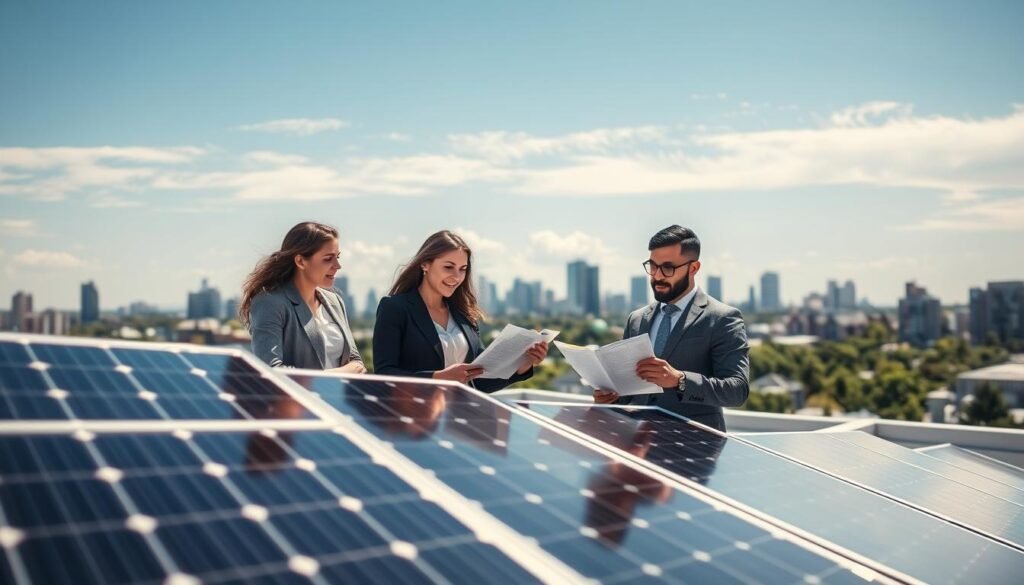
Solar energy can cut monthly bills by 50-75 percent. This is because companies make their own electricity. They don’t have to buy as much from the grid.
The exact savings depend on the solar system size, sunlight, and current energy use.
Lock in Predictable Energy Costs for 25-30 Years
Solar energy means stable energy costs for 25-30 years. Solar panels come with long warranties. The energy cost is fixed at installation.
This helps businesses budget better. They won’t worry about rate changes.
Eliminate Exposure to Future Utility Rate Hikes
Switching to solar protects against rate hikes. As rates go up, solar users stay the same. This is a big financial win.
It’s great for companies with thin profit margins.
Generate Revenue Through Net Metering Programs
Businesses can also make money with solar. Net metering lets them sell extra energy back to the grid. This lowers their costs even more.
Net metering rules vary by area. But it’s a good way for solar businesses to earn extra.
3. Federal Tax Credits and Financial Incentives Maximize Savings
Solar energy investments get a big boost from federal tax credits and incentives. The U.S. government offers financial help to encourage businesses to use solar energy. This makes the initial costs lower and improves the investment’s return.
30% Investment Tax Credit Reduces Upfront Costs
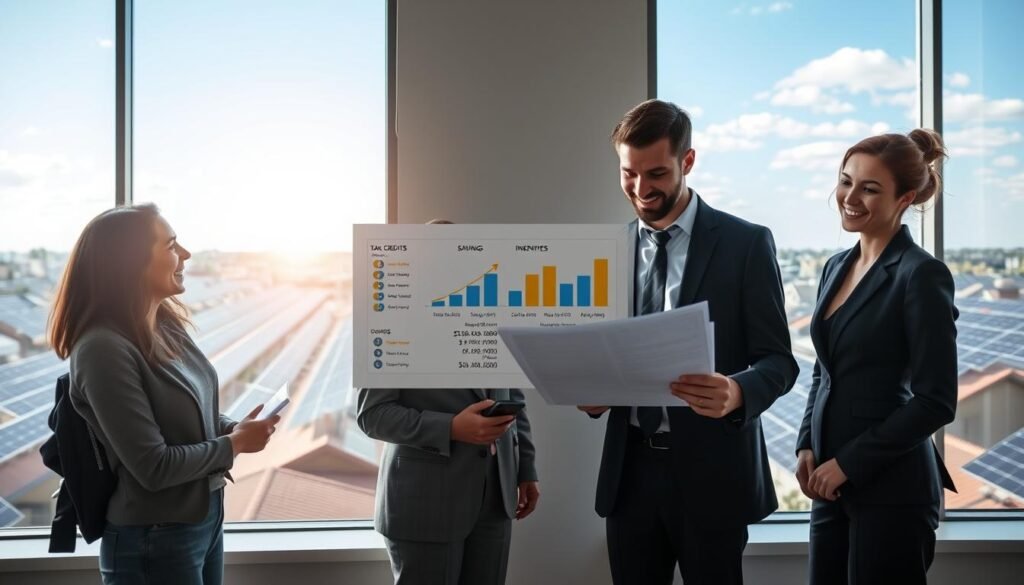
The government gives a 30% Investment Tax Credit (ITC) for solar energy investments. This credit lowers a business’s tax liability, cutting down the costs of installing solar panels.
For example, a $1 million solar investment can get a $300,000 tax credit. This makes the initial cost much lower.
MACRS Depreciation Accelerates Tax Benefits
Businesses also get benefits from the Modified Accelerated Cost Recovery System (MACRS) depreciation. This lets companies write off the solar system in just five years, speeding up tax benefits.
Writing off the asset quickly means lower taxes in the early years. This helps businesses save money right away.
State-Level Rebates and Local Utility Incentives
States and local utilities also offer rebates and incentives for solar energy. These can include cash rebates, property tax exemptions, and more. They help lower the cost of solar systems even more.
- State rebates can differ a lot, so it’s key to check what’s available in your area.
- Local utilities might offer extra incentives, like net metering programs. These let businesses sell extra energy back to the grid.
Renewable Energy Certificates Create Additional Revenue
Businesses that use solar energy can sell Renewable Energy Certificates (RECs). RECs are like green badges for one megawatt-hour of clean energy. They can be sold to companies wanting to reduce their carbon footprint.
This extra income can make solar energy investments even more attractive. It gives businesses another reason to choose renewable energy.
4. Exceptional Return on Investment for Commercial Solar
Businesses gain a lot from using commercial solar energy. They save money, increase their property value, and get a better reputation.
Average ROI Ranges from 20-30% Annually
Investing in commercial solar can bring in 20-30% ROI each year. This is because of big savings on energy costs and money made through net metering.
- Reduced energy bills by 50-75%
- Predictable energy costs for 25-30 years
- Elimination of exposure to future utility rate hikes
Payback Periods of 3-7 Years Across Industries
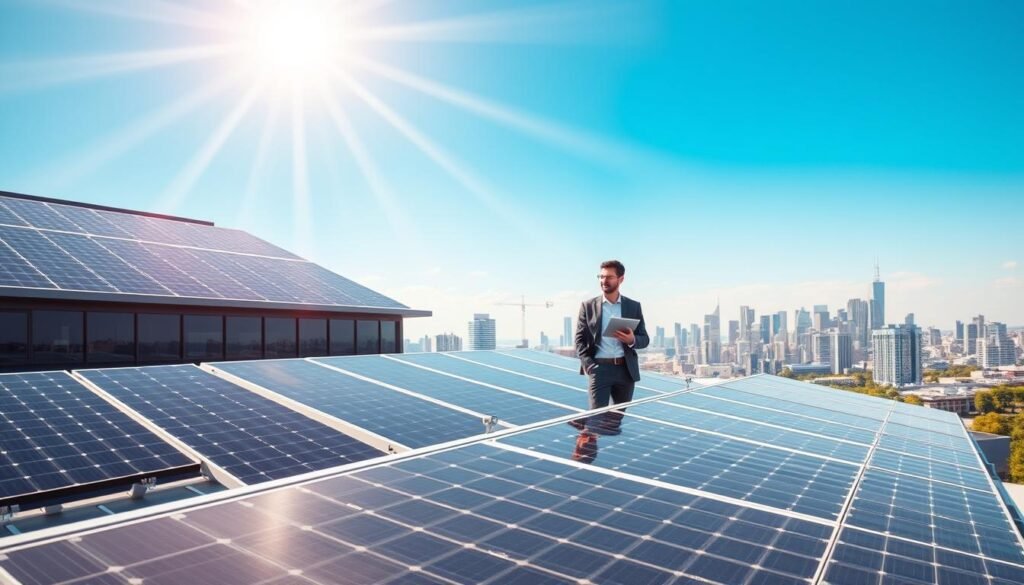
The time it takes to get back the investment in commercial solar is 3-7 years. This is true for many industries. Businesses can get their money back in a short time.
Cash Flow Positive from Day One with Financing
With different financing options, businesses can start making money from solar right away. This is thanks to things like power purchase agreements (PPAs) and solar leases.
- Zero upfront costs with PPAs and solar leases
- Immediate savings on energy bills
- Opportunity to invest in other areas of the business
5. Boost Property Value and Create Tangible Assets
Businesses can boost their property value by using solar energy. Solar installations provide clean energy and increase property value in many ways.
Commercial Properties with Solar Command Premium Prices
Studies show that commercial properties with solar installations get higher prices. This is because solar energy systems are seen as valuable upgrades. They reduce operating costs and make the property more appealing.
Some key benefits include:
- Reduced energy costs through on-site generation
- Predictable energy expenses due to fixed solar panel maintenance costs
- Enhanced appeal to environmentally conscious tenants and buyers

Solar Systems Add Quantifiable Balance Sheet Value
Solar energy systems are tangible assets that increase a company’s balance sheet value. This is key for businesses wanting to improve their finances and attract investors.
The value comes from:
- The initial investment in the solar energy system
- The long-term savings from reduced energy costs
- The revenue from net metering programs
Attractive Feature for Tenants and Future Buyers
Solar energy makes commercial properties more appealing. This is true in today’s market, where going green is important.
Key features include:
- Reduced energy costs and increased energy independence
- Enhanced brand reputation through renewable energy adoption
- Compliance with environmental regulations and sustainability goals
6. Strengthen Your Brand and Meet Sustainability Goals
As people care more about the environment, businesses using solar energy can boost their brand. This move towards green practices comes from consumer demand, laws, and a wish for a better future.
Align with Consumer Preferences for Green Businesses
More and more, people want to support companies that care about the planet. By using solar energy, businesses can show they’re committed to being green. This makes their brand stronger and keeps customers loyal.
A Nielsen study showed 81% of people think companies should help the environment. Using solar energy is a clear way for businesses to show they care about the planet.
Achieve Corporate ESG and Net-Zero Commitments
Many big companies aim to be carbon neutral and follow ESG goals. Solar energy helps them by cutting down on fossil fuel use and emissions.
| ESG Criteria | How Solar Energy Helps | Benefits |
|---|---|---|
| Environmental | Reduces carbon footprint | Lower emissions, improved air quality |
| Social | Demonstrates commitment to sustainability | Enhanced brand reputation, customer loyalty |
| Governance | Transparent reporting of sustainability efforts | Better governance, regulatory compliance |
Gain Competitive Edge in Sustainability-Focused Markets
Companies using solar energy stand out in a crowded market. By showing they care about the planet, they attract eco-conscious customers. This gives them an edge over others.
Qualify for Green Business Certifications
Using solar energy can make businesses eligible for green certifications like LEED or B Corp. These certifications boost a company’s image and open up new chances for growth.
By choosing solar energy, businesses can improve their brand, meet their green goals, and help make the world a greener place.
7. Achieve Energy Independence and Operational Resilience
Using solar energy, businesses can boost their resilience and gain energy independence. This is key in today’s world, where reliable energy is vital for keeping operations running smoothly and profits high.
Reduce Reliance on Aging Grid Infrastructure
The U.S. grid is getting old and worries businesses that need steady power. Solar energy is a good alternative, letting businesses make their own power. This cuts down on the risk of power cuts and protects against grid problems.
Maintain Operations During Power Outages with Battery Backup
Solar energy is great because it keeps businesses running even when the power goes out. With battery backup, businesses can keep working without pause, even when the grid fails. For example, companies can get solar energy solutions with batteries for a steady power source.
Lower Peak Demand Charges Through Self-Generation
Peak demand charges can really raise a business’s energy bills. Solar power lets businesses make their own energy, cutting down on these charges. This way, businesses can control their energy costs better and plan their finances more easily.
Hedge Against Energy Market Volatility
Energy market ups and downs can hurt businesses, but solar energy helps. It lets businesses make their own power at a set cost. This makes energy costs stable, helping businesses budget better and invest in other areas.
| Benefits | Description | Impact on Business |
|---|---|---|
| Reduced Reliance on Grid | Generate own power, reduce dependence on aging infrastructure | Enhanced operational resilience |
| Battery Backup | Maintain operations during power outages | Uninterrupted business continuity |
| Lower Peak Demand Charges | Self-generate energy to reduce peak demand | Significant cost savings |
| Hedge Against Volatility | Fixed energy costs through solar generation | Improved financial predictability |
8. Commercial Solar System Options for Every Business Type
Commercial solar energy solutions vary to fit different businesses. They cater to different needs, spaces, and budgets. This variety helps businesses pick the best option for them.
Rooftop Solar Panels Maximize Existing Space
Rooftop solar panels are great for using existing space. They let businesses make clean energy without needing more land.
Ideal for Warehouses, Retail Centers, and Office Buildings
Warehouses, retail centers, and office buildings with big rooftops are perfect for rooftop solar. They have lots of space for solar energy.
Minimal Land Requirements
Rooftop solar is great because it doesn’t need extra land. This is perfect for businesses in busy areas where land is hard to find.
Ground-Mounted Solar Arrays for Large-Scale Generation
Ground-mounted solar arrays are good for businesses with lots of land or big energy needs. They can be made to fit large operations.
Perfect for Manufacturing Facilities and Industrial Parks
Manufacturing facilities and industrial parks with lots of land are great for ground-mounted solar arrays. They help meet the high energy needs of these places.
Solar Carports Provide Dual Benefits
Solar carports are innovative. They make clean energy and provide shade for cars. This makes them a good choice for businesses wanting to add value.
Employee and Customer Parking Shade
Solar carports offer shaded parking for employees and customers. This improves their experience.
EV Charging Station Integration
Solar carports can also have EV charging stations. This supports businesses that want to be green and serve electric vehicle owners. For more info, visit Aisen Solar Energy.
Battery Energy Storage Systems
Battery energy storage systems are key for modern solar setups. They store extra energy for use when sunlight is low or at night.
24/7 Solar Power Availability
With battery storage, businesses get solar power all day, every day. This boosts their energy independence and cuts grid use.
Demand Charge Reduction Capabilities
Battery systems also cut demand charges. They store energy when it’s cheap and use it when it’s expensive. This lowers energy costs.
9. Flexible Financing Solutions Make Solar Accessible
Flexible financing options have opened the door for companies of all sizes to switch to solar energy. Businesses can pick from various choices that fit their budget and needs.
Direct Purchase for Maximum Long-Term Savings
Buying the solar system outright is called direct purchase. It leads to the biggest savings over time. Businesses can also get tax breaks and rebates.
Commercial Solar Loans Preserve Working Capital
Commercial solar loans let businesses fund their solar systems without using up cash. These loans have good interest rates and flexible payback plans.
Power Purchase Agreements Eliminate Upfront Costs
Power Purchase Agreements (PPAs) mean businesses can start using solar with little to no initial cost. A third-party owns and looks after the system. The business buys the electricity at a set price.
Solar Leases Provide Immediate Savings
Solar leases let businesses lease systems for a set monthly fee. This way, they save on energy bills right away without a big upfront payment.
PACE Financing Through Property Tax Assessment
Property Assessed Clean Energy (PACE) financing lets businesses fund solar systems through property taxes. It offers long-term financing with good terms.
Here’s a quick look at the different financing options:
| Financing Option | Upfront Costs | Long-Term Savings | Ownership |
|---|---|---|---|
| Direct Purchase | High | High | Business |
| Commercial Solar Loans | Low | High | Business |
| Power Purchase Agreements | Low | Medium | Third-Party |
| Solar Leases | Low | Medium | Third-Party |
| PACE Financing | Low | High | Business |
10. Your Roadmap to Commercial Solar Implementation
The journey to commercial solar involves several critical steps. These steps help businesses navigate the process efficiently.
Step 1: Request a Professional Solar Assessment
The first step is to request a professional solar assessment. This assessment evaluates your business’s energy needs. It determines if a solar installation is feasible.
- Evaluate your current energy usage and costs
- Assess your property’s solar capacity
- Identify possible savings and incentives
Step 2: Review Customized Proposals and Financial Projections
After the assessment, you’ll get customized proposals and financial projections for your project.
These documents will show the costs, savings, and return on investment (ROI) for your solar installation.
Step 3: Select an Experienced Commercial Solar Contractor
Choosing the right solar contractor is key for your project’s success.
Look for contractors with experience in commercial solar installations and a good track record.
- Check for certifications and licenses
- Review past projects and customer testimonials
- Compare quotes and services offered
Step 4: Navigate Permits and Interconnection Approvals
Once you’ve chosen a contractor, navigate the permitting and interconnection process.
This involves getting necessary permits and approvals from local authorities and your utility company.
Step 5: Monitor Installation Timeline and System Commissioning
After permits are secured, the installation starts.
Monitor the progress to ensure it meets the projected timeline and budget.
The final step is system commissioning, where the solar installation is tested and activated.
Ongoing Monitoring and Minimal Maintenance Requirements
After commissioning, your solar system needs minimal maintenance.
Ongoing monitoring is key to ensure optimal performance and address any issues promptly.
11. Conclusion
Investing in solar energy helps businesses save money and boost their image. It also supports a greener future. The perks of solar power are many, like cutting electricity bills by up to 90% and raising property value.
The solar market is growing, creating more jobs. This means businesses can make a big difference. Solar tech is getting better, making it easier for companies to cut down on carbon emissions.
Businesses can use special financing options to go solar. This makes it easier to start using solar energy. By doing so, they can lower their energy costs, be more eco-friendly, and improve their reputation.