
Solar-powered lighting has changed a lot by 2025. Now, your area can use green alternatives to old grid systems. These new systems save money on digging and cut down on your energy bills.
Your public areas need light that’s always on. Solar light tech now offers top-notch performance without the high costs of old electrical systems. You get steady light, even when the power goes out.
The world of solar street lights has grown a lot. You can find many types of lights for different places. Whether it’s a university, park, or home path, there’s a solar lighting solution for you.
Outdoor solar lighting is now a smart, affordable choice for 2025. Choosing solar lights helps the planet and saves you money. These systems are easy to set up and don’t need the grid.
Knowing your solar lighting options starts with seeing how they meet your needs. Your budget, how big the area is, and how bright you need it will help pick the right solar system.
Key Takeaways
- Solar street lights cut down on digging costs and lower energy bills by using the sun’s power
- They don’t need complicated wiring, making them perfect for hard-to-reach places
- They have built-in batteries to keep the lights on at night using sun power
- They’re made to last, even in bad weather, keeping important parts safe
- Motion sensors and automatic turn-on save energy and make life easier
- Solar lights are reliable for streets, parks, parking lots, and public areas everywhere
- They’re great for places far from power lines, where old systems can’t reach
Why Solar Light Solutions Are Transforming Public Spaces in 2025
Your city or commercial property needs to cut costs and meet green goals. Solar powered lights are a smart answer to both. They save money on installation and monthly bills by not needing underground wiring or grid connections.
Solar lights keep areas well-lit, even when the power is out. This is key for keeping people safe in busy places and during emergencies. It means streets, parks, and paths stay lit when they’re needed most.
Using solar lights means no more yearly costs that eat into your budget. You won’t have to pay for electricity every month. Plus, they’re built to last, with designs that stop thieves and damage.
They also come with new battery tech that lasts for days, even on cloudy days. This means they work well, even when it’s not sunny.
Your team will see big wins that get approval from everyone:
- Zero energy bills and lower costs for grid setup
- Less upkeep needed because they’re built to last
- They work on their own, keeping people safe
- They help meet green goals
- Long battery life means less work for you
Public works leaders across the U.S. are choosing solar for new and old projects. Investing in solar lights means big savings and safety for your community. It doesn’t mean giving up on quality or reliability.
Understanding the Core Types of Solar Pathway and Street Lighting Systems
Solar light fixtures come in three main types. Each type has its own way of combining or separating parts. Your choice depends on your site, budget, and how fast you need it installed. Knowing these types helps you choose the best for streets, parks, and pathways.
The way parts are arranged affects costs and upkeep. Some systems need more work to install. Others are quicker. Learning about each type helps you make informed decisions for new or updated projects.
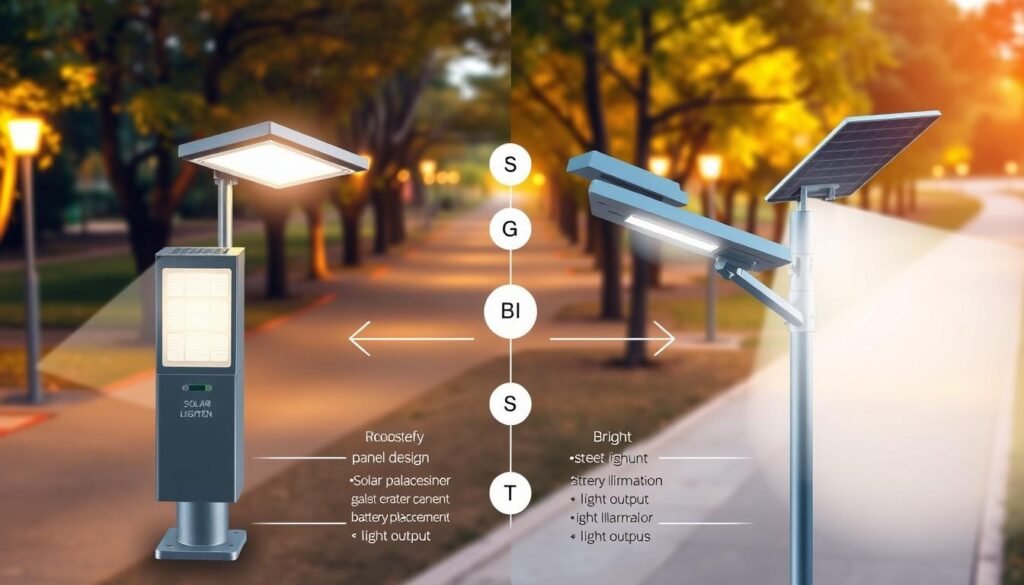
Split Solar Street Light Systems
Split solar lighting systems have all parts separate. The solar panel goes on top of a pole. The battery and controller are in a cabinet below. The LED lamp is attached to the fixture head.
This design is great for busy areas needing lots of light. You can update parts without replacing the whole system. But, it takes longer to install because of the extra wiring.
All-in-One Integrated Solar Fixtures
All-in-one solar lights put everything in one unit. The solar panel, battery, controller, and LED are all together. You just mount it and it works right away.
These units are quick to install and save on labor costs. They’re best for areas needing less light. Their compact design fits well in tight spaces.
All-in-Two Solar Lighting Solutions
All-in-two solar lights have the battery and LED together but the solar panel separate. The panel connects to the light unit with a cable. This design offers both simplicity and flexibility.
They install faster than split systems. The separate panel allows for better sun exposure. All-in-two lights are good for most homes and businesses.
| System Type | Component Configuration | Installation Time | Best For |
|---|---|---|---|
| Split Solar Lighting Systems | All components separate | 3-4 hours per unit | High-brightness commercial areas |
| All-in-One Solar Lights | All integrated in one unit | 15-30 minutes per unit | Low-to-medium brightness pathways |
| All-in-Two Solar Lights | Battery and LED combined, panel separate | 1-2 hours per unit | Residential and mixed-use spaces |
Each type of solar light fixture meets different needs. Your site, light needs, and budget guide your choice. Think about maintenance access and future upgrades when deciding.
Solar Bollard Pathway Lights for Residential and Hospitality Settings
Solar bollard lights are perfect for adding safety and beauty to outdoor areas. They are 2 to 4 feet tall, making them great for welcoming paths. With 100 to 400 lumens, they fit various path sizes and light needs.
These lights provide focused, downward light that avoids glare and light spill. This keeps the light on the path. They’re great for places like resorts, homes, hotels, and corporate areas where looks and function are key.
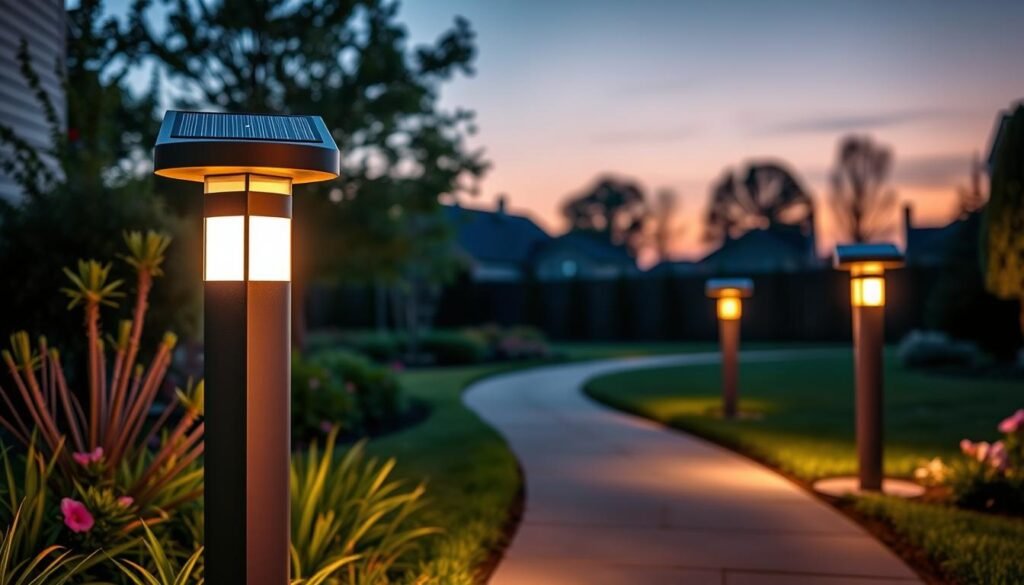
Space your solar lights 15 to 20 feet apart on 8-foot-wide paths. This ensures even light and meets safety rules. Their low height also cuts down on wind and vandalism risks.
Solar bollard lights make your project ADA compliant right away. They light the way for those with mobility issues and avoid tripping hazards. Plus, they boost your property’s look and appeal.
Check out Gama Sonic’s Vantage Bollard Solar Pathway for a stylish, functional option. It has automatic on/off, warm light, and durable aluminum.
- Height range of 2 to 4 feet for optimal pedestrian visibility
- Lumen output between 100 and 400 for flexible pathway coverage
- Glare-free, downward-directed illumination design
- Full ADA compliant lighting for accessibility standards
- Spacing recommendations of 15 to 20 feet for uniform light distribution
- Reduced wind loading and vandalism concerns
- Enhanced property aesthetics and landscape integration
Choosing solar pathway lights boosts your property’s value and guest happiness. Bollard lights offer controlled light, beauty, and fit well with your landscape.
Post-Top Commercial Solar Path Lights for Wide-Area Coverage
Post-top solar lights are the top choice for outdoor areas needing top-notch lighting. They are mounted 8 to 12 feet high. This height gives wide coverage to paths, plazas, and open spaces.
These lights are made for public spaces. They produce 800 to 1,000 lumens. This means you can light up more areas with fewer lights, saving money upfront and over time.
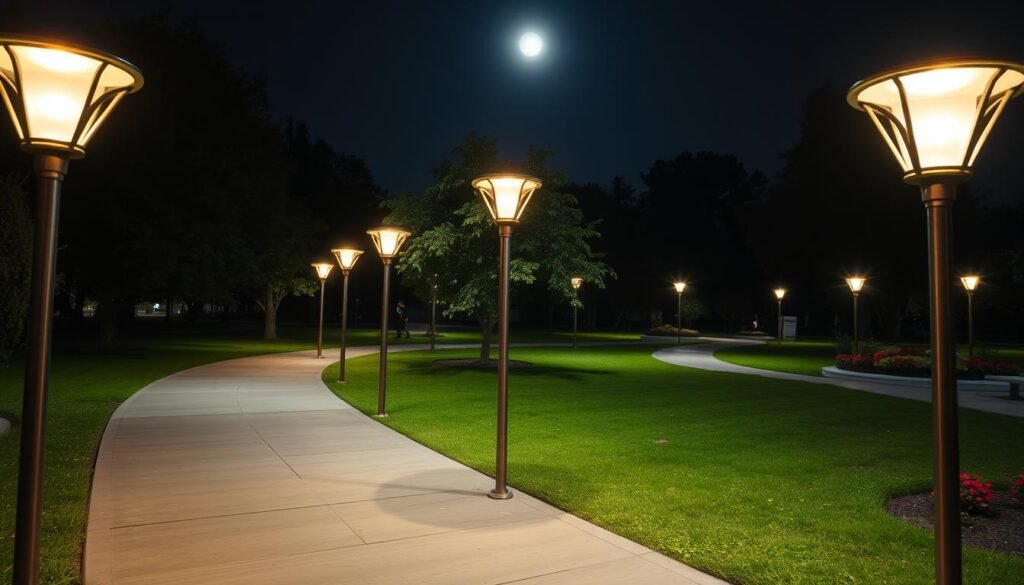
The high mount ensures even light distribution. This means no dark spots or shadows that could be dangerous. It also meets most city lighting standards.
Ideal Applications for Universities and Municipal Projects
Universities, parks, and public areas benefit a lot from these lights. They are perfect for busy areas. Universities use them for safe paths at night. Municipal areas use them for safe walking paths and parks.
Choosing these lights for public projects is smart. They work well in different areas. They light up paths and landscapes, making places safe and welcoming at night.
The best-selling solar garden light solutions have advanced designs. They are waterproof and work well all year.
Brightness and Coverage Specifications
Knowing the details of your lighting system is key. Post-top solar lights offer big advantages in coverage. They are more efficient than other options.
| Fixture Type | Mounting Height | Lumen Output | Coverage Area | Fixtures Needed (per 500 feet) |
|---|---|---|---|---|
| Post-Top Solar | 8-12 feet | 800-1,000 lumens | Broad, uniform | 6-8 units |
| Bollard Pathway | 2-3 feet | 200-400 lumens | Limited, concentrated | 15-20 units |
| In-Ground | Ground level | 100-250 lumens | Very limited | 20-25 units |
- Approximately 60% fewer fixtures required compared to bollard installations
- Reduced procurement and installation costs across municipal solar lights projects
- Lower long-term maintenance burden due to fewer units to monitor
- Superior light uniformity that eliminates dark zones
- Enhanced safety through consistent brightness levels
- Professional appearance suitable for institutional and public spaces
Choosing commercial solar lighting with post-top design is smart. It ensures you get the coverage you need for large outdoor areas. These lights are the go-to for keeping public spaces safe and well-lit.
In-Ground Solar Pathway Lighting for Architectural Design
In-ground solar lights are perfect for adding light to your outdoor space without being seen. They blend into the ground, creating a clean look. This makes them ideal for projects where looks are key.
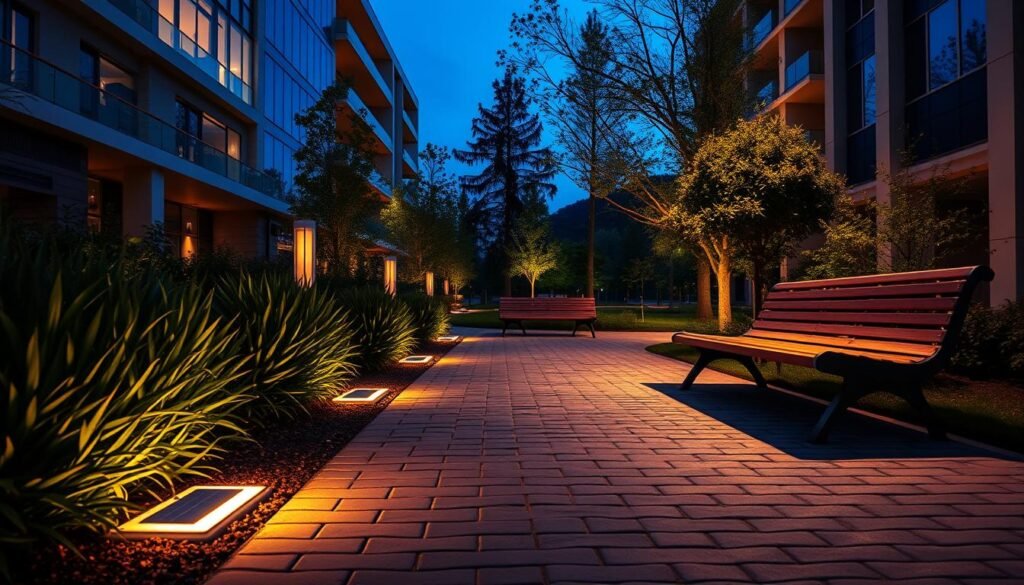
These lights give off 50 to 150 lumens, which is enough for guiding and adding ambiance. They’re great for places like hotel courtyards and luxury homes. They work well where you don’t want to block views.
These fixtures offer many benefits for your designs:
- Fully ADA compliant with no protruding elements that create tripping hazards
- Disappear into walkways and patios while providing elegant accent lighting
- Ideal for historically sensitive locations where modern fixtures would clash
- Impact-resistant ratings ensure durability in high-traffic pedestrian areas
- Require minimal maintenance once properly installed
When picking flush-mount solar lights, consider how to install them. You’ll need to prepare the surface well, ensure good drainage, and get enough sunlight. For more info, check out this guide on models and installation.
Opt for in-ground solar pathway lighting for a design that’s both subtle and elegant. They’re invisible during the day but light up your space beautifully at night. This guides visitors through your space in a stylish way.
Comparing Lumens, Mounting Heights, and Coverage Areas
Choosing the right solar light involves understanding brightness, height, and coverage. Different lights have varying brightness levels based on their design and placement. You must decide between bollard lights, post-top fixtures, and in-ground systems based on your needs.
Brightness Requirements for Different Applications
The right brightness keeps people safe without wasting energy. Bollard lights, 2 to 4 feet tall, produce 100 to 400 lumens. They’re great for small pathways. Post-top fixtures, 8 to 12 feet high, give 800 to 1,000 lumens for public areas. In-ground lights, 50 to 150 lumens, are for accents.
Pathway width determines the best fixture type. Narrow paths use bollards 15 to 20 feet apart. Wider areas need post-top fixtures 40 to 50 feet apart. Post-top systems cover 20 to 30 foot circles, while bollards light 6 to 10 foot wide paths.
| Fixture Type | Mounting Height | Light Output (Lumens) | Coverage Diameter | Spacing Recommendation | Best Use Case |
|---|---|---|---|---|---|
| Bollard Lights | 2-4 feet | 100-400 lumens | 6-10 feet wide | 15-20 feet | Pedestrian pathways and gardens |
| Post-Top Fixtures | 8-12 feet | 800-1,000 lumens | 20-30 feet diameter | 40-50 feet | Public parks and university campuses |
| In-Ground Lights | Flush to ground | 50-150 lumens | Accent only | 8-12 feet | High-design installations and borders |
For a 1,000 foot pathway, fixture count varies by type. Bollard systems need 50 to 65 units. Post-top fixtures require 20 to 25 units. In-ground accents need 80 to 125 units for visual guidance.
ADA Compliance and Safety Standards
Public spaces must meet ADA standards for safe navigation. Adequate lighting prevents trips and falls. The Illuminating Engineering Society sets minimum brightness levels for different spaces.
Mounting height affects safety and perception. Fixtures too high create shadows and uneven lighting. Bollards at 2 to 4 feet eliminate glare and light ground surfaces well. Post-top installations at 8 to 12 feet must maintain adequate spacing to prevent dark zones.
- Install lights uniformly across entire pathway to eliminate dark spots
- Place fixtures to avoid glare in pedestrian eye line
- Use mounting height specifications appropriate for space width
- Maintain consistent lumens output along entire route
- Test coverage area calculations before final installation
- Document compliance with local building codes and ADA standards
Your project budget affects fixture selection. While individual post-top units cost more, fewer pieces mean lower total expense. In-ground accents offer low-profile design but need careful lumens comparison to ensure visibility. Balance upfront costs with maintenance demands and long-term performance when making your decision.
Installation Advantages and Long-Term Cost Benefits
Solar installation offers many benefits beyond just the lights. Choosing solar pathway lighting means no need for expensive setup like traditional systems. This saves a lot of money on labor and equipment.
Traditional AC lights need a lot of prep work before they can be installed. You have to dig up paved areas, rent heavy equipment, and fix the pavement later. You also need to install wiring, get permits, and schedule inspections. This can take 2-3 weeks and cost $15,000-25,000 before you even buy a light.
Solar lights are different. They can be installed on existing poles or surfaces without digging. This process takes only 2-3 days. You also avoid delays and disruptions that worry managers at schools and hospitals.
Calculating Your Real Savings
Energy savings are a big plus in the long run. Let’s look at the numbers:
- Traditional AC lights cost $50-150 a year per fixture in energy bills
- Solar lights use no energy, so they cost nothing to run
- Over time, solar lights save you more and more money
- They need little maintenance, just occasional cleaning
Most commercial solar setups pay off in 3-5 years. With a 15-20 year lifespan, you get 10-17 more years of savings. This means no energy costs for a long time.
Durability, Maintenance, and Battery Longevity Considerations
Investing in solar pathway lighting means understanding its long-term performance. It’s not just about the lights themselves. You must consider weather resistance, battery life, and maintenance needs. Luckily, modern systems are built to last, with minimal upkeep required from trusted brands like Aisen Solar Energy.
Most pathway lights use advanced lithium iron phosphate batteries. These batteries last five to seven years before needing a replacement. The good news is that you only need to replace the battery, not the whole light. This keeps costs down and makes maintenance easy. Premium systems can last ten years or more with proper care.
Keeping your system in good shape is simple. Clean your solar panels two or three times a year. Dust can reduce efficiency and performance. Annual checks can catch physical damage early. Every two to three years, have a technician test your battery to ensure it’s working right.
Weather Protection and Impact Resistance Ratings
When choosing outdoor lights, look at protection ratings. Weather-resistant lights must meet at least IP65 standards. This means they’re dust-sealed and can handle water jets from any direction. In areas with heavy storms, look for IP66 or IP67 ratings for extra protection.
Impact resistance is also key. An IK08 rating means your light can withstand five joules of impact. This protects against accidental damage and vandalism. UV-resistant materials prevent yellowing and cracking. Corrosion-resistant coatings keep metal parts safe in coastal areas. Thermal management systems protect batteries from extreme temperatures.
| Protection Rating | Weather Protection Level | Best Use Cases |
|---|---|---|
| IP65 | Complete dust sealing, water jet protection | Standard outdoor pathways and parks |
| IP66 | Enhanced water protection, high-pressure jets | Coastal areas, heavy rain regions |
| IP67 | Temporary immersion protection | Flood-prone areas, intense weather zones |
| IK08 | 5-joule impact resistance | High-traffic areas prone to vandalism |
Expected Battery Life and Replacement Cycles
Battery performance is vital for your system’s reliability. Modern lithium iron phosphate batteries support over 6,000 charge cycles. This means years of dependable use with little capacity loss. LEDs can last 50,000 to 100,000 hours, or 11 to 22 years of nightly use.
Following proper maintenance extends your battery life. Clean your panels semi-annually to keep efficiency high. Battery tests every couple of years catch problems early. Advanced systems can be maintenance-free for ten years or more with quality products.
- Battery replacement takes about fifteen minutes for most fixtures
- LED components last 50,000 to 100,000 hours of operation
- Lithium iron phosphate batteries support 6,000+ charge cycles
- System lifespans of 15 to 20 years are achievable with proper care
- Replaceable components keep repair costs low
When picking your lighting system, ask for manufacturer documentation on component lifespans. Check if spare parts are available. Systems with easy-to-find parts can last two decades or more. This upfront focus on maintenance saves money and hassle later.
Conclusion
You now know how to pick the right solar lights for your needs. Solar street lights are a smart choice for saving energy and being green. Knowing the differences between bollard, post-top, and in-ground lights helps you make the best choice.
Choosing the best solar lights involves a few key steps. First, think about what you need to light. Is it a walkway or a big area? Then, consider how you want the lights to look. Do you want them to stand out or blend in?
Performance is also important. Figure out how bright you need the lights to be and how much area they should cover. Your budget and how fast you need the job done also play a role. Think about how easy the lights will be to maintain and replace parts over time.
When picking solar lights, look for detailed specs. Ask for info on how well they can handle weather, their battery type, brightness, and if they meet ADA standards. This will help you understand the costs and benefits of your choice.
Next, reach out to solar lighting companies with experience in your area. Ask for a detailed analysis of how the lights will work for your site. Make sure the lights you choose meet your needs for quality, durability, and price. Switching to solar lighting makes your company a leader in being green and saves money in the long run.