
When setting up solar power at home or a small business, knowing the difference between solar and hybrid inverters is key. A solar inverter changes DC from panels to AC for use and to send back to the grid. It’s affordable and works well for systems tied to the grid, but it stops working during power outages.
Hybrid inverters do more. They turn DC to AC and manage energy between solar panels, batteries, and the grid. This makes them ready for batteries, providing backup power and shifting loads.
In U.S. homes with split-phase systems, a split-phase inverter handles 120/240V for common loads. A split-phase hybrid inverter adds battery backup, giving more freedom from outages. Your choice between solar and hybrid inverters depends on your budget, how often you lose power, net metering rules, and if you want to charge EVs or expand your battery later.
Key Takeaways
- Solar inverter: cost-effective, ideal for grid-tied systems and net metering.
- Hybrid inverter: integrates battery management and offers backup power.
- Battery-ready inverter options simplify future storage or EV charging upgrades.
- Split-phase inverter models are important for U.S. 120/240V residential systems.
- Decide based on outage resilience, policy incentives, and long-term goals.
What is a Solar Inverter
Before choosing equipment for your home or business, it’s important to understand what a solar inverter does. It changes DC power from solar panels into AC power for your appliances and the grid. Its main job is to convert DC to AC, match grid voltage, and control power flow for safe use.
Definition and core function
A solar inverter makes DC power from solar panels into AC power for your home. This lets your lights, fridge, and HVAC run on solar energy. It also syncs with the local grid for net metering and safety.
Common types and typical applications
Most homes and businesses use grid-tied inverters, also known as string inverters. They connect panels in series for efficient output and easy setup. Split-phase string inverters are common in U.S. homes for 120/240V service.
Off-grid inverters are best for remote areas or cabins. They work with battery banks for energy storage. Hybrid systems offer both on-grid benefits and battery support, but off-grid setups are best where there’s no utility access.
| Inverter Type | Best Use | Key Benefits | Typical Limitation |
|---|---|---|---|
| Grid-tied inverter | Residential and commercial grid-connected systems | Lower cost, simple net metering, high efficiency | No backup power during outages |
| String inverter | Panels grouped in strings on roofs and arrays | Proven reliability, easy maintenance, cost-effective | Performance affected by shading on any module |
| Off-grid inverter | Remote homes, cabins, and standalone systems | Works independently of utility, integrated battery control | Requires larger battery bank and higher upfront cost |
Key limitations to consider
Grid-dependent inverters need batteries for backup power. You might need to upgrade later for more storage or EV charging. In areas with weak net metering rates, these setups might not be as financially rewarding.
String inverter setups can limit expansion and face shading issues. Off-grid systems avoid these but need careful battery management and more maintenance.
What is a Hybrid Inverter
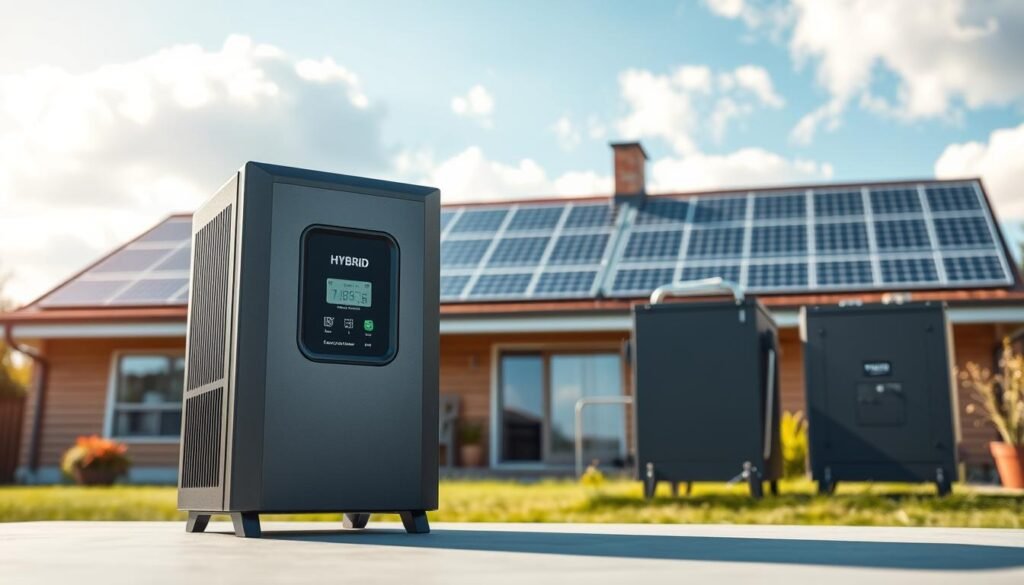
A hybrid inverter is the heart of your solar system. It connects your solar panels, battery pack, and the grid. It changes DC from panels to AC for your home. It also sends extra power to batteries or the grid.
Definition and how it differs from standard inverters
A hybrid inverter is like a single device for making, storing, and using power. It’s different from a basic inverter that only changes DC to AC. A hybrid inverter can send and receive power and control batteries.
Main functional advantages
Hybrid systems save extra solar energy for when you need it. This means you use less grid power. A hybrid inverter can also shift loads, keep important circuits running, and provide backup during outages.
Many hybrid units have built-in battery management. This makes setup easier and cuts down on clutter. You get smart charging, discharge limits, and safety features all in one. Companies like SMA and SolarEdge offer these benefits.
Who benefits most from hybrid systems
People with frequent power cuts or high energy costs benefit a lot. If you’re thinking about adding an EV charger or more storage, a hybrid inverter saves money. Small businesses also find value in the reliable power and load management.
When deciding between hybrid and solar inverters, check out solar inverter guides. They help you understand the differences.
How Solar Inverters and Hybrid Inverters Work
Solar systems turn sunlight into power your home can use. Solar panels make direct current, which needs to be changed. The inverter does this, making alternating current for your appliances and connecting to the grid.
Basic conversion process
An inverter takes DC from panels and makes a stable AC waveform. This changes the variable voltage from panels to household voltages. In the U.S., it gives you 120/240V for your circuits.
Energy routing in hybrid setups
Hybrid inverters have two-way power paths. You can send extra power to batteries, export to the grid, or import when needed. This helps manage energy, charge batteries, and use power wisely.
Monitoring and control features
Inverter monitoring shows how much power you’re making and using. You can get alerts and see how much power you’ve used over time. Many systems even let you update their software remotely.
For a closer look, check out solar generator details. They explain how off-grid systems work, protect batteries, and stay tough in tough weather.
| Function | Standard Solar Inverter | Hybrid Inverter |
|---|---|---|
| Primary task | DC to AC conversion for immediate use and export | DC to AC conversion plus bidirectional energy routing |
| Energy flow management | Limited to export/import depending on grid connection | Manages solar, battery, and grid flows with set priorities |
| Backup capability | Requires separate transfer switch and battery setup | Integrated backup that supplies selected circuits during outages |
| Monitoring | Basic meters or optional add-ons | Cloud and mobile inverter monitoring with analytics and controls |
| Use case | Grid-tied systems focused on generation and export | Self-consumption, storage, off-grid, and time-of-use optimization |
Performance and Reliability Comparison
When comparing inverter performance, look at how they handle real-world needs. Hybrid inverters can use stored power during outages. Standard inverters are great at converting but can’t power circuits when the grid is down.
Backup power and outage resilience
Hybrid models from Huawei and SolaX automatically switch to battery power. This keeps important circuits running. Traditional string inverters from Fronius or SMA need separate storage to provide backup.
Efficiency and real-world performance
Inverter efficiency is key to getting the most energy from your panels. Modern units can be up to 99% efficient. Hybrid systems offer extra benefits like using stored energy during peak hours.
Systems like SolarEdge keep energy output high even under shade. Monitoring tools from Huawei and SolarEdge help fine-tune performance.
Durability and maintenance considerations
Durability depends on the quality of parts and how well they handle heat. Warranties vary from five to twenty-five years. Hybrid systems require more maintenance than simple inverters.
Regular checks and remote monitoring help keep systems running smoothly. Make sure to update firmware and check battery health. For more information, see this guide: comparison of the most popular solar.
Cost, ROI, and Financial Considerations
When deciding between a standard solar inverter and a hybrid system, look at the costs and benefits. Consider the inverter price and how much you’ll save on your electricity bill. Think about the benefits of backup power too.

Upfront costs versus long-term savings
Standard solar inverters are usually cheaper to buy. This makes it easier to fit them into your budget. Hybrid inverters, on the other hand, cost more because they come with battery-ready features and can control energy flow both ways. Even though they cost more upfront, they can save you money by storing energy during high rates.
Incentives, net metering, and local policies
In the United States, federal incentives like the Investment Tax Credit can lower the cost of your solar system. State rebates and utility programs can also help. Net metering rules affect how much you save. If you get full retail rates for excess energy, a simple solar inverter might be the best choice. But, if net metering is limited, a hybrid system can store energy and boost your savings.
Payback scenarios and market trends
Calculate how long it’ll take to pay back your investment by looking at local electricity rates, incentives, and the inverter cost. Hybrid systems can pay off faster under time-of-use pricing by using solar energy when it’s more expensive. As battery prices drop and interest in resilience grows, hybrid inverters are becoming more affordable. The market is expected to keep growing, which could make your system more valuable in the future.
Get quotes from trusted brands like SolarEdge, SMA, Enphase, and Schneider Electric. Compare warranties, maintenance needs, and energy savings. This will help you choose the best option for your needs and goals.
Installation, Sizing, and System Design Differences
When setting up a solar system, you need to make key decisions. First, check your roof’s orientation and load needs. Think about future growth to ensure your design supports battery storage and backup. An IP65-rated hybrid inverter is great for outdoor use, standing up to harsh weather.
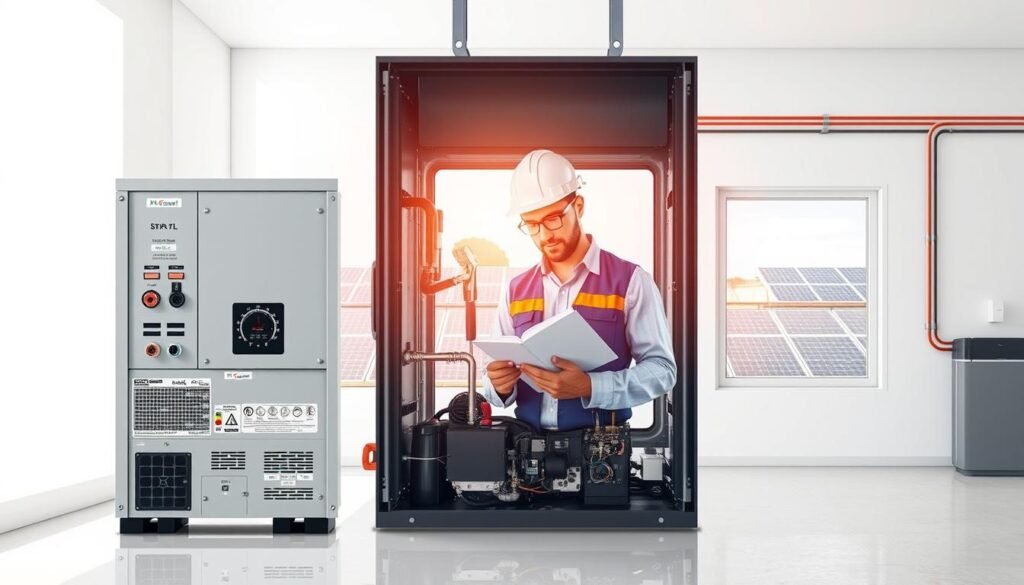
For homes with split-phase power, match the inverter’s output to your 120/240V system. Your installer will plan which circuits are most important. They’ll also make sure the loads are balanced to avoid issues during power outages. It’s important to include safe transfer switches and prioritize essential circuits when using batteries.
Designing for split-phase residential systems
First, list the circuits you need during an outage. This includes things like refrigeration, well pumps, and some lights. Choose hybrid inverters that support split-phase output and load prioritization. Make sure they work with your home’s panels and any smart devices you plan to add.
Sizing for panels, inverter capacity, and batteries
Inverter sizing depends on your home’s peak demand and PV array size. Choose an inverter that can handle your loads and has some extra capacity for surges. For hybrid systems, battery size is based on how long you want backup power and how deep you want to discharge the batteries.
Use this sample comparison to guide decisions for typical residential and commercial projects.
| Project Type | PV Capacity | Recommended Inverter Capacity | Battery Sizing | Notes |
|---|---|---|---|---|
| Residential rooftop | 5 kW | 6 kW hybrid | 10 kWh usable (2–4 hours backup) | Balance inverter sizing with panel output for efficiency |
| Small commercial | 50 kW | 55 kW hybrid or string array | 100 kWh usable (short critical load support) | Prioritize critical loads and staged battery additions |
| University project | 10 MW | Distributed hybrid inverters, modular | 2–5 MWh, scalable | Phased battery sizing for campus resilience |
Professional installation and permitting
It’s best to hire installers with experience in battery systems for safe installation. Certified teams will handle all the necessary steps, including anti-islanding measures and grounding. Remember, permitting rules vary, so factor in the time needed for permits in your project plan.
For durable and outdoor-ready options, look at IP65 hybrid solar inverter specs. For more information or to see an example system, visit the manufacturer’s page here: IP65 hybrid solar inverter.
Pros and Cons of Each Option
Before choosing your solar system gear, it’s important to know the trade-offs. Here are the main points to consider: cost, backup, growth, and long-term savings. Each section will help you understand the benefits and drawbacks of solar and hybrid inverters.
Advantages of Solar Inverters
Solar inverters are often cheaper upfront, which is great if you’re watching your budget. They’re also easier and quicker to install, saving you time and money on labor and permits.
These inverters are known for their high efficiency and work well with net metering programs. This means you can save money consistently when the grid is reliable and you don’t need a battery backup.
Disadvantages of Solar Inverters
One big drawback is that solar inverters rely on the grid for power. If the grid goes down, you’re out of luck unless you have a separate battery system.
They can also be hard to expand. Adding more battery capacity often means replacing the whole inverter. And, if local net metering rules change, your system’s value might drop.
Advantages and disadvantages of Hybrid Inverters
Hybrid inverters offer many benefits. They come with built-in battery management and automatic backup, so you’re covered during power outages without extra gear.
These systems help you use more of your own solar power, reducing your reliance on the grid. They also let you manage your energy smartly, prioritize loads, and optimize for the best times to use power. Plus, they’re designed to grow with your needs, like adding more batteries or charging for electric vehicles. You can even monitor your system in real-time with apps from companies like SolarEdge or Enphase.
But, there are downsides. Hybrid inverters cost more upfront and can be more complicated to install and get permits for. They also need more maintenance because of the batteries. And, you need to size them just right to get the best return on investment.
- Compare pros and cons solar inverter if you prioritize low initial cost and simple installs.
- Compare pros cons hybrid inverter if you value resilience, smart energy features, and future expansion.
When to Choose a Hybrid Inverter versus a Solar Inverter
When planning a solar system, you have many choices. Consider grid reliability, budget, future needs, and local rules. Quick answers help you pick the best option for your home or business.
Decision factors to evaluate
First, think about your area’s power outages. If they’re common, a hybrid inverter with battery backup is a good choice. Next, look at your local net metering policies. Good credits might make a grid-tied solar inverter cheaper if you want to save upfront.
Also, think about your future needs. If you might need EV charging or more storage later, a hybrid inverter is a smart choice. It lets you easily add more features as needed.
Common homeowner and business scenarios
If your area has a reliable grid and good net metering, a split-phase solar inverter might be best. It’s cheaper upfront and saves money during the day.
But, if your area has frequent power cuts or you want energy independence, a hybrid inverter is better. It keeps important systems running with its battery backup. Small businesses with critical equipment also benefit from hybrid inverters to avoid downtime.
For properties planning EV charging or future upgrades, hybrid inverters are a good choice. They help you use more of your own energy and save on utility bills.
Questions to ask your installer
Here are some questions to ask your solar installer:
- Does the inverter support split-phase 120/240V service?
- Is the inverter battery-ready or does it include a battery management system?
- What backup duration and critical loads will the battery support?
- How does the local utility handle net metering and export limits?
- What are total installed costs, incentives available, and expected payback?
- What warranties and maintenance plans do you offer?
For more on durable, low-frequency inverters and battery-ready options, check out low-frequency solar inverter resources. This will help you make a well-informed decision.
| Factor | When to choose hybrid inverter | When to choose solar inverter |
|---|---|---|
| Grid reliability | Frequent outages or desire for backup | Stable grid with rare outages |
| Budget | Higher upfront cost; long-term savings with storage | Lower initial cost; faster payback in net metering areas |
| Expansion plans | Planned EV charging or battery addition; future-proof | No immediate plans for storage or EV charging |
| Net metering and tariffs | Time-of-use or low export credits favor hybrids | Generous net metering favors grid-tied solar inverter |
| Business continuity | Critical loads require continuous power | Non-critical loads; interruptions acceptable |
Regulatory, Market, and Trend Insights for the United States
Understanding the impact of rules, market changes, and new technology is key. Federal and state policies affect costs and design. The Investment Tax Credit and state rebates change how quickly you can pay back for solar systems.
Net metering and time-of-use rates also play a role. They decide if adding a battery is worth it for your home.
When you buy, policy details are important. The Investment Tax Credit can save a lot upfront. State and utility rebates for solar inverters vary and can encourage using batteries.
Local net metering rules are also critical. They affect how much value you get from selling back to the grid versus storing energy.
The demand for inverters is growing steadily. The global market is expanding, and the hybrid inverter market is growing even faster. This is because battery prices are dropping and people want more reliable systems.
Manufacturers like SolarEdge, Enphase, and SMA are making smart, battery-ready inverters. They’re betting on these systems to meet the changing needs of homeowners.
Smart battery management and cloud monitoring are becoming more common. These features make it easier to manage energy, backup power, and EV charging. The next step for solar inverters is to be able to handle different modes seamlessly.
Planning for battery integration now is wise. Choosing a hybrid inverter means you can adapt as programs and markets change. This approach avoids expensive upgrades later and keeps your options open for EV charging and home resilience.
Use this information to make informed decisions about your system. Keep an eye on policy changes and market trends. This way, you can make the most of incentives and future-proof your system.
Conclusion
When you think about solar inverters, remember they both turn DC to AC. This keeps your panels working. A solar inverter is a good pick if your power is reliable. You also want to save upfront costs and sell extra energy back.
Hybrid inverters are different. They add battery power, backup, and better use of your energy. Choose one based on what you need, like staying on during outages or saving on energy costs.
Your choice should fit your system size, shading, local rules, and budget. Talk to a pro to get the right size and plan. For more info, check out this guide from Terawatt Solar: solar inverter overview.