
Finding the right lithium battery is key to meeting your energy storage needs. First, know that lithium batteries vary by chemistry and shape. These differences affect safety, performance, and cost. Look for quality and certifications like UL 9540 and UL 9540A for a reliable home battery.
Choose a battery that matches your use: home, RV, or marine systems have different needs. Check voltage, cycle life, temperature range, and space and weight limits. Proper sizing saves money and reduces downtime.
Use simple math to size your battery bank. Convert daily watt-hours to ampere-hours and confirm system voltage. Remember to consider depth of discharge and inverter efficiency. By following these steps, you can find a lithium battery that’s safe, long-lasting, and cost-effective.
Key Takeaways
- Understand chemistry and form factor to balance safety and performance.
- Verify UL 9540/9540A and manufacturer quality for stationary systems.
- Match voltage, power, and temperature limits to your use case.
- Convert Wh to Ah and account for depth of discharge when sizing.
- Prioritize total cost of ownership over lowest upfront price.
Understand your energy storage goals and applications
First, decide what you want your battery to do. Do you need it for home backup during outages? Or for storing solar energy for night use? Maybe for your RV trips, boating, or business needs. Knowing your goals helps choose the right battery type and safety features.
Think about how you’ll use your battery. For a home backup, list essential items like lights and refrigerators. For solar systems, track daily energy production and storage needs. RVs require batteries that are light and handle vibrations well. Marine batteries need to resist corrosion and shock.
Calculate how much energy you use each day. Multiply the power of each appliance by how long it runs. Then, convert this to amp-hours to find the right battery size. For example, a 12V device using 4.8A for 10 hours needs a 48 Ah battery.
Remember to account for peak power needs. Motors and compressors use a lot of power when starting. Make sure your battery and inverter can handle these spikes to avoid problems.
Match your battery’s voltage and system design to your equipment. Use 12V modules in series for 24V or 48V systems. Higher voltages reduce current, saving wire size and improving efficiency for big systems.
Consider your environment, expected battery life, and budget. Cold climates and space limits affect your choice. If unsure, get advice from a certified installer to ensure your battery meets your needs.
| Use Case | Key Design Focus | Typical Sizing Tip |
|---|---|---|
| Home backup battery | Reliable DoD, safety certifications, inverter compatibility | Sum essential loads in Wh, add 20–30% reserve for outages |
| Solar storage sizing | Match PV output to daily use and storage round-trip losses | Size for average night consumption plus cloudy-day buffer |
| RV battery | Low weight, vibration resistance, compact form factor | Prioritize Ah at system voltage; choose LiFePO4 for cycles |
| Marine battery | Corrosion protection, shock tolerance, peak discharge capacity | Choose marine-rated cells and allow headroom for starter loads |
| Commercial systems | Scalability, safety certifications, serviceability | Design for modular expansion and meet UL 9540 requirements |
Compare lithium battery chemistries for performance and safety
Choosing a lithium battery means looking at energy density, cycle life, and safety. You also consider cost and space. Different chemistries like LiFePO4, NMC, NCA, LTO, LMO, LCO, and LiPo have unique features. Knowing these helps pick the right battery for your needs.
LiFePO4 strengths for long life and safety
LiFePO4 cells use iron and phosphate. They are safe, non-toxic, and don’t catch fire easily. These cells last a long time, often up to 6,000 cycles. This makes LiFePO4 great for home use, off-grid systems, and boats.
Pairing LiFePO4 with smart BMS units adds extra safety. Look at product pages and technical sheets for details on cycle life and compatibility.
NMC and NCA: energy density for tight spaces
NMC and NCA batteries pack more energy than LiFePO4. They’re perfect for small spaces, like in powerwalls and electric cars. They last about 1,500 to 3,000 cycles, depending on how they’re used.
NCA cells have strong power but need careful handling. They contain cobalt and nickel, which can be a safety concern over time.
LTO, LMO, LCO, and LiPo: niche benefits and trade-offs
LTO batteries are very durable, lasting up to 20,000 cycles. They work well in places where they don’t need to be very heavy. This makes them great for heavy use.
LMO batteries charge fast and are safe. They’re often used in EVs. LCO batteries have high energy density but don’t last as long. LiPo batteries are light but need careful handling.
For a quick comparison, check out this lithium battery overview. It has cycle life, BMS features, and recommended uses for different models.
| Chemistry | Typical Cycle Life | Key Strengths | Primary Trade-offs |
|---|---|---|---|
| LiFePO4 (LFP) | 3,000–6,000+ cycles | High battery safety, long life, stable thermal profile | Lower energy density, slightly heavier |
| NMC | 1,500–3,000+ cycles | High energy density, good balance of power and capacity | Needs stronger thermal management, contains cobalt |
| NCA | 1,500–3,000+ cycles | Very high energy density and specific power | Higher cost, more demanding safety controls |
| LTO | 10,000–20,000+ cycles | Fast charge, extreme longevity, wide temp range | Low energy density, high upfront cost |
| LMO | 1,000–3,000 cycles | Fast discharge/charge, inherently safe | Lower energy density, often used in blends |
| LCO | 500–1,000 cycles | Very high energy density for small devices | Shorter life, less thermal stability |
| LiPo | 300–1,000 cycles | High density and flexible form factors | Requires careful handling and pack design |
When choosing between LFP and NMC, think about usable kWh, space, and safety. LFP is good for long life and low cost. NMC or NCA are better for small spaces but need more safety measures. LTO is best for extreme durability.
Evaluate form factors: cylindrical, prismatic, and pouch cells
When picking a battery form factor, think about shape, cooling, and how it fits. Each type affects how the battery fits in spaces and handles heat and stress.
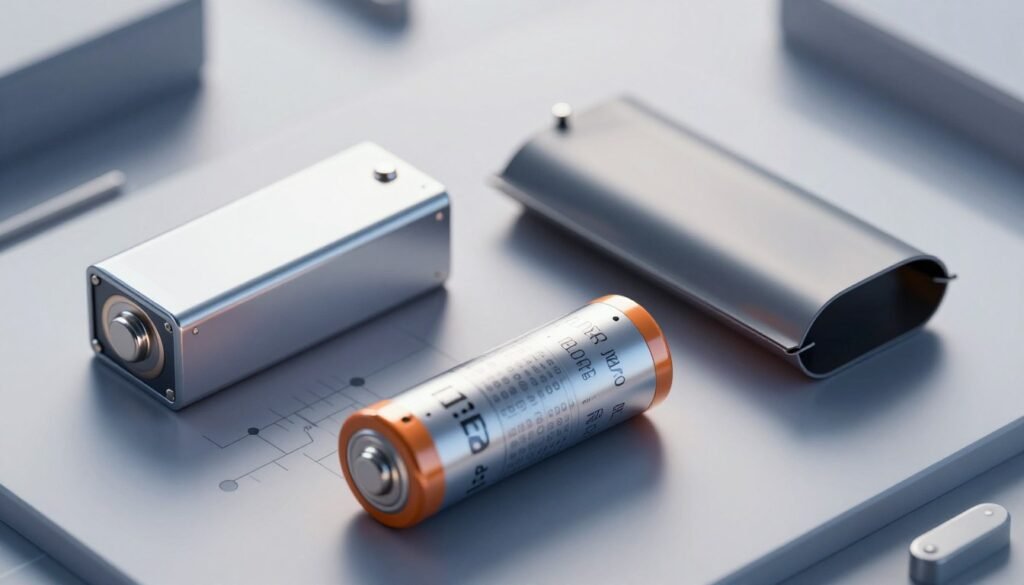
Advantages of cylindrical cells for home energy storage
Cylindrical cells are known for their standard sizes like 18650 and 21700. They offer consistent dimensions and quality. Their round steel can also withstand shocks and punctures well.
These cells cool down faster than flat ones, making cooling simpler. This is great for keeping them running long and safely, even in harsh conditions.
Prismatic and pouch trade-offs: cost, space efficiency, and thermal management
Prismatic cells fit tightly in rectangular cases, saving space. This is good for big packs or commercial racks. It means less space is wasted.
Pouch cells are the lightest and pack a lot of energy. They can be shaped to fit tight spaces. But, they need extra support and careful cooling to avoid problems.
How form factor influences pack design, safety, and lifespan
Choosing the right cells is key to pack design. Cylindrical cells are easy to cool with air channels. Prismatic and pouch cells need solid supports and more monitoring.
Safety depends on the cell type. Pouch cells need extra protection, while prismatic cells need heat paths. Cylindrical cells need careful contact to avoid hotspots.
Choose based on your needs. Prismatic or pouch cells are great for small spaces. Cylindrical cells are better for durability and easy maintenance. For more info, check out this guide on cell differences: differences between cylindrical, pouch, and prismatic.
Determine capacity, depth of discharge, and usable energy
First, turn your load into clear numbers for better battery sizing. Use current and run-time to find ampere-hours. Then, convert Ah to Wh to compare batteries at system voltage. For example, 4.8 A × 10 h = 48 Ah; at 12 V, that’s 576 Wh.
Consider depth of discharge when choosing a chemistry and capacity. LFP cells handle deeper discharge well, keeping more energy usable over time. A conservative DoD extends life but cuts immediate capacity.
Here’s a quick guide to size your bank:
- Calculate daily consumption in Wh: wattage × hours.
- Convert to Ah at the system voltage you plan to use.
- Adjust for desired DoD to find required nominal capacity.
- Factor in temperature, inverter losses, and BMS safety margins.
Use a simple table to compare scenarios. This helps balance budget and space. The examples below assume a 12 V system and show how DoD choices affect required capacity.
| Daily Load (Wh) | Ah Needed (12 V) | DoD (%) | Nominal Battery Capacity (Ah) |
|---|---|---|---|
| 576 | 48 | 80 | 60 |
| 576 | 48 | 50 | 96 |
| 1200 | 100 | 80 | 125 |
When planning series or parallel configurations, remember series raises voltage for inverter matching. Parallel increases Ah. Match your Ah to the inverter and your target usable energy after applying depth of discharge.
Balance capacity with cost and space by prioritizing what matters most. Choose more usable energy now or longer life and fewer replacements. Align your battery sizing with real product specs from established brands like Battle Born, Victron, or Tesla to avoid surprises from manufacturer variability.
Assess cycle life, calendar life, and total cost of ownership
When comparing batteries, focus on real-world longevity, not just marketing claims. Cycle life shows how many times a battery can be fully charged and discharged. Calendar life tells you how long a battery stays useful, even if it’s not used.
LiFePO4 batteries often last 3,000–6,000 cycles at 80% DoD. Some packs claim even more cycles. NMC and NCA batteries last about 1,500–3,000 cycles. LTO batteries can go over 10,000 cycles.
These numbers mean years of use with good care and management. DoD impact is a big factor you can control. Using a battery to 80% DoD can extend its life.
Charge and discharge rates also affect lifespan. High rates can stress cells and shorten life. Shallow cycles can increase effective cycle life and reduce replacement needs.
Quality and the Battery Management System (BMS) impact calendar life. Top brands like Tesla and BYD have strong BMS and thermal controls. These help prevent stress and slow down degradation.
To find the total cost of ownership, add upfront cost, replacement intervals, and maintenance. Use usable kWh per cycle, multiply by cycle life, then divide by system cost. This shows if a higher initial cost is worth it for longer life.
| Chemistry | Typical Cycle Life (at ~80% DoD) | Calendar Life Expectation | DoD Impact | Notes for TCO |
|---|---|---|---|---|
| LiFePO4 (LFP) | 3,000–6,000+ cycles | 10–15 years common | Moderate; shallower DoD extends cycles | Lower total cost of ownership for stationary use due to safety and longevity |
| NMC / NCA | 1,500–3,000+ cycles | 6–10 years typical | Higher DoD accelerates wear | Higher energy density but shorter battery lifespan can raise replacement costs |
| LTO | 10,000–20,000+ cycles | 10–20+ years possible | Low sensitivity to DoD; tolerates deep cycles | Higher upfront cost may be offset by very long service life |
Run scenarios for your load. Change DoD and cycle assumptions, then map replacements and downtime into your model. This approach clarifies the real total cost of ownership and helps you pick a chemistry and pack that match your goals.
Check safety features, certifications, and manufacturing quality

First, check for important certifications for stationary storage. UL 9540 ensures safety for homes, businesses, and factories. UL 9540A tests how batteries perform in fires and shows how they might fail.
Then, look at the battery management system (BMS). A strong BMS protects against overcharging and over-discharging. It balances cells and detects faults to keep the battery working well. It also works with thermal management to keep batteries cool, which is important for certain types.
Next, find proof of good manufacturing. Ask for tests, quality checks, and parts from trusted suppliers like Samsung SDI or Panasonic. Warranties that match what the product claims show the maker’s confidence in its quality and durability.
Check for safety features beyond electronics. Look for overcurrent protection, waterproof ratings for use in wet places, and tough enclosures for outdoor or mobile setups. Smart BMS options in all-in-one systems make setup easier and add extra safety.
Make a checklist to compare suppliers. Look at certifications, BMS features, and manufacturing quality. Use this checklist when getting quotes and visiting sites to make sure they meet your safety standards.
For more information on product lines and quality, visit Aisen Solar Energy. They show how testing, warranties, and quality processes ensure safe and reliable energy storage.
Match discharge rate (C-rate) and power capability to your load profile
First, list the devices and motors you’ll run. Note their continuous draw, startup pulses, and run times. This helps you figure out the discharge rate and peak power you need.
Understand C-rate as the battery’s discharge speed. A 1C battery can deliver its full capacity in one hour. Higher C-rate cells handle bigger currents without dropping voltage too much. Make sure your pack can handle both steady and short power peaks.
Look for batteries that can handle high power well. Cylindrical cells and LiFePO4 packs are good for this. They handle heat and high discharge well. Also, make sure your pack has good thermal management and a BMS that allows for quick startup currents.
Check if your inverter can handle the battery’s peak power early on. Your inverter needs to match the battery’s surge rating. This ensures the battery can handle both peak and steady discharge without any issues.
For motor loads, like trolling motors or compressors, you need batteries that can handle long, high discharge. Size your battery and C-rate to avoid overheating. For RVs and household appliances, focus on handling inrush current at startup for items like air conditioners and motors.
Use the table below to compare common scenarios and what to prioritize when you choose cells and packs.
| Load Type | Typical Peak Power Need | Key Battery Traits | What to verify |
|---|---|---|---|
| Trolling motors / propulsion | High sustained peaks (hundreds of amps) | High C-rate cells, robust thermal path, LFP or high-rate cylindrical | Continuous discharge rating, thermal management, BMS current limits |
| Home appliances / A/C startup | Short high inrush current at startup | Cells with strong short-duration C-rate, low internal resistance | Inrush current tolerance, discharge rate, inverter compatibility |
| EV chargers / fast charging | High peak and sustained power windows | High power packs, advanced cooling, high cycle-life cells | Peak power delivery, pack cooling, charge/discharge C-rate limits |
| Critical circuits / UPS | Moderate continuous with occasional peaks | Stable voltage under load, predictable discharge behavior | Continuous discharge rate, BMS response to transient loads |
Do calculations to see if your battery can handle the current needs. Add safety margins for sudden events and aging. This ensures your chosen C-rate and discharge rate meet both daily needs and sudden peaks.
Consider installation constraints: space, weight, temperature, and IP rating
When planning an install, think about your site’s physical limits. Measure the area for the battery and note its dimensions before buying. For mobile setups, Group 24-style modules fit well in vans and RVs. For home backup, cylindrical packs are better for heat dissipation and simpler layouts.
Check the battery’s weight for mounting and transport. A WattCycle 12V 100Ah LiFePO4 is about 10.2 × 6.6 × 8.2 inches and 23.0 lbs. It’s two-thirds lighter than lead-acid units. This makes it easier to install in boats and on walls, but it must be secured to prevent movement.
Know your system’s operating temperature limits. LFP cells work well in cold, but charging below 0°C can damage them. NMC and NCA need heat to avoid aging fast. For extreme temperatures, consider LTO chemistry.
Check the IP rating for outdoor or marine use. Choose enclosures with the right ingress protection to keep moisture and dust out. An IP67 or higher case is good for marine use, while IP54 is enough for sheltered garages.
Balance battery size, weight, and thermal needs with your mounting options and ventilation. For RVs and vans, choose slim and light batteries. For marine installs, pick corrosion-resistant enclosures with a high IP rating to protect against spray and humidity.
Use a short checklist before purchase:
- Confirm battery dimensions fit the intended space.
- Verify battery weight for mounting and handling.
- Check operating temperature ranges and charge limits.
- Match enclosure IP rating to outdoor or marine conditions.
- Ensure thermal management or insulation for cold climates.
Compare warranties, supplier support, and service networks
Warranty terms show how well a product will perform and the maker’s confidence. Look closely at cycle limits, how coverage is prorated, and what’s not covered. This includes installation and weather conditions.
Make sure suppliers can show UL certification and testing results. Brands like Generac and LG Energy Solutions share UL listings and warranty guides. These guides explain what you and the installer are responsible for.
Choosing a supplier is a big decision for the long run. Find out if they offer good support and easy access to technical help. This is for troubleshooting, updates, and handling claims.
Having local installers is key when you need service. Check if there are installers near you before you buy. Authorized dealers and certified installers ensure the battery is set up right. This keeps the warranty valid.
In the US, check if there are local dealers and service partners. Fast parts replacement and on-site checks reduce downtime. They also prevent damage from wrong repairs.
When looking at prices, also consider the warranty’s length and what it covers. A good warranty shows the manufacturer’s confidence. It can also save you money by reducing the need for replacements.
When picking vendors, ask about their response times, spare parts, and installer training. Good support and local dealers improve installation and battery life outcomes.
Cost vs. value: balancing price, performance, and long-term benefits
Choosing a battery is more than just looking at the cost. You need to understand how the price per kWh affects your long-term savings. Check the warranty, safety certifications, and manufacturing quality to make a fair comparison.
When higher upfront cost is justified by longer cycle life and safety
Choose LFP for its safety and long life. LiFePO4 cells last for thousands of cycles. This means you might not need to replace them as often, saving you money and reducing risks.
Evaluating price per usable kWh and replacement intervals
Compare the price per kWh after adjusting for how much you can use it. A cheaper battery might cost more over time if it doesn’t last as long. Look at how often you’ll need to replace it and the warranty to understand the true cost.
Financing, rebates, and incentives that improve payback for energy storage
Financing and incentives can lower the initial cost and improve your return on investment. Federal tax credits, state rebates, and utility programs can make a big difference. Include these savings in your financial plans.
| Metric | LFP (LiFePO4) | NMC/NCA |
|---|---|---|
| Typical upfront battery cost | $700–$1,200 per kWh | $400–$900 per kWh |
| Realistic price per usable kWh | $90–$150 (accounting for DoD & cycles) | $120–$220 (shorter lifespan) |
| Cycle life (typical) | 3,000–6,000+ cycles | 1,000–3,000 cycles |
| Expected practical lifespan | 10–15 years | 5–10 years |
| Safety and certifications | Strong thermal stability; common UL listings | Higher energy density; more thermal management needed |
| Effect of incentives | Improves LFP ROI significantly for home solar pairings | Incentives lower upfront battery cost but less impact on long-term value |
Before buying, do a total cost of ownership analysis. Include the battery cost, price per kWh, replacement cycles, and incentives. This will help you see the long-term value and choose the right battery for your needs.
Conclusion
To find the right lithium battery, first figure out what you need it for. Think about your daily usage and how much power you use. Decide if you want batteries that last a long time or ones that pack a lot of power.
For homes, RVs, boats, and off-grid systems, LiFePO4 is often the best choice. It’s safe and lasts a long time. NMC/NCA is better for tight spaces or if you need to save weight.
Make sure the battery has the right safety checks and a good management system. Check if it can handle the weather and if it’s easy to install. Fast charging and low self-discharge are good, but so is knowing how long it will last.
Think about the cost over time. A more expensive battery might save you money in the long run. Look at warranties, the supplier’s reputation, and their service when choosing.
Once you’ve decided, pick a supplier or installer you can trust. This guide will help you compare different options. For more information, check out this article on lithium-ion batteries: lithium-ion pros and cons.