
This case study looks at a solar street light system with lithium batteries. It was set up in several U.S. locations. The goal was to provide green and reliable lighting.
The project chose the right parts, suppliers, and installation methods. These choices are important for public spaces, schools, parks, and private projects.
The study talks about how reliable the system is. It also shows how it saves money and cuts down on CO2 emissions. This is because it uses less grid power.
It uses examples from companies like Shenzhen Upward Umbrella and Linhai Juhui. They explain how to pick the right parts and how long they should last.
The study compares different locations and how the lights work there. It shows how to size parts and choose vendors. It also talks about how to measure performance.
Key Takeaways
- Well-sized solar panels and a lithium battery street light deliver higher uptime with lower maintenance than many lead-acid alternatives.
- Supplier reliability and product durability—illustrated by brands used in the project—are critical to long-term performance.
- Off-grid street light systems can cut both capex and opex when designed for local climate and usage patterns.
- Municipal buyers should weigh lifecycle cost, CO2 reductions, and scalability when evaluating solar lighting for municipalities.
- Clear installation and commissioning practices reduce early failures and ensure expected returns on outdoor solar lighting investments.
Overview of the Solar Street Light Project and Objectives
This solar street light project aims to replace old HID fixtures and costly grid extensions. It targets low- to medium-traffic roads, park paths, parking lots, and rural intersections. The goal is to reduce trenching costs while ensuring consistent outdoor lighting that meets municipal and public needs.
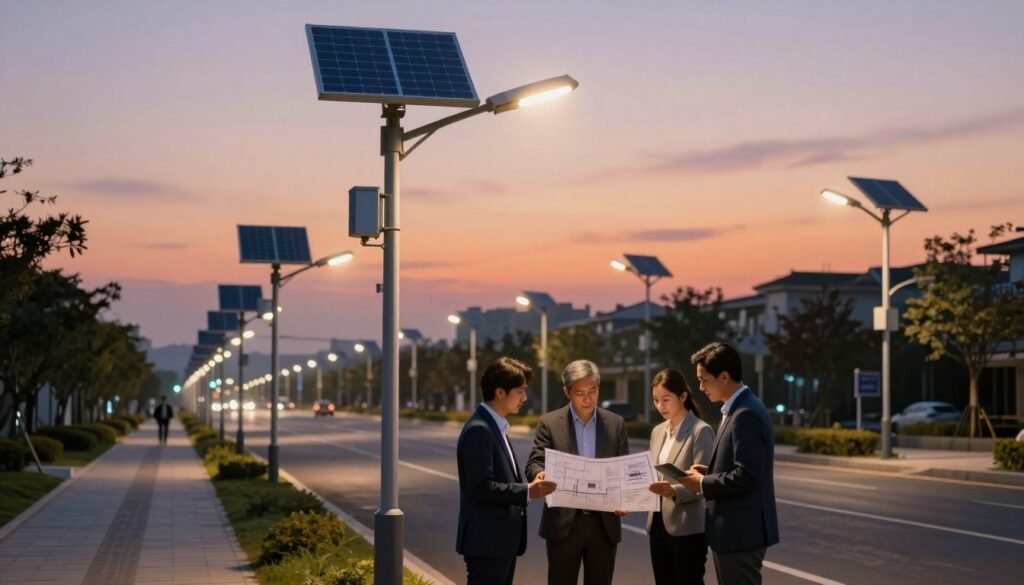
Project planning started with choosing the right sites for solar lighting. Factors like local insolation, shading, pole spacing, and soil conditions were considered. Coastal areas needed corrosion-resistant hardware due to salt spray risks. Inland areas focused on dust and freeze-thaw cycles.
Each location got a shading analysis and sun-hour study. This helped set the panel tilt and orientation for all seasons.
Project background and site selection
Teams looked for areas where trenching power is expensive or disruptive. Rural towns, suburban trail systems, campus pathways, and small parking areas were top choices. Field surveys checked insolation, seasonal changes, and shading from trees or structures.
Pole height, spacing, and foundation type were determined by soil tests. Designs aimed for 3–5 nights of autonomy to handle U.S. weather. Sample units were tested before bulk orders, and vendors provided IEC and UL test documents.
Goals: reliability, cost savings, and eco-friendly lighting
Reliability was key, with a focus on uninterrupted operation. Lithium batteries were chosen for their deep discharge tolerance and long cycle life. Systems were sized to ensure lights stayed on during cloudy periods.
Cost savings came from avoiding grid connection fees and lowering utility bills. Eco-friendly lighting aimed to reduce carbon footprint through solar power and longer-lasting lithium batteries.
Stakeholders and target locations in the United States
US solar lighting stakeholders include municipal public works, state transportation agencies, utilities, universities, homeowners associations, and private developers. Each group contributed to funding, permitting, and maintenance planning.
| Stakeholder | Primary Interest | Typical Target Locations |
|---|---|---|
| Municipal Public Works | Reduced O&M costs and uptime | Suburban neighborhoods, rural roads, parking areas |
| Parks Departments | Safety and low environmental impact | Trail systems, park paths, recreational areas |
| State Transportation | Reliable right-of-way lighting without trenching | Rural intersections, service roads |
| Universities | Campus safety and brand consistency | Campus pathways, parking lots |
| Homeowners Associations | Aesthetics and predictable fees | Residential streets, community centers |
| Private Developers | Turnkey solutions and quick installation | New subdivisions, commercial lots |
Procurement focused on suppliers who offer customization, reliable lead times, and documented delivery performance. Buyers were advised to request third-party test reports and sample units for site trials. This confirmed performance before large purchases.
System Components and Why Lithium Battery Was Chosen
A reliable solar street light needs the right parts. This section talks about the solar panel, battery, controller, LED fixture, and pole hardware. We picked each item for top performance, durability, and easy maintenance in U.S. cities.
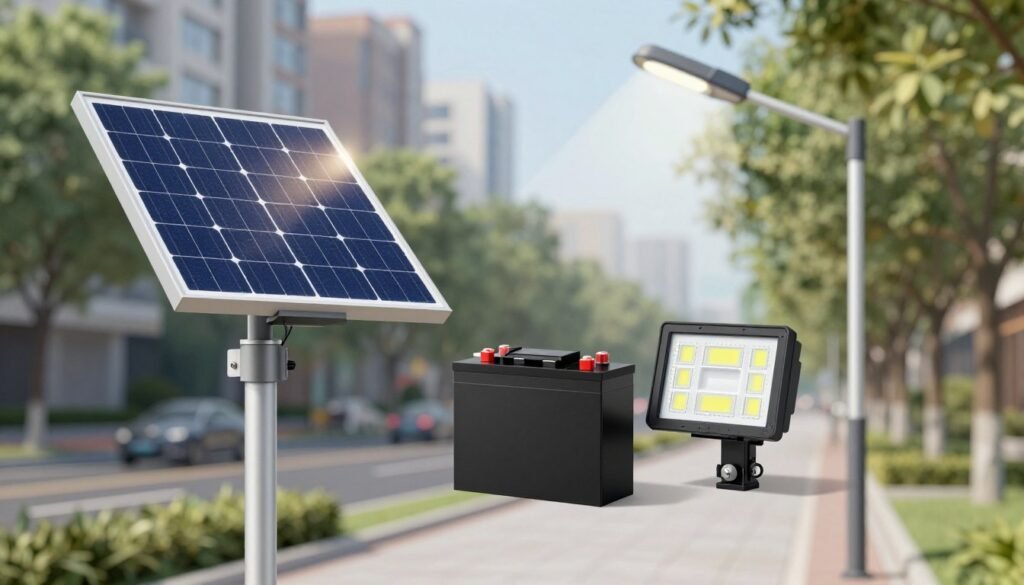
Solar panels: sizing, placement, and efficiency considerations
Choosing the right solar panel size starts with the daily load and sun hours. We figured out the needed wattage for lighting, losses, and extra power. High-efficiency panels save space on poles.
It’s key to place panels right, avoiding shadows and facing south in the U.S. Use a tilt close to your site’s latitude. For harsh areas, use durable fasteners and mounting brackets.
Choose suppliers that offer quick delivery and customization. This ensures the array fits the LED and battery perfectly.
Lithium battery advantages: lifecycle, depth of discharge, weight
Lithium batteries last a long time and can be used deeply. Modern LiFePO4 batteries can go through thousands of cycles, lasting years with the right temperature.
They can be used up to 80–90%, needing less storage than lead-acid. This makes them lighter and easier to mount on poles.
They also charge fast, lose charge slowly, and need little upkeep. Make sure the BMS has the right features and protections. For more info, check out this page: lithium battery options.
Controller, LED fixture, and pole hardware selection
Choosing the right controller is important. We went for MPPT controllers to get more energy. We also looked for programmable dimming, battery protection, and remote monitoring.
For the LED lights, we picked ones with high efficiency and the right color temperature. They should also have surge protection and be safe for outdoors.
The pole hardware had to be durable and protect the battery and controller. We designed the foundation and soil conditions in mind. We also made it modular for easy maintenance.
Design and Engineering Approach
Starting with a clear design brief is key for a good solar street light design. First, list the fixture wattage, planned hours of operation, and any extra loads like controllers or communication modules. Then, apply a system efficiency derating factor (usually 0.8–0.9) to account for losses in wiring, drivers, and environmental impacts.
Energy budget: calculating daily load and autonomy
To find daily Wh, multiply the fixture wattage by hours of operation and add standby and control loads. Remember to include LED driver efficiency and wiring losses in the total energy budget for solar lighting.
Set a goal for three to five nights of autonomy to cover cloudy days. Use techniques like part-night dimming and motion sensing to reduce daily consumption and storage needs.
Panel and battery sizing methodology using local insolation data
To find PV wattage, divide daily Wh by (peak sun hours * system efficiency). Use the worst month’s peak sun hours to ensure year-round performance.
To size battery capacity in amp-hours, use battery_Ah = (Wh/day * autonomy_days) / (battery_voltage * usable_DoD). Adjust for cold climates with temperature correction factors or insulated enclosures to keep usable capacity.
Include the battery sizing methodology in the design package. Look for suppliers that offer customizable batteries and reliable lead times. For component sourcing, consider reputable manufacturers listed on a supplier directory.
Durability choices: corrosion-resistant materials and weatherproofing
Specify IP66 or higher for controllers and battery housings to protect against dust and heavy rain. Choose LED fixtures with the right IK ratings for areas with impact risk.
Protect poles and brackets with hot-dip galvanizing or marine-grade powder coats in coastal areas. Use stainless fasteners—304 for general use, 316 for severe salt exposure—to improve corrosion resistance for outdoor lighting.
Seal cable penetrations with UV-stable grommets and conduit. Choose suppliers with consistent build quality and documented on-time delivery to avoid installation delays and ensure components match the design intent.
Installation Process and On-Site Implementation
Having a solid plan is key for smooth and safe field work. For solar street light setups, make sure all parts like panels, poles, and batteries arrive together. Check that everything is well-packed to avoid damage during transport.
Use a staging area close to where the lights will go. This makes handling easier and lets you check each part before installing it.
Logistics, foundation, and mounting best practices
Start by testing the soil to figure out the right footing size. Make sure the anchor bolt patterns match the pole bases. Use concrete mix, embed depth, and rebar as local codes require.
For quicker setups, consider precast foundations that fit the anchor templates perfectly.
Mount panels on tilt brackets to adjust their angle as needed. Use stainless-steel fasteners and follow the manufacturer’s torque specs. Make sure poles are straight and hardware is tightened correctly to avoid damage.
Store lithium batteries in approved packaging. Keep them in cool, controlled areas and install them in weatherproof boxes with air vents. Make sure compartments are labeled and have secure access for safety.
Electrical connections, safety checks, and commissioning steps
Wire systems according to NEC and local codes for safety. Ground poles and equipment to protect against lightning. Use waterproof cable glands and seal all openings.
Connect charge controller and battery leads correctly. Check BMS settings and battery voltage before turning it on. Set up MPPT inputs to match PV array specs and check charging limits.
When commissioning solar lighting, follow a checklist. Check PV voltage, MPPT charging, LED dimming, remote setup, and a full-night test if possible. Record initial readings for future checks.
Common on-site challenges and mitigation strategies
Shading or unexpected obstacles might appear after installation. To tackle site challenges, do a final site survey and adjust panels or add PV capacity if needed.
Coastal projects need extra protection against corrosion. Use 316 stainless hardware, strong coatings, and sacrificial anodes. For theft and vandalism, use tamper-proof fasteners and secure enclosures. Engage with the community to prevent misuse.
Extreme temperatures can harm battery life. Add insulation, passive vents, or active heating in cold areas. Choose batteries that work well in your local climate for reliability.
| Step | Action | Field Tip |
|---|---|---|
| Pre-delivery | Confirm lead times, inspect packaging | Staging area near install reduces damage risk |
| Foundation | Perform soil test and cast or place precast footing | Match anchor patterns exactly to pole base |
| Mounting | Torque stainless fasteners, align poles plumb | Use tilt brackets for optimal panel angle |
| Electrical | Grounding, surge protection, correct polarity | Seal all cable entries and label compartments |
| Commissioning | Run PV voltage, MPPT behavior, and full-night simulation | Document baseline telemetry for maintenance |
| Challenges | Shading, corrosion, vandalism, temperature | Site re-survey, material upgrades, locks, thermal management |
Performance Results and Measured Benefits
After six months, the project showed clear signs of success. The lights were on most nights, with only a few issues due to vandalism or bad weather. The lithium systems worked better than the old lead-acid ones, lasting longer and needing less maintenance.
Every day, the project tracked how much energy the lights produced. They found that dirt on the panels and shade at one school were big problems. Cleaning and adjusting the lights fixed these issues.
The project also kept detailed records of the batteries. They tracked how many times the batteries were used, how well they held their charge, and any problems. This helped the team plan for upkeep instead of fixing things when they broke.
They also kept an eye on how bright the lights were and when they needed cleaning. This way, they only went to clean the lights when it was really needed. The team could work faster because everything was standardized.
They compared the costs of the new lights to the old ones. The new lights cost more upfront but saved money in the long run. They used less energy and needed fewer battery swaps.
To figure out if the investment was worth it, they looked at the savings. They compared the money saved on energy and maintenance to the cost of the lights. It usually took three to eight years to break even, depending on the location and available grants.
| Metric | Observed Value | Implication |
|---|---|---|
| Nightly availability | 97–99% | High reliability for public safety |
| Average daily production | 1.8–3.4 kWh/array | Meets modeled demand with seasonal variance |
| Battery capacity retention (12 months) | ≈92% | Longer lifecycle reduces replacements |
| MTBF (controllers/LED drivers) | >3 years | Lower service labor and parts cost |
| Payback horizon | 3–8 years | Viable for most municipal budgets |
Looking at the long term, lithium systems are better because they last longer and save money. For more information, check out the project details on Aisen Solar Energy.
Maintenance, Longevity, and Best Practices
Regular care is key to keeping solar street lights running smoothly. A good maintenance plan saves money and prevents outages. Here are some routines and upgrade paths to help manage assets well.
Routine inspection schedule and seasonal care tips
Set up a schedule for checking solar lights that fits your needs. Do a quick visual check every month and after storms. Look for dirt, bird droppings, loose parts, or corrosion.
Do a full test every three months. Check the controller logs, battery health, and LED performance. Keep track of these to spot trends and for warranty claims.
Do a detailed check-up once a year. Clean the panels, oil moving parts, and test the system. Before winter, make sure batteries are charged and enclosures are sealed. Before summer, check ventilation and heat shielding.
Battery management: charging, storage, and replacement cycles
Start with good lithium battery care by following the maker’s guidelines. Avoid letting batteries get too low to extend their life.
Store batteries at 40–60% charge when not in use. Top them up every three months. Check BMS settings and watch for temperature issues. Plan for battery replacements every seven to twelve years, based on use.
Set aside money for when batteries need to be replaced or recycled. Keep spare parts ready to reduce downtime during replacements.
Upgrades and modular design for future scalability
Plan for future upgrades by using modular designs. Use enclosures that can hold extra batteries or newer types. This makes swapping parts easier and cuts down on truck rolls.
Use standard communication protocols like NEMA, LoRaWAN, or cellular for easy monitoring and updates. Choose modular designs for quick access or larger capacity setups.
Make sure to include spare parts and response times in contracts. A good parts plan and modular design lower costs and make it easier to grow your network.
Conclusion
This solar street light conclusion wraps up the main points from the study. High-efficiency panels paired with lithium batteries provide reliable, easy-to-maintain outdoor lighting. This is true for many places in the U.S., like rural roads, parks, and remote areas.
The advantages of using lithium batteries in solar lighting are obvious. They have a higher depth of discharge, last longer, and are lighter. This means lower costs over time, even if the initial cost is higher. When you add MPPT controllers and tested components, these systems work well and are easy to keep up.
Municipalities and developers should focus on a few key things for effective solar lighting. They need to do site-specific studies, require remote monitoring, and ensure the system works for 3–5 nights without power. They should also look at the total cost over time. It’s important to choose suppliers who can deliver, customize, and offer good warranties. Grants or incentives can help make the project more affordable.
By following the best practices outlined, solar street lights with lithium batteries are a smart choice. They make nights safer, reduce harmful emissions, and save money. This is true for many different places in the U.S.