
This case study looks at a solar street lighting project in the U.S. It cut down on electricity bills and maintenance costs. It also made nighttime visibility better. City workers, utility managers, and procurement teams will find useful info on design, installation, costs, and monitoring.
The project is about updating infrastructure and using renewable energy. It gained interest after public support and analyst coverage from NexGen Energy. They stressed the importance of detailed financial analysis to get grants and investors.
Procurement lessons include comparing U.S. and global options for poles, glass housings, and parts. The next sections will show how solar street lights cut costs and improved urban lighting.
Key Takeaways
- Solar street light installations can significantly reduce municipal electricity expenses.
- Careful design and vendor selection drive savings in maintenance and component replacement.
- Data and analyst reports strengthen proposals for grants and institutional investment.
- Solar-powered street lights improve public lighting quality while supporting sustainable urban lighting goals.
- Comparing domestic and international suppliers helps balance cost, lead time, and customization.
Project overview and objectives
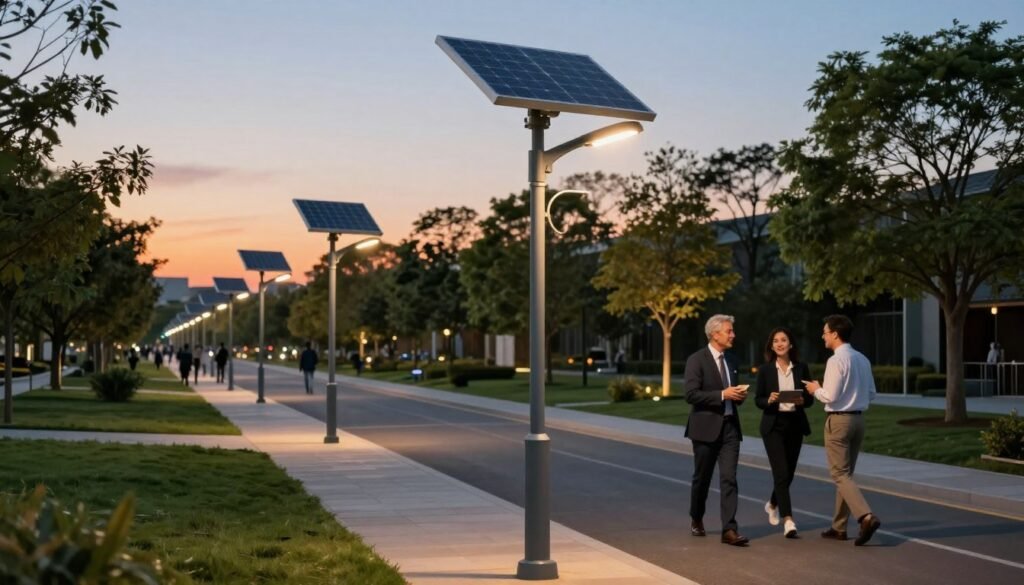
This project aimed to upgrade street lights to solar power. It explains why the city chose this path and what it hoped to achieve. The introduction covers the reasons, scale, and people involved. It also talks about what the city expected in terms of cost, performance, and community impact.
Background and motivation
City officials were worried about high electricity costs and the need for constant maintenance on old street lights. They wanted to cut down on these costs. At the same time, they wanted to meet their goals for using renewable energy and make nights safer for everyone.
They got support from public demonstrations and endorsements from the public works director and utility partners. Seeing the lights go up and getting regular updates helped build trust among residents and officials.
Project scope and geographic context
The pilot was set up in several neighborhoods of a mid-size U.S. city. The city has different amounts of sunlight and traffic patterns. The team picked sites to test the lights in real-world conditions, like shaded streets and busy areas.
They chose suppliers from both the U.S. and abroad. They looked at things like on-time delivery, ability to customize, and warranty when making their choices.
Primary goals: cost reduction, maintenance reduction, and sustainability
The team set clear goals for the project. They aimed to cut electricity spending by 50–80% compared to traditional street lights.
They designed the lights to need less maintenance, aiming for a 30–60% reduction. They used materials that wouldn’t rust and made parts that could be easily replaced. They also wanted to reduce the city’s carbon footprint.
They also wanted to make the streets brighter and safer at night. They looked into different ways to fund the project, like municipal bonds, energy-efficiency grants, and partnerships with private companies.
| Focus Area | Target | Key Measurement |
|---|---|---|
| Electricity cost | 50–80% reduction | Monthly utility bills compared to baseline grid costs |
| Maintenance frequency | 30–60% fewer visits | Number of routine service calls per year |
| Emissions | Significant municipal CO2 reduction | Annual greenhouse gas inventory |
| Community safety | Improved night-time visibility | Lumen uniformity and reported incidents after dusk |
| Funding | Mixed capital sources | Grants, bonds, and P3 commitments secured |
Solar street light selection and design considerations
Choosing the right components starts with clear design rules that match local climate and performance goals. This section covers practical sizing, light output choices, and rugged construction that cut downtime and extend service life.
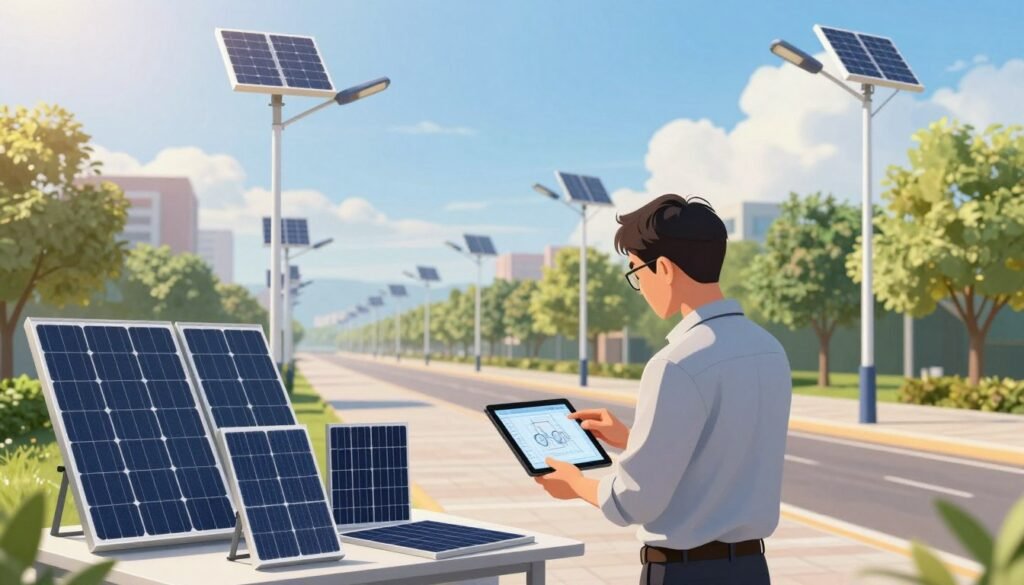
Accurate solar panel sizing relies on historical irradiance and a worst-case chain of cloudy days. Panels were specified with a 20–25% margin above calculated daily energy needs to account for seasonal shifts and soiling. This approach reduces risk and keeps batteries healthier over time.
Battery sizing for street lights targeted three to five nights of autonomy depending on microclimate and usage profiles. Lithium iron phosphate (LiFePO4) cells were chosen for long cycle life, broad temperature tolerance, and safe chemistry. Systems met applicable UL guidance to limit thermal events and to ensure safe field operation.
LED luminaires for street lighting were selected for high efficacy, typically 140–170 lm/W, with Type III and Type V optics to maintain uniform roadway and sidewalk illumination. Color temperatures between 3000K and 4000K balanced visual comfort and minimized skyglow. Dimming and motion-adaptive controls stretched system runtime and reduced light trespass.
Durability choices focused on corrosion-resistant street light design. Poles and housings used corrosion-resistant aluminum alloys with robust powder-coat finishes to suit coastal and freeze-thaw conditions. Protective covers used tempered or laminated glass with anti-reflective coatings in high-traffic locations to improve impact resistance and optical clarity.
Modular design cut mean time to repair. Plug-and-play drivers, removable battery trays, and replaceable LED modules let crews swap parts on-site with minimal downtime. Procurement favored vendors with proven on-time delivery, flexible customization, and warranty terms similar to those common in quality window and glass suppliers.
| Design Element | Specification | Benefit |
|---|---|---|
| Solar panel sizing | 20–25% performance margin; local irradiance data | Reduced energy shortfall risk; accounts for soiling and seasons |
| Battery sizing for street lights | LiFePO4, 3–5 nights autonomy, 2,000+ cycles | Long life, deep-discharge flexibility, improved safety |
| LED luminaires for street lighting | 140–170 lm/W; Type III/Type V optics; 3000K–4000K CCT | High efficiency, uniform light, reduced skyglow |
| Corrosion-resistant street light design | Aluminum alloys, powder coat, tempered/laminated covers | Lower corrosion, better impact resistance, longer service life |
| Modularity & serviceability | Plug-and-play drivers; battery trays; replaceable modules | Faster repairs; lower maintenance costs; easier upgrades |
| Standards & testing | ANSI/IES compliance; UL/ETL listings; UL 1973/9540A guidance | Regulatory acceptance; demonstrated safety and performance |
Site assessment and installation strategy
A clear site assessment is key to a smooth build. Start with a GIS-based solar resource assessment. Use local TMY datasets to map irradiance and shade patterns.
This data helps place poles correctly. It ensures fixtures meet IES lux values and avoid shadows from trees and buildings.
Assessing solar resource, pole placement, and spacing
Use modeled irradiance and spot checks to confirm panel output. Choose sites with unobstructed southern exposure to maximize energy capture.
Match pole heights and lumen output to traffic speed and pedestrian use. Adjust pole spacing to maintain uniform illuminance and meet roadway class targets.
Foundation, mounting systems, and supplier selection
Base selection depends on soil borings and frost depth. Poured footings work where conditions allow. Pre-cast concrete bases speed up installation in tight schedules.
Specify tilt-adjustable brackets and vandal-resistant fasteners. This allows crews to tune panel tilt and secure components. Evaluate suppliers for on-time delivery, customization, warranty, and production scale. Favor vendors who supply solar mounting systems and aluminum profiles with reliable lead times.
On-site installation workflow and quality inspection checklist
Organize tasks in a standard workflow. Start with site prep and utility locate, then foundation work, pole erection, and fixture and panel mounting.
Next, do electrical integration, commissioning, and performance verification. Follow an installation checklist solar lights. This includes torque checks, polarity and insulation resistance tests, battery and BMS validation, and system-level energy capture verification. Include initial lumen output measurements and firmware setup for dimming schedules.
| Stage | Key Actions | Acceptance Criteria |
|---|---|---|
| Pre-construction | GIS solar resource assessment; utility locate; soil borings | TMY irradiance mapping; clear work zones; geotechnical report |
| Foundations | Poured or pre-cast bases per geotech; frost depth compliance | Level bases; anchor bolt pattern within tolerance |
| Mounting & hardware | Install tilt brackets and solar mounting systems; use tamper-resistant fasteners | Panels angle within design range; fastener torque verified |
| Electrical & controls | Wire fixtures, integrate controllers, configure firmware | Polarity and insulation tests passed; BMS healthy; dimming schedules active |
| Commissioning | Measure initial lumen output; verify energy capture; photographic records | Measured lux meets target; energy capture aligns with modeled output |
| Handover | Deliver documentation, warranties, and as-built photos | Complete installation checklist solar lights signed off; client acceptance |
Costs, savings, and financial analysis
This section talks about the costs and savings of a pilot solar street light project. The project included poles, solar fixtures, batteries, and smart controls. It also covered installation labor and compared U.S. and international suppliers.
It looked at the costs of not using the grid, like avoiding connection fees and trenching. This saved money upfront. A model showed that even with higher first costs, solar lights can save money when grid extension is hard.
The project also measured energy savings. It found that solar lights could cut electricity bills by 50–80%. This was due to avoided utility charges and demand fees.
Maintenance was another area where solar lights saved money. They needed less frequent replacements and had fewer failure points. This led to savings of 30–60% in maintenance costs.
The project also considered mid-life replacements. Batteries needed to be replaced every 8–12 years, and inverter replacements were planned for 10–15 years. These costs were included in the overall cost-of-ownership.
Using financing options helped make the project more affordable. It used federal and state incentives, grants, and credits. This made it easier to get funding from bonds and private funds.
The payback period for solar street lights was 5–12 years. Factors like high electricity rates and strong maintenance savings could shorten this period. But, lower energy prices or expensive battery replacements could extend it.
| Item | Grid LED (per pole) | Solar LED (per pole) | Notes |
|---|---|---|---|
| Upfront equipment & installation | $1,200 | $3,500 | Solar includes panels, battery, controls, higher pole hardware |
| Utility connection & trenching | $1,000 | $0 | Eliminated for off-grid solar installations |
| Annual energy cost | $120 | $10 | Grid bills vs. minimal inverter losses for solar |
| Annual maintenance | $60 | $30 | Lower routine visits and modular replacements for solar |
| Mid-life battery/inverter reserve (present value) | $50 | $300 | Solar includes scheduled battery replacement costs |
| Estimated simple payback | N/A | 6–10 years | Depends on incentives, energy rates, and maintenance savings |
| Lifetime cost (20-year NPV) | $3,500 | $3,200 | Solar can be lower when incentives and avoided utility charges apply |
Performance monitoring and long-term reliability
Keeping systems running smoothly means tracking important metrics. Teams watched uptime, light output, battery life, and energy use. These numbers helped them make decisions and handle warranty issues.
Key metrics and operational targets
Teams aimed for high uptime and LED light quality over time. They also looked at how often systems went down and how fast they were fixed. Plus, they checked how much energy they got compared to what was expected.
Data platforms and remote oversight
Controllers sent data like battery health and temperature to a central place. This helped teams get reports weekly and monthly. It also helped prove that the systems were working as promised.
Teams could adjust lights remotely. This saved energy and made parts last longer. It also sent alerts for when parts needed to be replaced.
Maintenance schedule and lifecycle planning
Maintenance visits happened every 6–12 months. They cleaned panels, checked parts, and added lubricant. Having spare parts ready and quick suppliers helped avoid long outages.
Teams kept an eye on battery health to know when to replace them. Lead-acid batteries lasted 8–12 years. LiFePO4 batteries could go up to 15 years, depending on conditions.
LED parts were made to last 10–15 years. Teams could replace parts easily to avoid big problems. Warranties covered panels for 25 years, with different times for inverter and battery. For more on support, visit Aisen Solar Energy.
| Metric | Target | Monitoring Data | Action Threshold |
|---|---|---|---|
| System uptime | >98% | Telemetry uptime logs, outage count | Initiate field check after 2% downtime |
| Lumen maintenance (LED) | L70 > 60,000 hrs | Periodic photometric tests | Schedule module replacement at L70 prediction |
| Battery state-of-health | Capacity retention > 80% | Cycle count, SOH reports from BMS | Replace when SOH < 80% or rapid decline |
| Energy yield | ≥ 95% expected yield | Daily energy logs vs. modeled output | Investigate shading, soiling, or panel faults |
| Maintenance responsiveness | MTTR within contract SLA | Service ticket and closure times | Escalate if SLA breaches occur |
- Use telemetry for real-time fault detection and predictive maintenance.
- Keep a rotating stock of batteries, drivers, and LED modules to shorten repairs.
- Document warranty claims with aggregated reports for faster resolution.
Stakeholder benefits and broader impacts
The project brought wins for everyone involved. It made nighttime safer for walkers and drivers. This change reduced worries about dark paths and made walking safer.
Getting the community involved was key. Public tests helped fine-tune the lighting. People who helped test the lights were happier with the results later.
The project also helped the environment. It tracked how much less pollution there was. This was done by looking at how much energy was saved.
Thinking about the long-term was important. The project planned for what would happen to the lights at the end of their life. This made the environmental benefits clearer.
Choosing the right suppliers was critical from the start. The team picked suppliers based on their reliability and support. This made the installation smoother and easier to maintain.
Learning from other renewable projects helped shape the contracts. The team made sure the contracts included important details. This ensured the lights worked well and could be adjusted as needed.
| Stakeholder | Primary Benefit | Key Procurement Focus |
|---|---|---|
| Residents | Improved safety and walkability | Demonstration trials and adjustable color temperature |
| City Operations | Lower electricity and maintenance costs | Warranty terms, spare parts, and remote monitoring access |
| Environment | Reduced carbon footprint and measured kWh avoided | Lifecycle accounting and end-of-life plans |
| Local Economy | Jobs during installation and opportunities for smart-city add-ons | Supplier networks with local installers and integration options |
Combining local and big brands was smart. It kept costs down and ensured support was available. This strategy helped the project meet its deadlines.
The project showed how solar lighting can benefit everyone. It’s important to have strong procurement and clear environmental reports. This way, more people will support such projects.
Conclusion
The pilot showed great results: big savings on electricity, less need for maintenance, and better light at night. It confirmed the right choices for solar panels, batteries, LEDs, and where to place poles. This study proves that being cautious with sizes and using modular parts helps keep lights on and bright.
Important lessons include doing a thorough site check, using GIS for solar resource checks, and choosing reliable suppliers. Use LiFePO4 batteries and high-efficiency LEDs. Make sure to have spare parts and check suppliers’ performance. Good remote monitoring is key for catching problems early and keeping lights working well.
For others to follow, cities should involve the community, plan finances with incentives, and roll out projects step by step. Next, they should expand, add smart controls, and keep sharing results. This way, they can get more support and funding. This conclusion offers practical advice for making solar street lights a common sight.