
You’re looking into a solar garden light that uses a long-life lithium battery and LEDs for night lighting. This study shows how it can make your yard, walkways, and community greens safer and more active at night. It also helps you save money on electricity.
The study includes examples like the SRESKY Atlas Series. These show how off-grid lighting works well in different weather and cuts down on CO₂ emissions. It’s good for homeowners, landscape architects, and installers in the U.S. because it’s low maintenance and has a strong return on investment.
Key Takeaways
- Solar garden light systems remove ongoing electricity costs while providing reliable night lighting.
- Long-life lithium battery technology extends runtime and cuts maintenance compared with lead-acid options.
- Solar LED garden light solutions support community safety and after-dark activity with consistent output.
- Off-grid outdoor lighting installations such as SRESKY Atlas Series are proven in remote and suburban sites.
- Choosing high-quality components yields predictable ROI and lower lifetime CO₂ emissions.
Project background and community needs
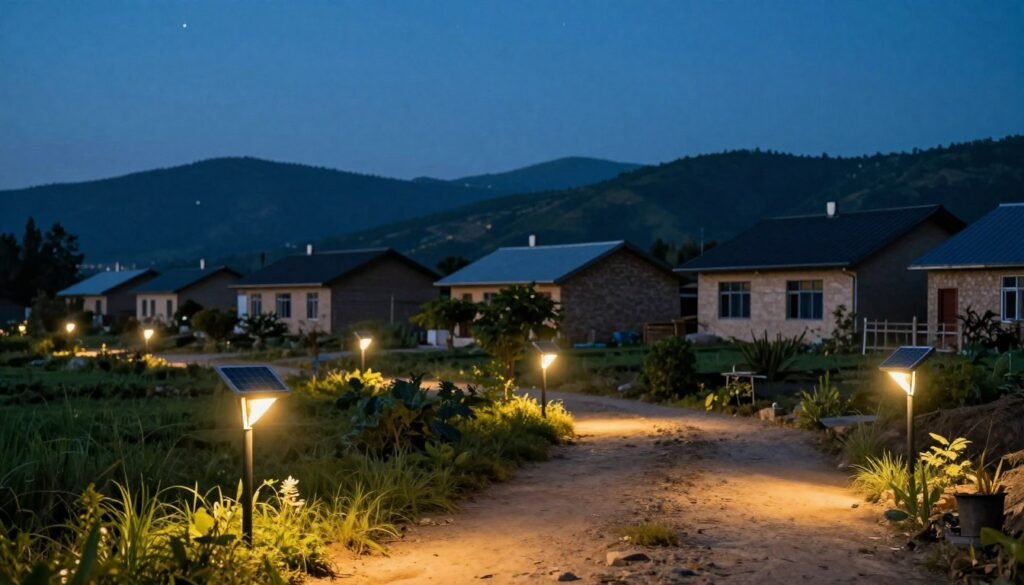
You’re planning lighting for a new high-end community in Chile. It has long cloudy seasons and big temperature swings. The site shows common rural lighting gaps and changing suburban needs that make evenings hard.
Your main goals are to keep sidewalks safe at night and reduce light pollution. You want lighting that works well in rain and cold without battery issues.
Rural and suburban lighting gaps
Many areas lack streetlights, with grid coverage under 20% in some places. Dark spots limit night markets, walks, and social life. You need to fill these gaps while keeping the area beautiful and well-designed.
Safety, social and economic drivers
Poor lighting is linked to more accidents at night and less safety feeling. It’s behind about 40% of rural nighttime incidents, hurting local business and social events.
Quickly installing solar lights can bring back evening activities and increase property value. Lighting that’s safe and also decorative can enhance the community’s look.
Why grid extension is often impractical
Extending utility lines over steep terrain costs over $100,000 per kilometer and takes months. High costs and ongoing fees make traditional power unaffordable for many.
Off-grid lighting offers independence, lower costs, and fast setup. It doesn’t need trenches or wiring. Established manufacturers have shown quick installations, making a big impact fast.
To see a similar project and its details, check out this case study on a Chile residential project: solar street and garden lighting project.
Solar garden light performance requirements
To ensure reliable night lighting without grid power, set clear performance targets. Choose panels and batteries that offer full solar autonomy and predictable lighting. Small design changes can double system usefulness during cloudy stretches.
Grid independence and charging efficiency targets
Opt for panels with conversion rates over 22% for efficient battery charging. Aim for systems that charge in 6.7–10 hours under typical insolation. This ensures zero electricity bills and dependable nightly operation.
Durability requirements for outdoor climates (IP65, IK08)
Specify IP65 solar lights for dust and heavy rain protection, and IK08 for impact resistance. Use aluminum alloy housings, polycarbonate lenses, and dual anti-rust coatings. These materials withstand UV, corrosion, and mechanical stress in varied U.S. climates.
Runtime, autonomy and expected cycle life (>1500 cycles)
Design for multi-night performance to keep paths lit during cloudy periods. Adaptive systems can extend runtime up to ten days at reduced brightness while preserving battery health.
| Requirement | Target | Benefit |
|---|---|---|
| Solar panel conversion | >22% charging efficiency | Faster recharge, reliable daily autonomy |
| Ingress protection | IP65 solar lights | Weatherproof for rain and dust |
| Impact resistance | IK08 impact resistance | Vandal and mechanical durability |
| Battery longevity | >1500 cycles battery cycle life | Multi-year service with EV-grade chemistry |
| Lighting performance | Multi-night lighting autonomy | Consistent safety during cloudy spells |
| Operational range | -20°C to +60°C | Reliable operation across U.S. climates |
| Energy management | MPPT charge controllers | Maximized charging efficiency and battery protection |
System components and specifications
To build a reliable solar garden light, you need a clear parts list. This section will cover battery chemistry, solar panels, LEDs, and smart controllers. You’ll learn how to pick the right parts for your site and goals.
Long-life lithium battery technology and temperature range
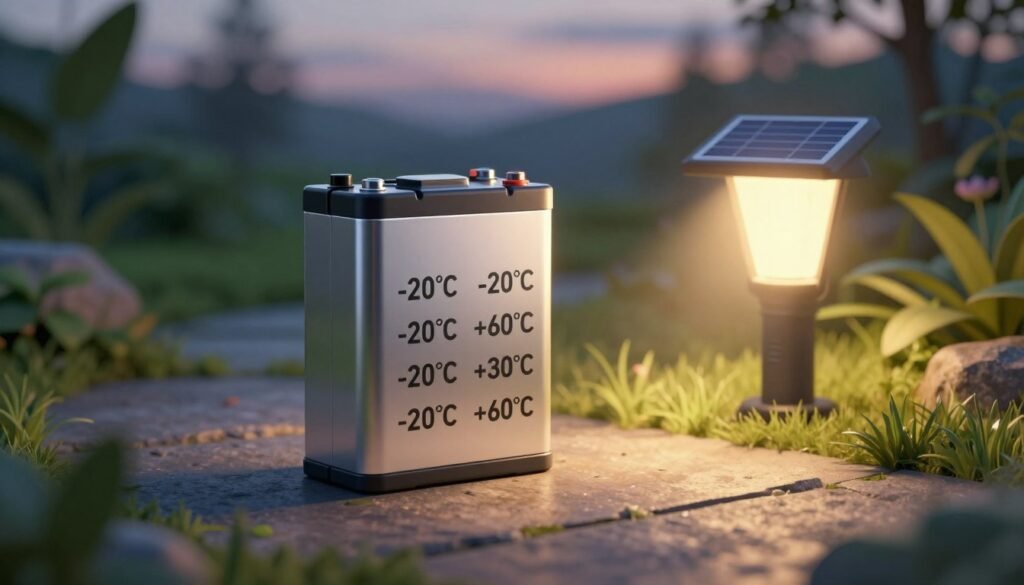
Choose EV-grade lithium cells or LiFePO4 packs for a wide operating range. A lithium battery works well from -20°C to +60°C. This means it performs well in cold winters and hot summers.
Expect over 1,500 cycles with quality cells. They have low capacity fade and longer warranties than NiMH or NiCd.
High-efficiency monocrystalline solar panels
Use monocrystalline panels with >22% conversion efficiency. They capture more energy per square foot. This means you need fewer panels and they charge faster.
Look for tempered glass, strong frames, and UV-resistant encapsulation. This ensures they last long outdoors.
LED modules, lumens and color temperature choices
Choose high-efficiency modules with proven chips like OSRAM LED 5700K. This gives a daylight-like color. Aim for luminous efficacy to keep wattage low while delivering enough light.
Go for CRI (Ra) above 70 for clear visibility. This is important for seeing things clearly.
Charge controllers and smart management
An MPPT charge controller charges about 20–30% better than PWM. Use ALS TCS algorithms to extend runtime and protect cells. ALS adapts output for changing weather.
TCS throttles charging above 35°C to reduce degradation. This helps your system last longer.
Optional sensors and mechanics
Add PIR motion sensors for 120° coverage and about an 8 m range. This boosts output on demand and saves energy at night. Use photocell dusk-to-dawn control for full autonomy.
Choose aluminum-alloy housings with anti-rust coatings and polycarbonate elements. A modular internal layout makes field replacement faster and lowers maintenance time.
| Component | Key spec | Benefit |
|---|---|---|
| Battery | LiFePO4 or EV-grade cells; rated -20°C to +60°C; >1,500 cycles | Stable performance across climates; long life; lower total cost of ownership |
| Solar panel | Monocrystalline >22% conversion; tempered glass; UV encapsulation | Higher energy harvest; smaller footprint; faster recharge |
| LED module | OSRAM LED 5700K; high lm/W; CRI Ra>70 | Daylight color, high visual clarity, efficient lumen output |
| Controller | MPPT charge controller with ALS TCS and protection | Maximized charging, adaptive runtime control, battery protection |
| Sensors & mechanics | PIR 120°/8 m, photocell; aluminum alloy housing | Energy saving, autonomous operation, durable installation |
Design and product selection for varied applications
Choose the right form factors based on site needs and installation skills. For small gardens and pathways, integrated solar lights are a great choice. They are compact and wire-free, making installation easier and faster.
For bigger areas like municipal streets or long rural roads, a split solar system is better. It has a larger battery and better thermal separation for longer life.
Match mounting choices to the corridor type and target lux levels. For narrow garden paths, use lower mounting height spacing of 3–4 meters. Choose 2,000–4,000 lm fixtures for these areas.
For wider neighborhood roads, use 6–10 meter poles with 6,000–10,000 lm luminaires. Space these 15–32 meters apart to ensure even lighting.
Light distribution is key for safety and comfort. Use Type II light distribution for sidewalks and streets. This pattern prevents dark spots and ensures even lighting.
Modular solar lighting is great for reducing downtime and long-term costs. These systems have swappable batteries, controller modules, and LED arrays. You can repair them on site in under 20 minutes. This approach supports warranty servicing and targeted replacements, cutting maintenance budgets and e-waste.
Below is a compact comparison to guide your selection between common options.
| Application | Recommended Form | Mounting Height & Spacing | Typical Lumen Range | Key Benefit |
|---|---|---|---|---|
| Private gardens & pathways | Integrated solar lights | 3–4 m, 6–12 m spacing | 2,000–4,000 lm | Quick install, low cost |
| Residential streets | Split solar system or modular solar lighting | 6–8 m, 12–20 m spacing | 4,000–8,000 lm | Better thermal control, scalability |
| Rural roads & arterials | Split solar system with modular components | 8–10 m, 15–32 m spacing | 6,000–10,000 lm | High output, long autonomy |
Smart features that extend reliable night lighting
Smart controls help keep lights on when it’s dark. An Adaptive Lighting System adjusts brightness and time based on weather. It predicts cloud cover and lowers light output by 25% to 100%.
Field tests show this system can keep lights on for about 30% longer than usual. This is compared to lights that always shine at the same level.
PIR motion sensors help save energy. They detect movement up to 120° and 8 meters away. This lets your system use less power until someone walks by.
There are special settings for energy savings. Mode M1 starts at 30% and goes to 100% when someone moves. Mode M2 shines brightly for five hours, then dims to 25% with boosts for movement. Mode M3 stays at 70% for steady light.
Keeping the battery cool is key. It stops batteries from wearing out too fast and helps them charge better in cold. The system keeps battery temperatures below 35°C to slow down wear.
In cold weather, it charges batteries safely. This keeps the system working well from -20°C to +60°C.
Using all three features together is best. The Adaptive Lighting System, PIR motion sensors, and battery control save energy. They also protect batteries for longer, keeping your lights on through cloudy days.
Implementation, installation and commissioning
Start with a site walk to check the layout, soil type, and access. Use illumination modeling to plan pole height, lumens, and spacing. This ensures even lighting on paths, roads, and parking without dark spots.
Customize designs for road widths of 2–10 m. Remember to use C20 mix concrete and follow bolt patterns for secure mounts.
Pre-installation planning
Make detailed drawings for mounting heights, foundation sizes, and cable runs. Run simulations to check LED output and daylight charging. This confirms if the lights will work on their own.
Get permits and plan access times to avoid delays on installation day.
Efficient transport and handling
Use strong, waterproof packaging for modules and poles to prevent damage. Include foam cradles and sealed covers for panels and controllers. This keeps them safe during transport.
Plan logistics to reduce handling and lower the risk of losing parts during transport.
Rapid installation steps
For modular units, start by digging foundations, pouring cages, and setting anchor bolts. Then, hoist the pole and secure brackets. Mount the unit on the pole.
Typically, a trained crew can install one light in under 30 minutes.
Commissioning and checks
During commissioning, check battery and controller readouts. Make sure LEDs are working right: red for low, orange for medium, and green for high.
Test the lights’ behavior and motion modes. Check MPPT readings and light distribution against the model.
Seal connections and check gaskets for weatherproofing. Give a handover pack with maintenance tips. Offer regular checks to keep the lights running and batteries lasting longer.
For more on all-in-one systems and packing, see this product overview.
Project outcomes: social, economic and environmental impact
Using long-life solar garden lights brings many benefits. Studies show a 40% drop in accidents in rural areas. Also, people feel 30% safer at night.
These lights make night markets come back to life. They also keep neighborhoods lively and safe in the evenings.
Switching to solar power cuts down on electricity costs. Big projects save over $50,000 a year. The lights are easy to maintain, thanks to their design and batteries.
This means you can save money and enjoy fewer outages. The lights pay for themselves in about three years.
Going solar also helps the environment. It cuts down on CO2 emissions by a lot. Some projects reduce over 10 tons of CO2 each year.
Using lithium batteries and replaceable parts is better for the planet. It means less waste and more green benefits.
Investing in solar lighting brings many benefits. It makes people trust their local government more. It also helps cities meet green goals and win more funding.
The impact of solar lights goes beyond just lighting. It improves lives and boosts the local economy.
| Metric | Typical Result | Benefit to You |
|---|---|---|
| Accident rate | -40% in documented rural deployments | Fewer collisions and safer travel after dark |
| Perceived safety | +30% among residents | Higher foot traffic and longer evening commerce |
| Annual electricity savings | $50,000+ for larger projects | Lower operating budgets and reallocated funds |
| Payback period | ~3 years | Rapid ROI solar garden light for planners |
| CO₂ reduction | >10 tons annually in some scopes | Measurable climate benefit from operations |
| Equipment lifecycle | >1500 battery cycles with modular parts | Lower e-waste and maintenance costs |
Conclusion
This solar garden light case study highlights the importance of choosing the right components. Opt for long-life lithium battery packs, high-efficiency monocrystalline panels, and OSRAM-grade LED modules for reliable outdoor lighting. These systems come with MPPT charge controllers and smart features like ALS, PIR, and temperature control.
They offer true grid independence, multi-day autonomy in poor weather, and fast installation. This makes them ideal for sustainable garden lighting.
Avoid cheap disposable lawn lights that use NiMH or NiCd cells and flimsy plastic panels. They underperform and contribute to e-waste. Instead, invest in EV-grade lithium batteries. These are rated for more than 1,500 cycles and operate from -20°C to +60°C.
This ensures predictable runtime and lower lifecycle costs. Your practical benefits include lower operating expenses, reduced maintenance, and strong social and environmental returns.
If you need more detail on pros and cons, read this short guide on solar lighting options from Garden Lighting London: solar garden lighting pros and cons.
When upgrading outdoor lighting for a property or community, focus on proven components. Choose adaptive energy management and modular designs. This approach offers reliable outdoor lighting, measurable ROI, and the lasting benefits of sustainable garden lighting.