
Off-grid lighting is changing how people in remote U.S. homes get light. This study looks at a mini solar lighting system for single homes and small groups in rural areas. It uses solar LED lights, a small battery, and a simple setup to meet evening needs and charge phones.
Design and quality checks use modern mobile labs and on-site tests. Mobile Quality Control Vans in India show how quick, field tests and GPS reports build trust. These methods help quickly check the small solar home systems in remote U.S. areas.
Safety and durability are key. New isolation switch tech and standards like IEC and UL help choose parts for tough environments. Using certified parts lowers failure risk and supports remote monitoring for a reliable solar kit.
Community factors also play a big role. Real events show that secure communication and local help are vital for systems in isolated areas. For rural solar lighting, building trust and clear maintenance plans are as important as the tech itself.
Key Takeaways
- A mini solar lighting system can provide reliable off-grid lighting and basic charging for rural households.
- Mobile lab–inspired testing and GPS-linked reporting improve field quality assurance and transparency.
- Choose IEC/UL-certified components and modern isolation switches for safety and environmental resilience.
- Integrating remote monitoring supports system upkeep and rapid response to failures.
- Community engagement and clear maintenance plans increase adoption and long-term success.
Project overview and objectives
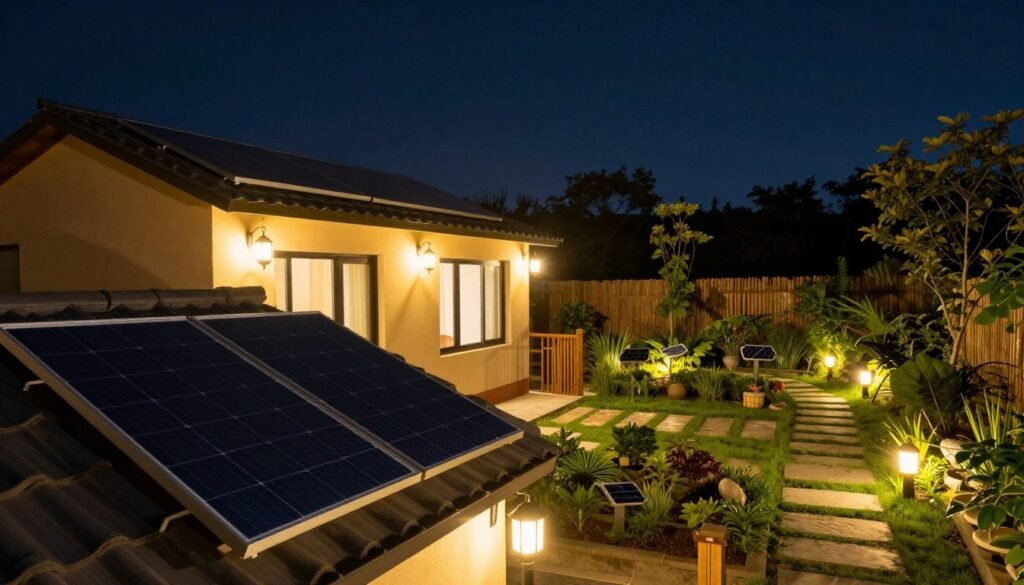
This project aims to create a simple, easy-to-use off-grid lighting solution for homes in rural areas. It’s designed to meet the need for light for daily tasks, studying, security, and communication in remote places. It offers a safer option than kerosene lamps and dangerous wiring.
Background and need for lighting in rural and residential areas
In the U.S., many homes in Alaska, Montana, Appalachia, and tribal lands don’t have reliable electricity. People use unsafe wiring or open-flame lights, leading to fires and limited evening activities. This also makes communication hard during storms or winter.
Remote villages, only accessible by long walks or seasonal roads, highlight the need for reliable lighting. Small solar systems provide enough light without needing the grid. They are safe, support evening activities, and are easy to maintain.
Scope of the case study and target outcomes
The study focuses on single-family homes and small rural areas with a standard solar kit. The goal is to provide 4–8 hours of light at 200–800 lumens each evening. The system should last two to three cloudy days and last three to five years.
Testing will use mobile labs and digital logging to check how well the system works in real life. We’ll look at how it changes study time, productivity, safety, and maintenance needs. We aim to meet IEC and UL standards for safe and easy scaling.
Key stakeholders and geographic focus
Key players include homeowners, electricians, community leaders, installers, and manufacturers. Quality teams, procurement officers, and funders like state energy offices and USDA Rural Development will help roll it out.
The focus is on U.S. rural areas with off-grid populations and similar challenges worldwide. We’ll study how to adapt the design and standards for different rural settings.
Site selection, baseline conditions, and community profile
Choosing the right places for solar systems is key. It’s about finding a balance between what’s needed technically and what’s possible locally. This guide helps teams, partners, and funders pick the best spots for solar lighting projects in off-grid areas.

Criteria for choosing demonstration sites in off-grid residential and rural communities
Look for places that are easy to get to for installers and for regular check-ups. The state of the roads, how far trails are, and if they close in certain seasons all matter a lot.
Focus on homes with kids, the elderly, or small businesses. This way, you can see how solar lights affect their lives. Having the community on board makes it easier to keep the systems running well.
Choose areas with different weather conditions. This includes hot, humid, rainy, or snowy places. This helps test how well the systems work. Also, pick places where bad lighting is a big problem to show how solar lights can help.
Baseline energy access, typical household loads, and lighting patterns
First, find out how people get their energy before you start. Many homes use kerosene, candles, or unsafe wiring for light at night.
Households in rural areas usually need light at three to four spots, charge phones, and sometimes watch TV or listen to the radio. They often use light for four to six hours in the evening.
Map out when and where people use light. Make sure the system can charge things and provide light for daily tasks.
Socioeconomic factors, seasonal considerations, and local infrastructure constraints
People’s income affects how much they can pay and if they can keep things running. Building trust with the community is important. Use local partners and offer clear warranties.
Think about how the seasons change the amount of sunlight. Monsoons, cloudy periods, and snow can reduce how much energy you can make. Make sure batteries can last for a few days if needed.
Look at the local infrastructure too. Things like bad roads, spotty phone or internet, and few skilled workers can make things harder. Choose strong parts, make it easy for users to fix things, and have ways to check systems from afar.
| Factor | Key Considerations | Implication for Pilot Design |
|---|---|---|
| Accessibility | Road quality, trail length, seasonal closures | Plan installation windows, use modular kits, budget travel contingencies |
| Community profile | Presence of school-age children, elderly, small businesses | Prioritize households that show clear socio-economic benefit |
| Baseline energy access | Kerosene/candles reliance, DIY wiring risks | Design safe replacements and include user training |
| Rural household loads | 3–4 LED points, phone charging, radio/TV | Right-size panel and battery; include portable task lights |
| Seasonal solar availability | Monsoons, cloud seasons, snow cover | Increase battery autonomy and consider hybrid or community charging options |
| Infrastructure constraints | Poor connectivity, limited local technicians | Use rugged components, simple user maintenance guides, and mobile QA tools |
Design and components of the Mini solar lighting system
This mini system is both compact and tough. It has 10–50 W framed PV modules, a controller, a small battery, and efficient LED lights. It can be mounted on roofs or poles, making it perfect for homes and rural areas.
System architecture: solar panel, controller, battery, LEDs, and mounting
The solar panels are chosen for their efficiency. They have IP65 junction boxes and tilt based on the site’s latitude. The charge controllers use MPPT for better energy capture or PWM for cost savings.
The battery size is set for 2–3 days of use. It’s usually a 12 V 20–50 Ah LiFePO4 battery for longer life. For those who prioritize upfront cost, sealed lead-acid batteries are used.
The LED lights are very efficient, using 100–200 lm/W. They provide 200–800 lumens each, with a color temperature of 2700–4000K for comfort. Keeping the system on 12 V DC reduces energy loss.
Component selection criteria: efficiency, durability, certifications and environmental suitability
High-efficiency panels and LEDs are chosen to save space and money. The materials are rated IP65/IP67 for outdoor use and UV-stable for durability. Look for IEC UL certified components, like panels with IEC 61215/61730 and BOS parts meeting UL or IEC standards.
Environmental suitability is key. Use salt-spray resistant mounts and wide temperature ranges. For humid or dusty areas, sealed enclosures and ventilation for batteries are essential.
Integration of safety features and isolation switch considerations for maintenance and protection
An isolation switch is included for safe maintenance and emergency shutdown. Choose DC-rated switches that can handle outdoor conditions, with high electrical isolation and optional remote monitoring.
System protection includes overcurrent fuses or breakers, surge protection devices, and clear labels for safety. For sensitive areas, use GMR or magnetic-coupling switches and EMI-optimized components to reduce interference.
Scalability and modular options for varying household sizes and community needs
Design modular kits for easy upgrades. Use 12 V DC plug-and-play connectors for simple repairs and additions.
Offer options for single-house lighting and community microgrids. Provide clear purchasing guides, cost comparisons, and installation instructions. For more information, visit a solar generator website.
Installation, testing, and quality assurance processes
Plan carefully before starting to avoid mistakes and ensure systems work well. Check for shading, roof strength, theft risks, and local materials. Use the right anchors and theft-resistant fixtures.
Weatherproof wiring is key in rural areas. Use the right wire gauge for DC, seal cable glands, and protect against rodents and UV. Mark wires clearly and install an easy-to-reach switch for maintenance.
Use mobile lab QA on-site to check systems fast without stopping service. Tools like PV irradiance meters and thermal imagers find issues quickly. Keep records and GPS-tag visits for tracking.
Testing should be quick and easy. Check voltage and current under real sun conditions and compare to specs. Also, measure panel temperature and sun exposure for later checks.
Do a battery capacity test during setup. Calibrate the battery, discharge it, and log its behavior. Make sure voltage under load matches what you expect for runtime.
Check light levels where people work. Measure lux at desks, cooking areas, and entryways. Aim for 150–300 lux and note initial readings for future checks.
Use digital monitoring systems for ongoing checks. Set up controllers or loggers with GSM, LoRa, or Wi-Fi. This captures important data for remote review.
Make a simple dashboard for easy monitoring. Show GPS-tagged logs, alerts, and maintenance history. Remote monitoring helps find problems early and supports better maintenance.
Train local techs and users with simple guides and hands-on practice. Teach them basic troubleshooting, safe practices, and how to read system indicators. Good training cuts downtime and keeps systems running well.
Performance results, user feedback, and lessons learned
The field trial gave us detailed system performance results and user feedback. Teams tracked how long the lights lasted each night, how bright they were, and how long they worked on sunny and cloudy days. They also watched how the panels and batteries performed over time to see when they might need to be replaced.
The lights worked for 6–10 hours each night, even in winter. The brightness of the LEDs stayed pretty consistent for the first year. But, the panels and batteries didn’t last as long in dusty or shaded areas.
LiFePO4 batteries lasted longer and lost less charge than sealed lead-acid ones. How long the lights worked depended on the battery’s health and the sun’s strength. This data helped predict when the batteries would need to be replaced, saving money in the long run.
People’s lives changed with the new lighting. Kids studied longer, and families made more money in the evenings. Using kerosene lamps went down, making homes healthier and saving money on fuel.
Charging phones at home made it easier to stay connected. Users wanted brighter lights, easier controls, and clear information about warranties. This feedback helped improve what was bought and how it was supported.
Looking at maintenance logs showed common problems. Issues like loose connections, corroded parts, and battery loss were common. Isolation switch failures often happened because of corrosion or the wrong current rating.
Teams fixed these problems by choosing better switches and protecting them from the environment. Using data to plan maintenance cut down on unexpected failures and saved time and money.
The table below shows how different parts and failures compare.
| Metric | LiFePO4 System | Sealed Lead-Acid System | Common Failure Drivers |
|---|---|---|---|
| Average usable runtime (hours/night) | 8–10 | 6–8 | Battery health, seasonal insolation |
| Typical lumen output retention (year 1) | 92–95% | 90–94% | LED quality, thermal stress |
| Annual panel output fade | 2–3% | 2–4% | soiling, partial shading |
| Expected cycle life | 2000–4000 cycles | 300–800 cycles | Depth of discharge, temperature |
| Isolation switch reliability | High with IP66, IEC/UL rating | Moderate unless upgraded | environmental corrosion, contact wear |
| Estimated replacement interval | 8–12 years (battery modules replaced once) | 3–6 years | maintenance quality, usage patterns |
| Lifecycle cost analysis (TCO drivers) | Higher upfront, lower TCO over life | Lower upfront, higher TCO over life | replacement cycles, fuel savings, health savings |
Choosing the right parts is key. Look for certified components and designs that are easy to fix. Using the right isolation switches saves time and money.
Thinking about the cost over time helps make smart choices. Mobile checks and clear information from suppliers make sure products are reliable and sustainable.
Conclusion
A well-designed mini solar lighting system can provide safe, affordable light and phone charging for off-grid homes. It includes solar panels, a charge controller, LiFePO4 batteries, LEDs, and isolation switches. This setup is reliable and cost-effective for rural areas in the U.S. and similar places.
Choosing the right components is key. Look for IEC/UL certification, ruggedness, and long-lasting performance. This ensures the system works well and saves money in the long run.
Mobile quality checks and digital monitoring are also important. They help track performance and catch issues early. This approach makes maintenance easier and helps communities grow with solar power.
Using certified isolation switches and remote monitoring tools helps avoid problems. This makes the system more reliable and easier to maintain. It also helps keep costs down.
For better results, design systems that can grow with needs. Train local experts for upkeep. And always think about the total cost of owning the system.
Next steps include picking the right parts, designing for growth, and training local teams. These actions will help make solar power a lasting solution for homes off the grid.