
This case study looks at a solar street light project in major US cities. It covers the technical design, installation, and results of an off-grid street light project. The project lights up busy city streets and suburban areas.
The project is in cities like New York, Los Angeles, Phoenix, and Seattle. It shows how electricians, installers, and others work together. They follow specific steps to set up and check the lights, ensuring they work well and meet expectations.
We also explore how the project’s success was influenced by 2025–2026 trade changes. This study connects the choice of parts to the lights’ reliability, energy savings, and safety on roads.
Key Takeaways
- Solar street lights can meet road standards, cut down on grid use, and save money.
- A detailed checklist for setting up lights helps keep them running smoothly and makes maintenance easier.
- Working together—electricians, installers, and city staff—is key for quick and safe installation.
- Being open about the supply chain and how parts are chosen affects the cost and warranty of the system.
- Results from the project show it can pay off and make nights safer in cities.
Project Overview and Objectives
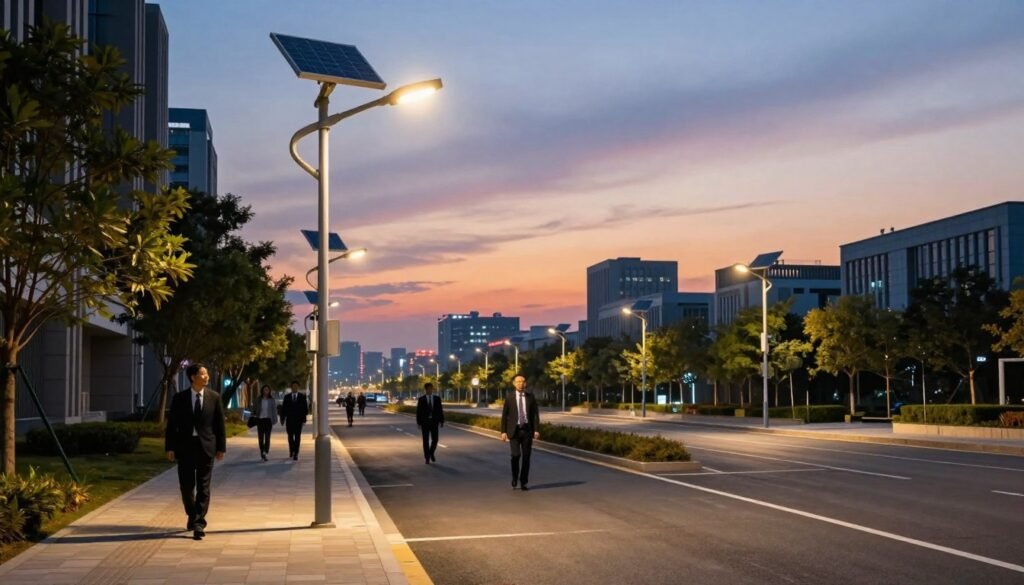
This project aims to light up busy city streets at night. It aims to reduce car and pedestrian accidents, prevent crime, and support businesses that are open all day. Cities like New York, Los Angeles, and Chicago were chosen based on accident rates, foot traffic, and the need for new power lines.
Context and motivation for urban road illumination
Many cities have old power lines and expensive digging to fix them. Solar lights are a reliable choice that works even when the power goes out. Cities want to use solar power to reduce pollution and save money on old infrastructure.
Project location selection and urban needs
When picking places for solar street lights, we looked at areas that are busy at night and often have power outages. We chose spots with a lot of accidents, foot traffic, and where fixing the power lines was too expensive. We mapped out areas in big cities to make sure the lights are safe and easy to install.
Primary goals: safety, sustainability, and cost savings
The main goal is to make streets safer by meeting lighting standards. We want to use solar and LED lights to reduce pollution. We also aim to save money by avoiding digging and cutting energy costs, making it affordable for cities.
We planned how to work with electricians, sales teams, drivers, and installers. This way, the project can smoothly move to the city’s maintenance team. For more information, visit Aisen Solar Energy for details on solar street lights.
Site Assessment and Design Strategy
A thorough site assessment for solar lighting is key for design choices in cities. Teams used traffic counts, daylight modeling, and climate data. This helped match light levels to real conditions. Working closely with local staff made the planning smooth.

The design focused on traffic patterns in major cities. Roads with more traffic got brighter lights and closer poles. Bus stops, intersections, and crosswalks got extra light that dims when not needed.
Environmental studies looked at how much sun each city gets. Places like Phoenix needed smaller solar panels due to lots of sun. But cities like Seattle needed bigger panels and more batteries for night use.
Designs also considered how long the lights would last. In coastal cities like San Diego, lights were made to resist salt damage. In colder places, like Milwaukee, lights were made to work in cold temperatures.
Getting everyone involved was important. This included city officials, police, and local businesses. Field teams helped with site visits and kept things moving.
Getting permits was a big task. Teams had to follow different rules in each city. They prepared all the needed documents to make the process easier.
Solar street light System Specifications and Components
This section talks about the hardware and how it’s put together for city streets. It combines small PV panels, strong batteries, precise LED lights, and smart controls. This mix aims to keep streets safe and well-lit while making upkeep easy.
High-efficiency PV panels and placement strategies
We picked monocrystalline PERC or N-type modules for their high efficiency. This made the panels smaller and more efficient. We used fixed-tilt mounts for the panels.
In places with shiny pavement, we used bifacial modules to catch extra light. We placed the panels to avoid shadows from trees and buildings. The size of the panels varied based on how much sunlight each area gets.
Battery storage sizing, chemistry choices, and lifecycle expectations
We chose lithium iron phosphate batteries for their safety and long life. The goal was to have enough power for three to seven days, depending on the area.
The batteries came with warranties from five to ten years. They were expected to last over 3,000 cycles. We used special cooling and heating to keep the batteries working well in all weather.
LED luminaires, optics, and lumen output for roadway standards
We picked LED lights that met strict standards for brightness and evenness. The light output matched the height and spacing of the poles. We designed the optics to reduce glare and light pollution.
The color temperature of the lights was between 3000K and 4000K. This made the lights easy to see and pleasant to look at. We used special mounts to ensure the lights were evenly lit.
Smart controls, sensors, and remote monitoring integration
The smart controls used motion sensors and light sensors to adjust the light levels. This saved energy during quiet times. It also kept the streets safe.
Telemetry sent real-time data over cellular or LoRaWAN networks. This included updates on the lights’ status and battery levels. It helped with maintenance and keeping the lights running smoothly.
Installation, Logistics, and Workforce Considerations
Planning is key to a smooth transition from pilot to full deployment. A phased approach helps avoid disruptions. It also allows teams to test procedures in different climates like Phoenix, Seattle, and New York.
Project managers use a checklist for each corridor. They do immediate checks, thermal and power tests, and hand over to maintenance teams. This reduces rework and speeds up acceptance.
Project phasing and timeline for urban corridors
Pilot projects last 8–16 weeks from start to finish. After the pilots are validated, larger waves follow. Each urban corridor deployment has its own timeline.
- Site assessment and permitting: 4–12 weeks
- Procurement and manufacturing lead time: 8–20 weeks
- Civil works and foundations: 1–3 weeks per block section
- Electrical and pole installation: 1–2 weeks per block section
- Commissioning and testing: 1 week
Local workforce planning and relevant trades
Local talent is recruited to cut down travel costs and meet rules. Electricians, installers, truck drivers, sales reps, and maintenance techs are needed.
Training covers LiFePO4 battery handling and PV module care. It also includes remote monitoring and preventive maintenance. Working with city public works ensures smoother approvals.
Supply chain and sourcing risks informed by global trade dynamics
Procurement teams map suppliers by location, capacity, and compliance. Tariffs, export controls, and carbon reporting rules affect lead times and prices.
To mitigate risks, teams use multiple sources and pre-position spares. They also focus on delivery certainty and compliance with regulations.
| Phase | Typical Duration | Primary Risk | Mitigation |
|---|---|---|---|
| Site assessment & permitting | 4–12 weeks | Permitting delays, utility coordination | Early stakeholder engagement, permit tracker |
| Procurement & manufacturing | 8–20 weeks | Supply chain risks solar components, lead-time spikes | Dual sourcing, long-lead orders, inventory buffers |
| Civil works & foundations | 1–3 weeks per block | Ground conditions, traffic management | Geotech survey, phased lane closures |
| Electrical & pole installation | 1–2 weeks per block | Skilled labor availability | Local hiring, targeted training programs |
| Commissioning & handover | 1 week | Incomplete documentation, functional issues | Embarkation checklist, municipal acceptance walkthrough |
Performance Results, Energy Savings, and Reliability
The field evaluation used photometric surveys, energy logs, and maintenance records. It aimed to understand how the system works in real life. The data helped adjust control settings and plan for spare parts to meet city needs.
The lights met IES RP-8 standards for brightness and evenness on main and collector streets. Adjustments in urban areas improved uniformity. Police and traffic teams saw better visibility for pedestrians at key crosswalks.
PV production matched expected levels at all sites. Places like Phoenix and Los Angeles did better than predicted. Seattle, though cooler and cloudier, produced enough for nighttime use with smart controls.
Studies showed savings in utility costs and lamp replacements compared to old sodium lights. Financial models considered LED brightness loss and battery replacements over time. This helped cities plan their budgets.
Remote monitoring sent alerts and performance updates to field teams. This led to high uptime, over 95%, thanks to quick fixes and efficient dispatches. Regular checks also helped extend the life of the lights and mounts.
The maintenance plan included yearly checks, cleaning every two years in dusty areas, and battery health tests. LiFePO4 batteries were expected to last seven to ten years. Local electricians and city crews quickly swapped out batteries and lamps, keeping the system running smoothly.
| Metric | Phoenix / Los Angeles | Seattle / Milwaukee | Notes |
|---|---|---|---|
| Average daily PV yield (kWh) | 6.5 | 3.2 | Higher insolation increases charge margin |
| Average maintained illuminance (lux) | 12.5 | 11.8 | Meets IES RP-8 after tuning |
| System uptime | 96% | 94% | Remote resets reduced field calls |
| Projected battery replacement (years) | 7–9 | 8–10 | Based on cycles and ambient temps |
| Estimated simple payback | 6–9 years | 8–11 years | Includes maintenance and avoided utility costs |
Policy, Procurement, and Economic Context
Local policies and procurement choices played a big role in picking vendors and setting contract terms for the lighting program. Teams looked for traceability, lifecycle carbon reports, and clear warranties. This was to meet new rules after 2025 trade changes.
How procurement choices respond to regulatory and trade conditions
Legal teams considered tariff risks and customs delays when evaluating proposals. They asked for proof of where PV modules and batteries came from. This was to ensure compliance and lower risks from trade policies.
Funding models, incentives, and municipal budgeting
The project used a mix of city funds, state energy grants, and federal money from the Department of Energy and Department of Transportation. Performance contracts helped pay for upfront costs with energy savings. Municipal funds also included money for maintenance and upkeep.
Scaling the project across multiple US cities and regions
To grow solar lighting across the US, the team used standard specs and designs. These designs fit different climates and rules for installing lights. They used multiple vendors, staggered orders, and a central warehouse to avoid delays and help with logistics.
Operational playbooks captured lessons for New York, Los Angeles, Chicago, Houston, Phoenix, and Seattle. They adjusted PV sizes for different solar resources and added extra protection against corrosion for coastal areas.
- Standard procurement templates improved bid comparability.
- Lifecycle cost models included carbon accounting and replacement battery cycles.
- Budget alignment with fiscal cycles aided municipal funding solar projects planning.
Conclusion
This solar street light case study shows how well-designed systems can improve safety at night. They also save money over time in U.S. cities. By using site assessments and the right batteries, these systems work well in different climates.
Urban solar lighting does more than save energy. It also helps keep systems running smoothly with remote monitoring and standard maintenance. This teamwork ensures that cities like New York and Los Angeles can rely on these lights.
The study teaches us about choosing the right materials and planning for the workforce. It also shows how to fund and align policies for solar street lights. This information helps cities choose a reliable and sustainable lighting solution.