
This case study shows how to design and set up a solar garden light system for homes. It combines lessons from EverGen and partnerships with Tier 1 fixtures. It also uses DIY circuits like QX5252F to make reliable solar lights for yards and paths.
Choosing the right solar LED garden light involves picking efficient LEDs and driver ICs. You’ll also learn to pair small solar panels with NiMH packs. Sealing everything in jars or Plexiglas is key. This approach is affordable and meets the needs of solar lighting in the United States.
The study also talks about the trade-offs between DIY and commercial options. Knowing the difference between a homemade light and a Tier 1 fixture with a 10-year warranty is important. It helps you decide between cost, performance, and reliability for your home.
Key Takeaways
- Combine proven DIY circuits such as QX5252F builds with quality components to create effective solar garden light units.
- Select solar LED garden light parts that balance panel current (60–160 mA) with NiMH capacity for predictable runtime.
- Use simple sealed enclosures and silicone-covered wiring to improve durability in outdoor solar lighting United States climates.
- Prototype multiple units to refine costs and performance before wider deployment around your home.
- Compare DIY savings against commercial warranties and Tier 1 fixtures when planning long-term residential solar lighting solutions.
Project overview and goals for residential solar lighting
You will create small, efficient lights for paths, planters, and small areas in homes. These lights will use special circuits, solar panels, and batteries. This way, you can adjust how bright and long they last for each spot.
Scope and objectives
Your goal is to make these lights affordable, waterproof, and easy to make more. You’ll use a special driver to control how much light they give off. You’ll also test different sizes and battery types to fit each spot perfectly.
Designing the lights to be waterproof is key. You’ll use materials like silicone and Plexiglas to keep them dry. Try out different ways to attach the lights to find the best look and durability.
Why choose solar for residential outdoor spaces
Using solar power means no digging or wiring, making it easy to add lights to your home. It’s also cheaper to run and keeps your lights on during power outages. Studies show it can even save you money on your electricity bill.
Solar lights are also easy to grow with. You can buy parts in bulk to keep costs down. For small spaces, consider using solar caps or tiny panels that fit right into planters and birdbaths.
Key performance targets
Set clear goals for how well your lights should work. Aim for them to last all night in summer on small batteries. In winter, use bigger panels or bigger batteries to keep them going.
Make sure the lights can be bright or dim as needed. Use different parts to control how much light they give off. Match the size of the solar panel to the battery to avoid damage.
Make sure your lights can withstand the weather and last a long time. Aim for them to last for years, needing only occasional battery replacement. For inspiration, check out best selling solar garden light designs.
Design and components selection with emphasis on high-efficiency parts
You will pick parts to meet runtime, cost, and durability targets while keeping assembly simple. Start with a clear plan for LED output, solar charging, battery capacity, and a resilient enclosure. Use quality components that match each other so charging and load behavior stay predictable.
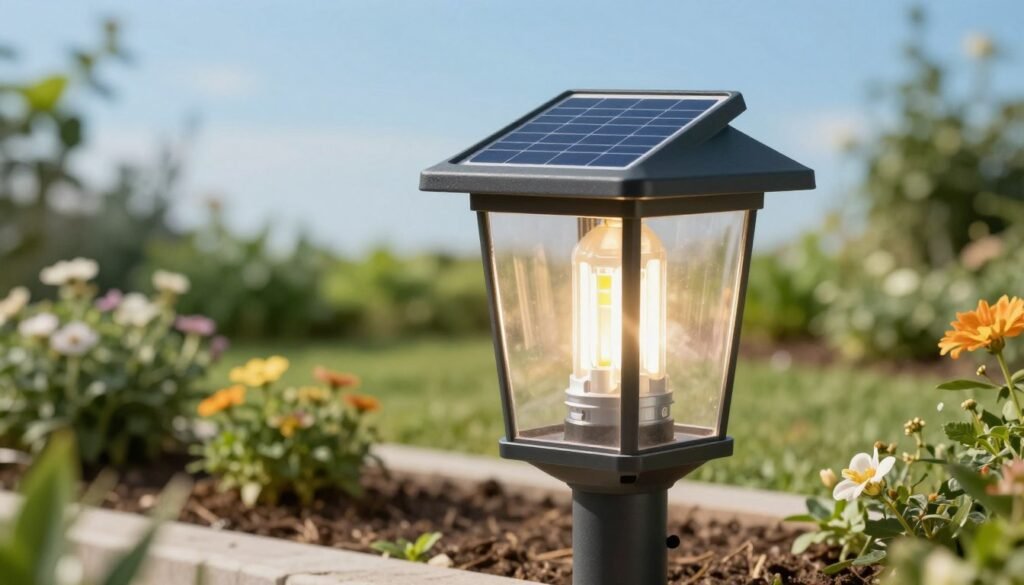
LED choice drives perceived brightness and current draw. For single-color white LEDs target roughly 20 mA for efficient light. If you want color effects, an RGB slow-flash 5mm LED with a 0.1 µF capacitor and a BAT85 diode gives attractive patterns with minimal parts. Manage LED current and nighttime behavior with an LED driver QX5252F; the chip handles low light start and a range from a few milliamps up to hundreds of milliamps depending on configuration.
Use the inductor brightness chart to tune output. Typical inductance-to-current pairs let you estimate DC output and set your target lumens per LED. For example, 330 µH yields about 11 mA while 100 µH yields roughly 34.5 mA. A quick rule for design is 3750 divided by the desired mA to estimate inductance. Keep in mind higher currents shorten runtime and stress batteries.
LED choice and driver strategy
Your driver strategy should pair LED forward voltage and chosen current with the QX5252F’s behavior. Configure the driver so it shuts down or dims in deep discharge and avoids overdriving LEDs. For decorative fixtures you can add simple color-change circuitry while keeping the main driver for reliable night operation.
Solar panels and charging considerations
Select panels that match battery chemistry and expected insolation. For compact units you can use a solar panel selection 2V 60mA for typical garden caps. In shaded sites or when charging AA cells, choose higher-current panels such as 160 mA 2V options to recover lost energy.
Your charge approach should avoid overcharging because basic QX5252F circuits often lack active overcharge protection. Match panel current to battery tolerance: AA cells accept higher charge currents than AAA. Buy panels in bulk to lower unit cost and consider mounting angle to maximize seasonal output.
Battery type and capacity planning
NiMH battery planning matters for runtime and winter performance. Choose AAA NiMH for compact designs and AA for longer runtime and lower internal resistance in cold weather. Size cell capacity so panel current equals safe trickle charge for the battery chemistry.
Plan for periodic replacement and manage heat inside the housing. You can reduce temperature stress by painting battery caps white or keeping internal components away from direct heat paths. Regular inspection extends service life.
Waterproofing and enclosure materials
A reliable waterproof garden light enclosure prevents the most common failures. Use clear silicone or white silicone sealants at panel edges and around wire penetrations. Epoxy can reinforce panel seams on long-run batches where repair is impractical.
Practical enclosure options include trimmed crystal shot glasses, jars, and custom Plexiglas lids that accept a panel mount. Glue panels to Plexiglas with silicone, drill small sealed holes for wires, and secure batteries and boards with silicone dabs to avoid shorting from movement. Test seals with soapy water before final assembly.
You can find a broad inventory of panels, battery boxes, LEDs, and accessories from reputable suppliers when you need replacement parts or bulk buys; check product lines such as Inlux Solar for high-efficiency panels and durable fixtures via solar light parts.
Build process and prototyping informed by DIY circuit data
Start by gathering parts for a QX5252F circuit build. Use small perfboard layouts for single-color and RGB units. Keep essential parts ready: QX5252F IC, a 220 µH inductor, BAT85 diode, 0.1 µF capacitor, and LEDs.
Also, have 26 AWG silicone-coated wire, AAA/AA NiMH cells, and a 2V solar panel. A clear wiring convention helps avoid mistakes: red for battery positive, yellow for LED positive, white for solar positive, and black for common ground.
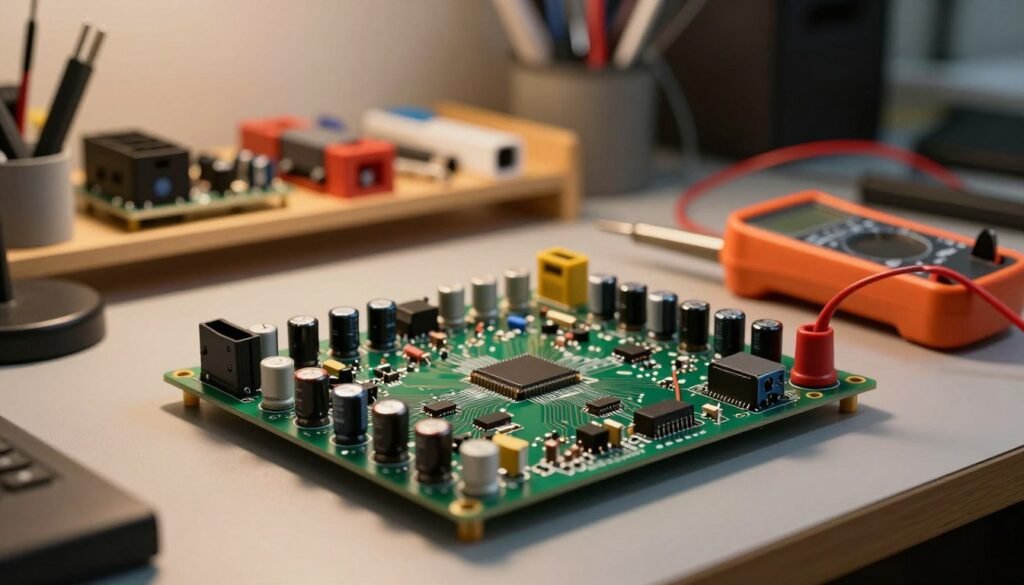
Circuit components and configuration
Trim perfboard into 4×6 hole pieces for RGB builds and 3×5 for single-color units. Bend IC pins and component leads on the copper side. This makes them reach adjacent pads.
Use the BAT85 and 0.1 µF across color pins for RGB switching. Choose inductors from a selection chart to balance brightness and runtime.
Use 26 AWG silicone wire for solar LED wiring. Twist and solder ground wires together for a solid common ground. Label harnesses for easier assembly later.
Assembly, soldering, and testing workflow
Sand battery terminals lightly and tack-solder quickly to avoid heat damage. Protect joints with heat shrink tubing or silicone. Use silicone adhesive to secure components and epoxy to seal solar panel edges.
After soldering, test each unit immediately. A charged cell should light the LED. Use a multimeter for troubleshooting if a unit fails to light. Keep solder joints neat and use a temperature-controlled iron for consistent results.
Prototyping multiple units and cost optimization
Buy parts in bulk, like QX5252F chips and inductors, to lower costs. Glass containers and batteries are expensive, so standardize containers or use painted caps.
- Cut multiple perfboard patterns from a single panel to maximize yield.
- Test a range of inductors guided by the inductor selection chart to find the best trade-off between brightness and runtime.
- Use consistent solar LED wiring harnesses so you can swap parts quickly during outdoor validation.
Scale assembly by batching steps: soldering, adhesive curing, sealing, and final testing in stages. Follow iterative firmware and editor workflows shown in this demo write-up to coordinate pattern testing and outdoors trials with your prototypes: Lunar LED interaction project.
Field installation, performance results, and maintenance outcomes
A clear installation plan makes setup faster and better. For solar garden lights, choose flat, sunny spots in the U.S. Place them on planters, pathway edges, or tree rings to highlight areas and avoid shade.
If sun is limited, use higher-output panels or upgrade cells to AA. This helps keep lights on longer. Avoid areas with frequent water unless the light is waterproofed well. Test lights in birdbaths or shot-glasses before using them.
https://www.youtube.com/watch?v=cjLL_aXPmnE
Installation strategy and site placement
Arrange lights to avoid shading from other panels. Place them where lawn tools and foot traffic won’t hit them. Use small mounts or stainless fasteners for a strong hold.
When near water, use silicone and epoxy to prevent water damage. Keep switches dry. Make battery access easy for future swaps.
Measured performance and runtime data
Runtime data shows different times based on inductor and battery size. A 330 uH inductor gives about 11 mA for long times. A 220 uH inductor gives around 15.5 mA for a good balance. A 33 uH inductor draws ~110 mA for quick, bright light.
In summer, lights with AAA NiMH and good sun stay on till morning. In winter, they last less. Use AA cells with bigger panels for consistent light all year. Record nightly runtimes for two weeks when setting up each layout.
| Component | Typical Draw | Expected Night Runtime | Notes |
|---|---|---|---|
| 330 uH inductor + AAA NiMH | ~11 mA | 8–12 hours (summer) | Low brightness, long runtime |
| 220 uH inductor + AAA NiMH | ~15.5 mA | 6–9 hours (summer) | Balanced output and runtime |
| 33 uH inductor + AA cells | ~110 mA | 1–3 hours (high output) | High brightness, short duration |
| Higher-output panel + AA cells | Varies | 6–10 hours (winter improved) | Recommended for low-sun sites |
Durability, failure modes, and maintenance
The biggest problem is water getting in and causing damage. Fix this by adding silicone seals and epoxy. Also, avoid exposed switches. Check seals every season.
Batteries get weaker over time. Make them easy to replace without taking apart the light. Use strong adhesives or clips to keep parts together.
For easy, worry-free lighting, consider Tier 1 commercial fixtures. They cost more but save money in the long run and offer support when needed.
User feedback and community impact
People love the look and extra light at night. They like color-changing LEDs and clear containers. Simple designs are great for neighborhood projects.
Community lighting makes streets safer and parks more inviting. It also saves money and avoids grid problems. Group installations make areas more appealing and usable.
For community projects, use bulk parts and simple maintenance. This makes it easy to run giveaways or shared programs. Keep track of maintenance to ensure smooth operations and support future growth.
Conclusion
This solar garden light case study shows you can make reliable, attractive lights. Choose the right parts and seal them well. Our tests used a QX5252F circuit, 2V panels, and NiMH cells for good night light.
Make sure to waterproof your lights with epoxy and silicone. This keeps batteries, controllers, and LEDs safe from moisture and dust.
To build your own solar garden lights, match the panel mA to the battery type and size. AA cells last longer and work better in cold weather. Use an inductor chart to find the right balance between brightness and runtime. Start with 220 µH for about 15–25 mA LED drive.
Test several prototypes with bulk components to improve your design. Then, scale up or buy a Tier 1 fixture with a warranty.
For weather-resistant lights, choose the right enclosures and ensure good ventilation and heat dissipation. This will make your lights last longer. If you prefer ready-made options or need help, look into commercial fixtures with warranties.
For more information and tips on solar lighting, check out this resource from Aisen Solar Energy: solar light solutions.