Many organizations are now focusing on solar energy to save money and protect the environment. This case study shows how big solar projects can help businesses and industries. They use solar panels on rooftops and in large farms to save money and help the planet.
These solar projects vary in size, from small rooftop systems to huge farms. They often pay for themselves in 3 to 8 years. By using solar power, businesses can save on energy costs, increase their property value, and reduce CO2 emissions.
Champion Solar makes it easy for businesses to go solar. They handle everything from design to getting the project up and running. They even offer financing options like PACE and help with federal incentives. Check out this case study for a Minnesota commercial project to see how it works.
Key Takeaways
- Large-scale solar and commercial PV installations cut energy costs and hedge against rising utility rates.
- Industrial solar systems commonly achieve ROIs between 3 and 8 years, varying by scale and incentives.
- Well-designed rooftop and ground-mounted solar power systems deliver substantial CO2 reductions and long-term value.
- Financing options such as PACE and the federal Commercial Solar Tax Credit improve project economics and cash flow.
- Working with an integrated installer simplifies permitting, utility interconnection, and incentive optimization.
Project Overview: large-scale commercial and industrial solar installations
This overview shows key commercial solar projects and industrial PV studies. They highlight scale, performance, and value for stakeholders. Metrics like capacity, annual generation, CO2 offset, and payback periods help compare different projects.
Representative projects and metrics
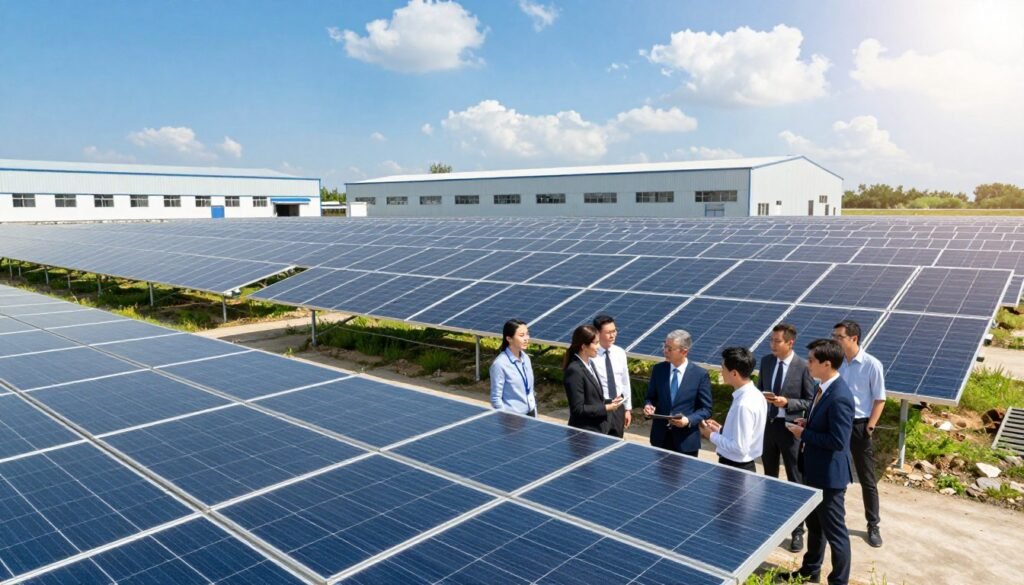
Utility-scale arrays have the biggest impact. Combermere Abbey (13,968 kW) offsets about 3,170,944 kg CO2 per year. It saves around £1,451,974 annually, with a 25-year total saving of £36.3M and a ROI of 7.8 years.
Fardanes (12,000 kW) and Honnington (11,000 kW) also show strong performance. They reduce CO2 by over 2 million kg each year and have ROIs near eight years.
Large rooftop and manufacturing installations also offer strong returns. RMS Company’s 968 kWDC rooftop had a 4-year ROI and an IRR near 40%. Goebel Fixtures’ 323 kWDC system supplies half of the site’s electricity, generating about 363,465 kWh per year.
Mid-size commercial systems like Dorset Council (2,200 kW) and Moss Electrical (1,200 kW) have steady cash flows. Dorset produces about £341,880 per year in value. Small projects like SIS TV (251.74 kWp) achieve full self-consumption at roughly 225,492 kWh per year.
Project goals and stakeholder benefits
Financial goals aim to cut energy bills now and in the future. Doboszenski & Sons used PACE financing to save over $20,000 per year and $800,000 over 25 years. Their property value increased by over $300,000.
RMS Company’s quick payback and large lifetime savings show how solar projects boost asset value and protect against rising utility rates.
Environmental goals are seen in CO2 reductions. Combermere Abbey alone reduces about 3.17 million kg of CO2 each year. Aggregated figures across industrial PV case studies reach tens of millions of kilograms, supporting corporate sustainability targets.
Operational goals focus on energy independence and tenant benefits. Menzies cut grid reliance by more than 30%. SIS TV achieved 100% self-consumption of its generation.
Stakeholders benefit from predictable pricing, marketing value, and incentives. Projects often enable promotional materials that improve public image. They also secure commercial tax incentives and grants. For equipment and system options, see product lines and commercial applications from Aisen Solar Energy, which supports batteries, inverters, and off-grid solutions suitable for commercial deployments.
Challenges: technical, financial, and operational barriers to deployment
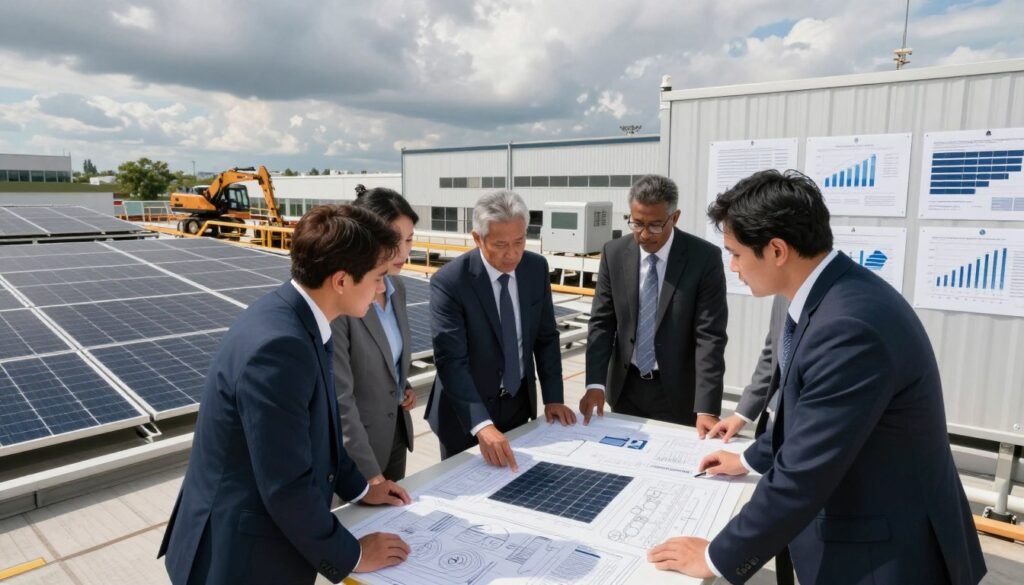
Big commercial projects face real-world challenges. These affect design, schedule, and cost. Teams must check roofs, work with building owners, and balance energy goals with physical limits. This section talks about the main obstacles and how teams overcome them to stay on budget and on time.
Site and technical constraints
Rooftop limits, shading, and direction impact yield and layout. For example, Arthur House’s east-west system (31 kW producing 25,099 kWh/year) shows how geometry changes output and needs tailored plans.
High-clearance installs need special crews and safety planning. Doboszenski & Sons’ 300-panel project on a 30-foot rooftop required close coordination with the owner and the utility to secure a safe interconnection.
Adding storage, EV charging, and carports makes design more complex. These additions boost self-consumption and demand management but require more detailed engineering and control systems.
Large warehouses and manufacturing roofs often need structural reviews and reroof scheduling. AR North America relocated arrays to allow reroof work and later expanded capacity after the roof project finished.
Financing and incentives
Project economics depend on creative financing and incentives. PACE financing made the Doboszenski project cash-flow positive from Day 1 with no upfront cost.
Power purchase agreements are useful for tenants. Thermo Fisher’s PPA cut energy spend by about 15%, lowering operating costs without capital outlay.
Federal tax credits improve returns. The commercial ITC at 30% plus a 10% Made in the USA bonus for 2026 commercial installs can make a marginal project profitable.
Local grants and utility programs help with financing. Teams like iDEAL Energies and Champion Solar use tax incentives, grants, and debt to deliver positive cash-flow outcomes.
Operational and regulatory hurdles
Permitting, utility coordination, and interconnection delays create schedule risk. Experienced vendors who manage permits, inspections, and utility agreements shorten timelines and reduce surprises.
Ongoing solar O&M and performance monitoring are key for long-term value. Active maintenance contracts, regular cleaning, and diagnostics protect ROI across a 25-plus-year asset life.
Project logistics can disrupt business operations if poorly planned. Careful sequencing and skilled crews minimize downtime while allowing for marketing materials and client site visits when appropriate.
| Barrier | Typical impact | Mitigation |
|---|---|---|
| Rooftop geometry and shading | Reduced yield and complex layouts | Detailed site surveys, 3D modeling, custom racking |
| High-clearance installs | Higher labor and safety costs | Specialized crews, phased work, owner coordination |
| Integration with storage/EV | Longer design and commissioning | Integrated system design and tested controls |
| Financing complexity | Delayed approvals, cash constraints | PACE, PPA, tax credit stacking, grant sourcing |
| Interconnection delays | Schedule slips and revenue loss | Early utility engagement, dedicated interconnection teams |
| Ongoing operations | Degraded performance over time | Long-term solar O&M contracts, monitoring, cleaning |
solar power system performance and results
Commercial and single-site solar systems show clear results. Big farms like Combermere Abbey and Fardanes cut millions of kilograms of CO2 each year. Smaller sites, like SIS TV and Oakland Grange, also make a big difference.
Together, these systems save tens of millions of kilograms of CO2 over 25 years.
Energy generation and CO2 reductions
Combermere Abbey’s solar array powers over 3,500 homes and cuts 3,170,944 kg CO2 yearly. Fardanes cuts about 2,462,291 kg CO2 annually. Soho Farm saves 702,644 kg CO2 yearly and brings in big money savings.
Smaller sites also make a big impact. SIS TV saves 225,492 kWh yearly and cuts 46,679 kg CO2. Oakland Grange produced 46,399 kWh in its first year, avoiding 9,600 kg CO2.
Using tools like SAM, teams can accurately measure energy generation. The U.S. Department of Energy helps compare predicted and actual yields. This improves future project forecasting with detailed KPIs understanding solar photovoltaic system performance.
Financial savings, ROI, and lifetime value
Projects show strong commercial PV results and attractive solar ROI. Doboszenski & Sons projects over $800,000 in savings over 25 years. Combermere Abbey reports about £1,451,974 in annual value and £36.3M over 25 years, with an ROI near 7.8 years.
Mid-size and industrial installations offer steady returns. Bay Farm saves about £850,080 annually. Magazine/Lains saves £561,750, and Dorset Council saves £341,880. Menzies projects show lifetime savings near £888,636 and £2,102,521 for two systems with ROIs of 3.2 and 3.7 years.
Operational benefits and asset uplift
Operational performance boosts site resilience and tenant value. Self-sufficiency varies from partial to full site coverage. AR North America achieved arrays that offset 100% of electricity needs in select cases, while SIS TV reached full self-consumption of generated energy.
Owners see tangible asset uplift and non-financial returns. Doboszenski estimated property value increases above $300,000 in Minnesota. Improved sustainability boosts leasing and marketing.
| Metric | Sample Value | Range / Notes |
|---|---|---|
| Number of PV systems analyzed | 75 federal systems | Combined capacity 30,714 kW; sizes 1–4,043 kW |
| Average system size | 410 kW | Installed 2011–2020 |
| Availability (avg) | 95.1% | Min 31.0%, Max 100.0%, SD 8.8% |
| Performance Ratio (avg) | 78.6% | Min 46.0%, Max 101.0%, SD 11.7% |
| Energy Ratio (avg) | 74.6% | Min 29.0%, Max 101.0%, SD 14.1% |
| Modeling approach | SAM alignment | Hour-by-hour, day-by-day or month-by-month production comparison |
Measured commercial PV results and careful modeling reveal realistic expectations. These metrics support investment decisions and operational planning for landlords, developers, and corporate energy managers.
Result: measurable outcomes and lessons learned
The solar case study results show clear benefits. Rooftop, carport, and ground-mounted systems cut CO2 emissions by tens of millions of kilograms over 25 years. Large farms saved millions, while smaller ones saved hundreds of thousands to millions.
Here’s a quick look at some outcomes from various solar projects.
| Project Type | Capacity | Key Outcomes | Typical ROI |
|---|---|---|---|
| Residential rooftop | 5 MW | Lower bills, moderate CO2 reductions, rapid activation and monitoring | 4–8 years |
| University sustainability | 10 MW | Large generation, campus resilience, strong marketing value | 3–6 years |
| Commercial & Industrial | Varied | Reduced energy costs, demand charge management, emissions cuts | 3–5 years with incentives |
| Battery-integrated systems | Paired with PV | Peak shaving, resilience, higher self-consumption | Dependent on tariff and incentives |
Consolidated outcomes across case studies
Environmental impact was significant. Sites cut CO2 emissions by tens of millions of kilograms over 25 years. Financial benefits were just as impressive, with savings ranging from hundreds of thousands to tens of millions of pounds.
ROI varied based on scale and incentives. Manufacturing and some commercial projects paid off in 3–4 years with federal credits and state bonuses. Adding solar with storage and demand strategies helped high-demand facilities even more.
Key lessons and best practices
Work with full-service developers for a smooth process. Companies like Champion Solar and iDEAL Energies lead the way, reducing risk and improving schedules.
Creative financing is key. PACE financing and PPAs can start positive cash flow right away. Federal commercial tax credits and manufacturing bonuses also boost economics when used wisely.
Plan early for integration. Pair solar with energy storage and EV charging to increase self-consumption and resilience. Focus on long-term O&M and real-time monitoring to protect savings and performance.
Start addressing permits and utility timelines early. Early coordination with vendors for interconnection and inspections can avoid delays and cost overruns.
Highlight the value beyond energy. Use case study materials, videos, and metrics to show sustainability wins. Use project activation and monitoring tools to track savings and publicize results. Or learn more about energy storage and mobile power bank.
Conclusion
Large-scale solar projects show clear benefits. They cut down on pollution and save money. For example, rooftop systems can reduce CO2 emissions by tens of thousands of kilograms each year.
Big installations can even cut millions of kilograms of CO2. This proves solar power is good for the environment and reliable for energy.
Studies show that solar projects can pay off in three to eight years. They can save millions of dollars or pounds over their lifetime. This is great news for owners and investors.
One important lesson is to pair solar with storage and EVs. This makes systems more reliable and self-sufficient. It’s also key to use real data to size systems correctly.
Property owners should look into tax credits and local programs. Working with experienced developers can help reduce risks and increase profits.